Apache HTTP Server End of Life (EOL) Dates and End of Support (EOS) Dates
Apache HTTP Server end of life (EOL) and end of support (EOS) dates: 3 Apache HTTP Server versions have reached EOL, including Apache HTTP Server 2.2 (EOL date: Jul 11, 2017) — no longer receiving security updates or patches. Apache HTTP Server 2.4.71 is the current supported release. Also see Apache ActiveMQ Artemis lifecycle dates for related end-of-life information.
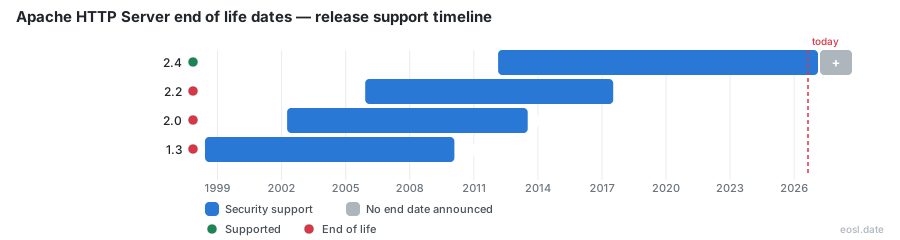
Currently Supported Apache HTTP Server Releases - Active EOS/EOSL Support (1)
| Release | Released | Security Support | Latest |
|---|---|---|---|
| 2.4 | (14 years and 9 months ago) | Active | 2.4.71 (1 week and 3 days ago) |
Apache HTTP Server End of Life (EOL) Releases - No Longer Supported (3)
| Release | Released | Security Support | Latest |
|---|---|---|---|
| 2.2 | (20 years and 11 months ago) | (9 years and 4 months ago) | 2.2.34 (9 years and 4 months ago) |
| 2.0 | (24 years and 7 months ago) | (13 years and 4 months ago) | 2.0.65 (13 years and 4 months ago) |
| 1.3 | (28 years and 5 months ago) | (16 years and 9 months ago) | 1.3.42 (16 years and 9 months ago) |
Still running an older build and wondering whether it gets fixes? The Apache HTTP Server end of life schedule answers that: the 2.4 branch is supported, while 2.2, 2.0 and 1.3 are not. This guide lists every cutoff date, explains how the Apache HTTP Server Project retires a branch, and shows you how to move your httpd installation off an unsupported release.
Apache HTTP Server End of Life Dates by Branch
Each branch of this open-source web server has its own lifespan. The table below lists the four branches the project has shipped, with the dates when maintenance stopped. If your host reports a different number, run httpd -v to see which one you actually have.
| Branch | First released | Support ended | Last release |
|---|---|---|---|
| 2.4 | 21 February 2012 | Still supported | 2.4.69 (1 October 2026) |
| 2.2 | 1 December 2005 | 11 July 2017 | 2.2.34 |
| 2.0 | 5 April 2002 | 10 July 2013 | 2.0.65 |
| 1.3 | 1 June 1998 | 3 February 2010 | 1.3.42 |
Final Release of Each Branch
The final release of a branch is the last version that received any change. Once it ships, the branch is frozen, and the software can only stay as safe as that last build. The 2.4 branch has no announced end date, so its newest build is simply the supported release you should be running, and the project calls it the best version of the software available.
Apache httpd 2.2 End-of-Life and the 2.2.x Branch
Apache httpd 2.2 end-of-life arrived in July 2017, when the project shipped 2.2.34 and declared the line finished. Every 2.2.x server still online today runs code that the maintainers no longer touch, and the project tells users to move to 2.4. Web servers older than that, such as 2.0 and 1.3, were retired years earlier.
No More Security Patches
The project's own announcement says that no further patches will appear for the old line, and that no further activity will occur, which means no security patches either. A flaw found in 2.2 today stays open. Distribution vendors sometimes backport fixes to their own packages, but that is the vendor's work, not the project's, and it can end whenever the vendor's support does. Treat it as a stopgap, not as security support from the people who write httpd.
How the Apache HTTP Server Project Retires a Branch
The Apache Software Foundation runs httpd as a volunteer community, and the Apache HTTP Server Project follows written policy when it ships or retires a version. The Apache Software Foundation does not publish a fixed calendar for each branch, which is why old ones fade out instead of ending on a set day.
Release Guidelines and Voting
Under the published release guidelines, a committer acts as the release manager, builds a release candidate from a tagged revision in Subversion, and calls a vote. A release candidate needs three +1 votes, and more +1 than -1 votes, from the PMC before it becomes a public release. The group has also liked to see roughly 48 to 72 hours of use on the apache.org production servers before voting. The project follows an odd-even release strategy: odd minor numbers such as 2.1 were alpha and beta work, and the next even number, 2.2, was the general availability release.
Maintainers put their effort into the current line, so older ones stop receiving a release candidate at all. That is how a branch ends: contributors stop cutting releases for it and say so on the project site and in the Apache Software Foundation's announcements.
Risks of Running an Unsupported Web Server
A server that sits on the internet and parses untrusted requests is a constant target, so a codebase frozen at its retirement date becomes a liability. Rating services treat it that way too: some risk ratings drop versions that have been past their support date for over a year, so unsupported software can hurt a vendor review even before an attacker shows up.
Missing Security Updates and Bug Fixes
Without security updates, every newly published flaw stays open on your host, and the list of known security vulnerabilities for an old branch only grows. You also lose bug fixes for crashes, memory leaks and other bugs, plus newer protocol behavior. Modern encryption is one example: a TLS 1.3 server built on OpenSSL 1.1.1 needs httpd 2.4.43 or newer, and no 2.2 build can offer that. Legacy SSL settings carried over from old configs add further risk. Compliance audits and cyber insurance questionnaires commonly ask for supported software, so a frozen web server stack can fail a review on paper alone.
Upgrading httpd from 2.2 to 2.4.x
Moving to a supported build is the only real fix. The 2.4 line builds on and extends the 2.2 API, and it brings new features such as better event-based handling, so most of your setup carries over. Plan for a few specific changes:
- Recompile modules. Modules written for 2.2 must be recompiled to run on 2.4, and they usually need little or no source change.
- Check thread safety. If you use a threaded MPM other than prefork, every module and library it loads must be thread-safe.
- Update the APR libraries. This release needs the Apache Portable Runtime (APR) 1.5.x or later, and some features need 1.6.x.
- Review the configuration. Test your virtual hosts and .htaccess rules on a staging copy before switching traffic.
Choose the Latest Release
Get the latest release from the download page and follow the installation guide for your operating system. The latest version, 2.4.69, was published on 1 October 2026 as a security, feature and bug fix build. Verify your downloads against the published checksums and signatures, and read the changelog before you upgrade.
Stay on the Stable Branch
Pin your servers to the stable branch and apply each point update as it appears. The project recommends the newest stable release over all previous releases, so follow it instead of freezing at one number, and keep httpd packages on automatic security feeds where your distribution offers them.
Why Apache HTTP Server 2.4 Still Fits Production Use
Apache HTTP Server 2.4 is not just supported; it is still widely deployed. According to W3Techs, in April 2026 the server ranked third among all websites at 23.7%, behind nginx at 32.7% and Cloudflare Server at 27.7%. Netcraft counted 17.83% of the million busiest sites in March 2025, with Microsoft IIS far behind. Other web servers have gained ground, but httpd remains a common default.
The reasons are practical. Loadable modules add authentication, compression, URL rewriting and a reverse proxy with load balancing. Multiple processing modes (MPMs) handle thousands of connections, HTTP/2 and TLS run through OpenSSL, and .htaccess files give per-directory control on shared hosting. The cross-platform design runs on Linux, Unix, Windows and OpenVMS, so the same configuration and performance tuning apply across systems.
Open-Source License and Community Behind httpd
The source code is free software under the Apache License 2.0, so anyone may fork it, though only members of the project may call a release "Apache." Developers and committers work in public, and review and testing happen in the open. That openness is why a security fix usually lands quickly on the branch that is still maintained, and why you should stay on it. The license also lets companies bundle httpd in their own software without paying fees.