GitLab End of Life (EOL) Dates and End of Support (EOS) Dates
GitLab end of life (EOL) and end of support (EOS) dates: 66 GitLab versions have reached EOL, including GitLab 19.3 (EOL date: Nov 19, 2026) — no longer receiving security updates or patches. GitLab 19.4 reaches its End of Support date on Dec 17, 2026 — plan your upgrade path now. Also see Adobe ColdFusion end of support dates for related end-of-life information.
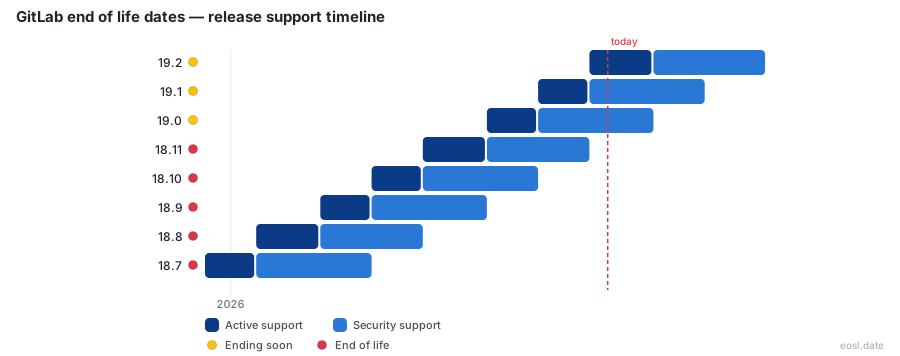
GitLab Releases Nearing End of Life - Support Ending Soon (3)
| Release | Released | Maintenance Support | Active Support | Latest |
|---|---|---|---|---|
| 19.4 | (2 months ago) | (in 3 weeks and 5 days) | (1 month and 6 days ago) | 19.4.10 (2 days ago) |
| 19.5 | (1 month and 6 days ago) | (in 2 months) | (2 days ago) | 19.5.8 (2 days ago) |
| 19.6 | (2 days ago) | (in 2 months) | (in 3 weeks and 5 days) | 19.6.1 (2 days ago) |
GitLab End of Life (EOL) Releases - No Longer Supported (66)
| Release | Released | Maintenance Support | Active Support | Latest |
|---|---|---|---|---|
| 19.3 | (3 months ago) | (2 days ago) | (2 months ago) | 19.3.9 (5 days ago) |
| 19.2 | (4 months ago) | (1 month and 6 days ago) | (3 months ago) | 19.2.10 (3 weeks and 3 days ago) |
| 19.1 | (5 months ago) | (2 months ago) | (4 months ago) | 19.1.10 (3 weeks and 3 days ago) |
| 19.0 | (6 months ago) | (3 months ago) | (5 months ago) | 19.0.11 (3 weeks and 3 days ago) |
| 18.11 | (7 months ago) | (4 months ago) | (6 months ago) | 18.11.14 (3 weeks and 4 days ago) |
| 18.10 | (8 months ago) | (5 months ago) | (7 months ago) | 18.10.8 (5 months ago) |
| 18.9 | (9 months ago) | (6 months ago) | (8 months ago) | 18.9.8 (5 months ago) |
| 18.8 | (10 months ago) | (7 months ago) | (9 months ago) | 18.8.11 (4 months ago) |
| 18.7 | (11 months ago) | (8 months ago) | (10 months ago) | 18.7.7 (5 months ago) |
| 18.6 | (1 year ago) | (9 months ago) | (11 months ago) | 18.6.8 (5 months ago) |
| 18.5 | (1 year and 1 month ago) | (10 months ago) | (1 year ago) | 18.5.7 (5 months ago) |
| 18.4 | (1 year and 2 months ago) | (11 months ago) | (1 year and 1 month ago) | 18.4.6 (11 months ago) |
| 18.3 | (1 year and 3 months ago) | (1 year ago) | (1 year and 2 months ago) | 18.3.6 (1 year ago) |
| 18.2 | (1 year and 4 months ago) | (1 year and 1 month ago) | (1 year and 3 months ago) | 18.2.8 (1 year and 1 month ago) |
| 18.1 | (1 year and 5 months ago) | (1 year and 2 months ago) | (1 year and 4 months ago) | 18.1.6 (1 year and 2 months ago) |
| 18.0 | (1 year and 6 months ago) | (1 year and 3 months ago) | (1 year and 5 months ago) | 18.0.6 (1 year and 3 months ago) |
| 17.11 | (1 year and 7 months ago) | (1 year and 4 months ago) | (1 year and 6 months ago) | 17.11.7 (1 year and 3 months ago) |
| 17.10 | (1 year and 8 months ago) | (1 year and 5 months ago) | (1 year and 7 months ago) | 17.10.8 (1 year and 5 months ago) |
| 17.9 | (1 year and 9 months ago) | (1 year and 6 months ago) | (1 year and 8 months ago) | 17.9.8 (1 year and 6 months ago) |
| 17.8 | (1 year and 10 months ago) | (1 year and 7 months ago) | (1 year and 9 months ago) | 17.8.7 (1 year and 7 months ago) |
| 17.7 | (1 year and 11 months ago) | (1 year and 8 months ago) | (1 year and 10 months ago) | 17.7.7 (1 year and 8 months ago) |
| 17.6 | (2 years ago) | (1 year and 9 months ago) | (1 year and 11 months ago) | 17.6.5 (1 year and 9 months ago) |
| 17.5 | (2 years and 1 month ago) | (1 year and 10 months ago) | (2 years ago) | 17.5.5 (1 year and 10 months ago) |
| 17.4 | (2 years and 2 months ago) | (1 year and 11 months ago) | (2 years and 1 month ago) | 17.4.6 (1 year and 11 months ago) |
| 17.3 | (2 years and 3 months ago) | (2 years ago) | (2 years and 2 months ago) | 17.3.7 (2 years ago) |
| 17.2 | (2 years and 4 months ago) | (2 years and 1 month ago) | (2 years and 3 months ago) | 17.2.9 (2 years and 1 month ago) |
| 17.1 | (2 years and 5 months ago) | (2 years and 2 months ago) | (2 years and 4 months ago) | 17.1.8 (2 years and 2 months ago) |
| 17.0 | (2 years and 6 months ago) | (2 years and 3 months ago) | (2 years and 5 months ago) | 17.0.8 (2 years and 2 months ago) |
| 16.11 | (2 years and 7 months ago) | (2 years and 4 months ago) | (2 years and 6 months ago) | 16.11.10 (2 years and 2 months ago) |
| 16.10 | (2 years and 8 months ago) | (2 years and 5 months ago) | (2 years and 7 months ago) | 16.10.10 (2 years and 2 months ago) |
| 16.9 | (2 years and 9 months ago) | (2 years and 6 months ago) | (2 years and 8 months ago) | 16.9.11 (2 years and 2 months ago) |
| 16.8 | (2 years and 10 months ago) | (2 years and 7 months ago) | (2 years and 9 months ago) | 16.8.10 (2 years and 2 months ago) |
| 16.7 | (2 years and 11 months ago) | (2 years and 8 months ago) | (2 years and 10 months ago) | 16.7.10 (2 years and 2 months ago) |
| 16.6 | (3 years ago) | (2 years and 9 months ago) | (2 years and 11 months ago) | 16.6.10 (2 years and 2 months ago) |
| 16.5 | (3 years and 1 month ago) | (2 years and 10 months ago) | (3 years ago) | 16.5.10 (2 years and 2 months ago) |
| 16.4 | (3 years and 2 months ago) | (2 years and 11 months ago) | (3 years ago) | 16.4.7 (2 years and 2 months ago) |
| 16.3 | (3 years and 3 months ago) | (3 years ago) | (3 years and 1 month ago) | 16.3.9 (2 years and 2 months ago) |
| 16.2 | (3 years and 4 months ago) | (3 years ago) | (3 years and 2 months ago) | 16.2.11 (2 years and 1 month ago) |
| 16.1 | (3 years and 5 months ago) | (3 years and 1 month ago) | (3 years and 3 months ago) | 16.1.8 (2 years and 1 month ago) |
| 16.0 | (3 years and 6 months ago) | (3 years and 2 months ago) | (3 years and 4 months ago) | 16.0.10 (2 years and 1 month ago) |
| 15.11 | (3 years and 7 months ago) | (3 years and 3 months ago) | (3 years and 5 months ago) | 15.11.13 (3 years and 3 months ago) |
| 15.10 | (3 years and 8 months ago) | (3 years and 4 months ago) | (3 years and 6 months ago) | 15.10.8 (3 years and 5 months ago) |
| 15.9 | (3 years and 9 months ago) | (3 years and 5 months ago) | (3 years and 7 months ago) | 15.9.8 (3 years and 6 months ago) |
| 15.8 | (3 years and 10 months ago) | (3 years and 6 months ago) | (3 years and 8 months ago) | 15.8.6 (3 years and 7 months ago) |
| 15.7 | (3 years and 11 months ago) | (3 years and 7 months ago) | (3 years and 9 months ago) | 15.7.9 (3 years and 7 months ago) |
| 15.6 | (4 years ago) | (3 years and 8 months ago) | (3 years and 10 months ago) | 15.6.8 (3 years and 9 months ago) |
| 15.5 | (4 years and 1 month ago) | (3 years and 9 months ago) | (3 years and 11 months ago) | 15.5.9 (3 years and 10 months ago) |
| 15.4 | (4 years and 2 months ago) | (3 years and 10 months ago) | (4 years ago) | 15.4.6 (3 years and 11 months ago) |
| 15.3 | (4 years and 3 months ago) | (3 years and 11 months ago) | (4 years and 1 month ago) | 15.3.5 (4 years ago) |
| 15.2 | (4 years and 4 months ago) | (4 years ago) | (4 years and 2 months ago) | 15.2.5 (4 years and 1 month ago) |
| 15.1 | (4 years and 5 months ago) | (4 years and 1 month ago) | (4 years and 3 months ago) | 15.1.6 (4 years and 2 months ago) |
| 15.0 | (4 years and 6 months ago) | (4 years and 2 months ago) | (4 years and 4 months ago) | 15.0.5 (4 years and 3 months ago) |
| 14.10 | (4 years and 7 months ago) | (4 years and 3 months ago) | (4 years and 5 months ago) | 14.10.5 (4 years and 4 months ago) |
| 14.9 | (4 years and 8 months ago) | (4 years and 4 months ago) | (4 years and 6 months ago) | 14.9.5 (4 years and 5 months ago) |
| 14.8 | (4 years and 9 months ago) | (4 years and 5 months ago) | (4 years and 7 months ago) | 14.8.6 (4 years and 6 months ago) |
| 14.7 | (4 years and 10 months ago) | (4 years and 6 months ago) | (4 years and 8 months ago) | 14.7.7 (4 years and 7 months ago) |
| 14.6 | (4 years and 11 months ago) | (4 years and 7 months ago) | (4 years and 9 months ago) | 14.6.7 (4 years and 7 months ago) |
| 14.5 | (5 years ago) | (4 years and 8 months ago) | (4 years and 10 months ago) | 14.5.4 (4 years and 9 months ago) |
| 14.4 | (5 years and 1 month ago) | (4 years and 9 months ago) | (4 years and 11 months ago) | 14.4.5 (4 years and 10 months ago) |
| 14.3 | (5 years and 2 months ago) | (4 years and 10 months ago) | (5 years ago) | 14.3.6 (4 years and 11 months ago) |
| 14.2 | (5 years and 3 months ago) | (4 years and 11 months ago) | (5 years and 1 month ago) | 14.2.7 (4 years and 11 months ago) |
| 14.1 | (5 years and 4 months ago) | (5 years ago) | (5 years and 2 months ago) | 14.1.8 (5 years ago) |
| 14.0 | (5 years and 5 months ago) | (5 years and 1 month ago) | (5 years and 3 months ago) | 14.0.12 (5 years ago) |
| 13.12 | (5 years and 6 months ago) | (5 years and 2 months ago) | (5 years and 4 months ago) | 13.12.15 (5 years ago) |
| 13.11 | (5 years and 7 months ago) | (5 years and 3 months ago) | (5 years and 5 months ago) | 13.11.7 (5 years and 4 months ago) |
| 13.10 | (5 years and 8 months ago) | (5 years and 4 months ago) | (5 years and 6 months ago) | 13.10.5 (5 years and 5 months ago) |
You need to know when your version stops getting fixes, and GitLab end of life follows a predictable monthly schedule. This DevOps lifecycle product ships a new release every month, but only the newest stable version gets bug fixes, so a version you installed last spring may already sit outside its support window. Here is how to read the dates and plan your move.
GitLab End of Life: What the Support Timeline Means
GitLab is a web-based open source platform that bundles a Git repository manager, a wiki, issue tracking and a continuous integration and deployment pipeline. Because it is a single piece of software that touches your code and your CI/CD runners, the GitLab lifecycle matters more than for most tools: a version that no longer receives patches becomes a standing risk.
Each release moves through active support, then a period of security-only maintenance support, then end of support. Once a version is past that last stage, the vendor no longer ships fixes for it, and you must treat the installation as unsupported until you upgrade. Some trackers also label the final months before cutoff as phasing out, which is your cue to schedule the work.
GitLab Release Cadence and Semantic Versioning
GitLab uses semantic versioning in the form major.minor.patch. In version 19.5.1, the 19 is the major number, 5 is the minor number and 1 is the patch number. The release cadence is the heart of the release strategy, and the reason support windows are so short: a new minor version appears every month, so older ones age out quickly.
| Version type | What changes | Cadence |
|---|---|---|
| Major | Significant changes, or backward-incompatible changes to the public API | Yearly, normally in May; the next is 20.0 on May 20, 2027 |
| Minor | New backward-compatible features and smaller feature sets | Monthly, on the third Thursday |
| Patch | Backward-compatible bug fixes and security fixes | Twice monthly |
Major Release and Minor Release Types
A major release is where breaking changes and data migrations live, so these upgrades need the most planning. A minor release adds functionality without breaking the public API, which makes monthly upgrades routine for most teams.
Monthly Release Schedule on the Third Thursday
Since late 2023, the monthly release date has been the third Thursday. Patch versions land on the Wednesday a week before and the Wednesday a week after that day, so you can plan around a rhythm instead of watching the release notes every morning. These dates also tell you when the next monthly release will push the current one out of active support.
Maintained Versions Under the GitLab Maintenance Policy
The published maintenance policy keeps three maintained versions alive at any moment. As of late October 2026, the current stable release gets everything, and the two before it get security work only.
| Version | Released | Active support ends | Security support ends |
|---|---|---|---|
| 19.5 | 15 Oct 2026 | 19 Nov 2026 | 21 Jan 2027 |
| 19.4 | 17 Sep 2026 | 15 Oct 2026 | 17 Dec 2026 |
| 19.3 | 20 Aug 2026 | 17 Sep 2026 | 19 Nov 2026 |
| 19.2 | 16 Jul 2026 | 20 Aug 2026 | 15 Oct 2026 |
| 19.1 | 18 Jun 2026 | 16 Jul 2026 | 17 Sep 2026 |
Current Stable Release and Active Support
The current stable release is 19.5, with latest version 19.5.1 shipped on 20 October 2026. Only this line gets bug fixes backported, and it is the one the vendor tells everyone to run. If you check the gitlab versions list and your number is not in the table above, you are already outside the window. Check the documentation pages for the exact list, because GitLab support for a line ends the day it leaves it.
GitLab Support for Patch Releases and Backporting
Patch releases carry only backward-compatible fixes. New features cannot ship in them, because that would break semantic version expectations for teams that must verify every change against internal compliance rules. That is also why GitLab support for old versions is so narrow.
Bug Fixes and Security Fixes Under Backporting
Backporting means copying a fix from the newest code onto an older release. The vendor does it sparingly: bug fixes go only to the current stable line, while security fixes reach the current version plus the previous two monthly releases. Backporting costs a lot, because the Community and Enterprise distributions double testing work, and older branches rarely pass the same tests unchanged. A backport to anything older is the exception, not the rule.
Policy Exceptions for Severe Vulnerabilities
For a highly severe security vulnerability, there is precedent for going further back than two releases through the policy exceptions process. High and critical issues always get a patch release, while a vulnerability with very low likelihood of exploitation may wait for the regular monthly release. Do not plan on an exception for your old install; plan on upgrading.
End-of-Life Dates and Support Status by Version
Every release follows the same pattern: roughly one month of active support, then two more months of security maintenance. So GitLab support for a release is short, and the support timeframe for a version is about three months from its release day. The support status of each line is easy to derive, as the next table shows for a few older releases still widely deployed.
| Version | Released | Security support ended |
|---|---|---|
| 18.11 | 16 Apr 2026 | 16 Jul 2026 |
| 18.0 | 14 May 2025 | 21 Aug 2025 |
| 17.0 | 15 May 2024 | 15 Aug 2024 |
| 16.0 | 18 May 2023 | 22 Aug 2023 |
Version History and Latest Version
The version history is long: tracking sites list more than 180 releases, going back to 2015. In 2026, dates for every release since 16.x are now past, and only the three newest lines remain supported. For the newest numbers, check the upcoming releases page before you plan a change window.
Long-Term Support and LTS Releases
There is no long-term support track. Trackers mark every line as not LTS, so no release is protected for years. The practical answer to “how long does my version last” is therefore short: every release reaches end of support about three months after launch, and testing each upgrade in staging is the only defence.
Upgrade Recommendations for an Unsupported Version
The vendor encourages everyone to run the latest stable release. If you cannot follow the monthly cycle, the upgrade recommendations are simple: follow the documented upgrade paths, never skip a required stop, and build an upgrade plan before a major version arrives. Moving from an unsupported version usually means several hops, so start early.
- Read the official documentation and upgrade documentation for the release you are moving to, not for the one you run now.
- Back up your data and test the upgrade in staging before production, especially for any migration of background data.
- Pick a patch version that already carries the latest security fixes before you jump to the next minor version.
Upgrade Path for Linux Package Installs
When a Linux package install falls out of its support window, upgrade it in the documented version-stop order. The bundled PostgreSQL database is upgraded along with it, and the package is built on Omnibus. Read the version-specific notes for 17, 16 and 15 before you start. Afterwards, confirm your pipeline, deployment jobs and continuous integration runners still work, since a broken CI/CD job is the usual surprise. Staying on security support is far cheaper than recovering from a compromised server.
Version Support by GitLab Edition and Tier
What you receive from the vendor depends on how you run the product and which tier you pay for. Unless your support contract says otherwise, GitLab support through the support team helps with the current major version and the previous two, so with 19.x current, you can ask about 19.x, 18.x and 17.x. The version support line here is separate from the maintenance policy above, which governs engineering fixes.
Self-Managed and GitLab.com Customers
Self-managed customers run their own infrastructure, including Kubernetes clusters and high availability setups, so they must upgrade before their version leaves the support window. Customers on GitLab.com are upgraded by the vendor, which monitors every incident, so they carry no end-of-support exposure of their own.
Free and Community Edition Users
A free user of the Community Edition gets no direct help from the support engineer queue. Use the community forum, the documentation and Stack Overflow instead, since the wider community answers most upgrade questions quickly.
Enterprise Edition: Premium and Ultimate Customers
Paid Premium and Ultimate customers on the Enterprise Edition hold a subscription that includes ticket support. That enterprise support still excludes versions outside the window, so a ticket about an old install will get an invitation to upgrade.
GitLab Dedicated Tenants
GitLab Dedicated is a single-tenant service managed by the vendor, so the version is upgraded for you. Your installation and its wiki content follow the vendor’s upgrade schedule, so end-of-support exposure is limited to that schedule.