FreeBSD End of Life (EOL) Dates and End of Support (EOS) Dates
FreeBSD end of life (EOL) and end of support (EOS) dates: 84 FreeBSD versions have reached EOL, including FreeBSD releng/15.0 (EOL date: Sep 30, 2026) — no longer receiving security updates or patches. FreeBSD releng/14.5 is the current supported release, with support through Jun 30, 2027 — 5 versions in active support. Also see BIG-IP EOSL dates for related end-of-life information.
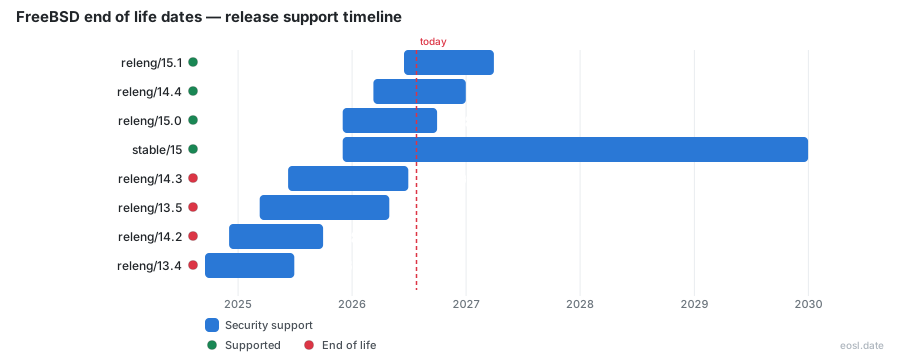
Currently Supported FreeBSD Releases - Active EOS/EOSL Support (5)
| Release | Released | Security Support |
|---|---|---|
| releng/14.5 | (1 month and 3 weeks ago) | (in 7 months) |
| releng/15.1 | (4 months ago) | (in 4 months) |
| releng/14.4 | (7 months ago) | (in 1 month and 4 weeks) |
| stable/15 | (10 months ago) | (in 3 years and 1 month) |
| stable/14 | (2 years and 11 months ago) | (in 2 years) |
FreeBSD End of Life (EOL) Releases - No Longer Supported (84)
| Release | Released | Security Support |
|---|---|---|
| releng/15.0 | (10 months ago) | (1 month and 2 days ago) |
| releng/14.3 | (1 year and 4 months ago) | (4 months ago) |
| releng/13.5 | (1 year and 7 months ago) | (6 months ago) |
| releng/14.2 | (1 year and 10 months ago) | (1 year and 1 month ago) |
| releng/13.4 | (2 years and 1 month ago) | (1 year and 4 months ago) |
| releng/14.1 | (2 years and 4 months ago) | (1 year and 7 months ago) |
| releng/13.3 | (2 years and 7 months ago) | (1 year and 10 months ago) |
| releng/14.0 | (2 years and 11 months ago) | (2 years and 1 month ago) |
| releng/13.2 | (3 years and 6 months ago) | (2 years and 4 months ago) |
| releng/12.4 | (3 years and 10 months ago) | (2 years and 10 months ago) |
| releng/13.1 | (4 years and 5 months ago) | (3 years and 3 months ago) |
| releng/12.3 | (4 years and 10 months ago) | (3 years and 7 months ago) |
| stable/13 | (5 years and 6 months ago) | (6 months ago) |
| releng/13.0 | (5 years and 6 months ago) | (4 years and 2 months ago) |
| releng/12.2 | (6 years ago) | (4 years and 7 months ago) |
| releng/11.4 | (6 years and 4 months ago) | (5 years and 1 month ago) |
| releng/12.1 | (6 years and 11 months ago) | (5 years and 9 months ago) |
| releng/11.3 | (7 years and 3 months ago) | (6 years and 1 month ago) |
| stable/12 | (7 years and 10 months ago) | (2 years and 10 months ago) |
| releng/12.0 | (7 years and 10 months ago) | (6 years and 8 months ago) |
| releng/11.2 | (8 years and 4 months ago) | (7 years ago) |
| releng/10.4 | (9 years ago) | (8 years ago) |
| releng/11.1 | (9 years and 3 months ago) | (8 years and 1 month ago) |
| stable/11 | (10 years ago) | (5 years and 1 month ago) |
| releng/11.0 | (10 years ago) | (8 years and 11 months ago) |
| releng/10.3 | (10 years and 6 months ago) | (8 years and 6 months ago) |
| releng/10.2 | (11 years and 2 months ago) | (9 years and 10 months ago) |
| releng/10.1 | (11 years and 11 months ago) | (9 years and 10 months ago) |
| releng/9.3 | (12 years and 3 months ago) | (9 years and 10 months ago) |
| stable/10 | (12 years and 9 months ago) | (8 years ago) |
| releng/10.0 | (12 years and 9 months ago) | (11 years and 8 months ago) |
| releng/9.2 | (13 years and 1 month ago) | (11 years and 10 months ago) |
| releng/8.4 | (13 years and 4 months ago) | (11 years and 3 months ago) |
| releng/9.1 | (13 years and 10 months ago) | (11 years and 10 months ago) |
| releng/8.3 | (14 years and 6 months ago) | (12 years and 6 months ago) |
| stable/9 | (14 years and 9 months ago) | (9 years and 10 months ago) |
| releng/9.0 | (14 years and 9 months ago) | (13 years and 7 months ago) |
| releng/8.2 | (15 years and 8 months ago) | (14 years and 3 months ago) |
| releng/7.4 | (15 years and 8 months ago) | (13 years and 8 months ago) |
| releng/8.1 | (16 years and 3 months ago) | (14 years and 3 months ago) |
| releng/7.3 | (16 years and 7 months ago) | (14 years and 7 months ago) |
| stable/8 | (16 years and 11 months ago) | (11 years and 3 months ago) |
| releng/8.0 | (16 years and 11 months ago) | (15 years and 11 months ago) |
| releng/7.2 | (17 years and 5 months ago) | (16 years and 4 months ago) |
| releng/7.1 | (17 years and 9 months ago) | (15 years and 8 months ago) |
| releng/6.4 | (17 years and 11 months ago) | (15 years and 11 months ago) |
| stable/7 | (18 years and 8 months ago) | (13 years and 8 months ago) |
| releng/7.0 | (18 years and 8 months ago) | (17 years and 6 months ago) |
| releng/6.3 | (18 years and 9 months ago) | (16 years and 9 months ago) |
| releng/6.2 | (19 years and 9 months ago) | (18 years and 5 months ago) |
| releng/5.5 | (20 years and 5 months ago) | (18 years and 5 months ago) |
| releng/6.1 | (20 years and 5 months ago) | (18 years and 5 months ago) |
| stable/6 | (20 years and 11 months ago) | (15 years and 11 months ago) |
| releng/6.0 | (20 years and 11 months ago) | (19 years and 9 months ago) |
| releng/5.4 | (21 years and 5 months ago) | (20 years ago) |
| releng/4.11 | (21 years and 9 months ago) | (19 years and 9 months ago) |
| releng/5.3 | (21 years and 11 months ago) | (20 years ago) |
| releng/4.10 | (22 years and 5 months ago) | (19 years and 9 months ago) |
| releng/5.2 | (22 years and 9 months ago) | (21 years and 8 months ago) |
| releng/4.9 | (23 years ago) | (22 years and 2 months ago) |
| releng/5.1 | (23 years and 4 months ago) | (22 years and 6 months ago) |
| releng/4.8 | (23 years and 6 months ago) | (22 years and 8 months ago) |
| stable/5 | (23 years and 9 months ago) | (18 years and 5 months ago) |
| releng/5.0 | (23 years and 9 months ago) | (23 years and 1 month ago) |
| releng/4.7 | (24 years ago) | (23 years and 3 months ago) |
| releng/4.6 | (24 years and 4 months ago) | (23 years and 9 months ago) |
| releng/4.5 | (24 years and 9 months ago) | (24 years and 1 month ago) |
| releng/4.4 | (25 years and 1 month ago) | (24 years and 6 months ago) |
| releng/4.3 | (25 years and 6 months ago) | (24 years and 10 months ago) |
| releng/4.2 | (25 years and 11 months ago) | (25 years and 3 months ago) |
| releng/4.1 | (26 years and 3 months ago) | (25 years and 8 months ago) |
| releng/3.5 | (26 years and 4 months ago) | (25 years and 4 months ago) |
| stable/4 | (26 years and 7 months ago) | (19 years and 9 months ago) |
| releng/4.0 | (26 years and 7 months ago) | (26 years ago) |
| releng/3.4 | (26 years and 10 months ago) | (26 years and 1 month ago) |
| releng/3.3 | (27 years and 1 month ago) | (26 years and 8 months ago) |
| releng/3.2 | (27 years and 5 months ago) | (26 years and 10 months ago) |
| releng/3.1 | (27 years and 8 months ago) | (27 years and 2 months ago) |
| releng/3.0 | (28 years ago) | (27 years and 5 months ago) |
| releng/2.2 | (29 years and 7 months ago) | (28 years and 7 months ago) |
| releng/2.1 | (30 years and 11 months ago) | (29 years and 4 months ago) |
| releng/2.0 | (31 years and 11 months ago) | (30 years and 8 months ago) |
| releng/1.1 | (32 years and 5 months ago) | (31 years and 5 months ago) |
| releng/1.0 | (32 years and 11 months ago) | (32 years and 2 months ago) |
Running a server on an old build is a gamble, so it pays to know the FreeBSD end of life schedule before a deadline catches you. Every FreeBSD line gets a fixed window of fixes, and once that window closes, the end-of-life (EOL) date means no more advisories or fixes. This page lists which builds are covered today, which are not, and how the dates are decided.
FreeBSD End of Life: Supported Releases, Stable Branch and Security Branch Dates
The FreeBSD Project publishes the latest list on its security page, and that list is the source for the table below. The FreeBSD Project keeps one stable branch per major line (for example stable/15) for ongoing development, while each numbered build gets its own security branch, named like releng/15.1. Treat the expected EOL as the earliest date. The FreeBSD Project may push it back if circumstances warrant, but never count on that, because support can only be promised, not stretched.
| Tag | Release | Release date | Support ends |
|---|---|---|---|
| stable/15 | n/a | n/a | December 31, 2029 |
| releng/15.1 | 15.1-RELEASE | June 16, 2026 | March 31, 2027 |
| stable/14 | n/a | n/a | November 30, 2028 |
| releng/14.5 | 14.5-RELEASE | September 8, 2026 | June 30, 2027 |
| releng/14.4 | 14.4-RELEASE | March 10, 2026 | December 31, 2026 |
As of late October 2026, FreeBSD 14.4 is closest to its deadline, with only about two months of support left. FreeBSD 15.0 reached its end on September 30, 2026, so anyone still on it should move to 15.1 or to FreeBSD 14.5, which keeps support until mid-2027.
Production Releases and Legacy Releases
The FreeBSD Project sorts builds into production releases and legacy releases. Most users are best served by the newest build, currently 15.1. The conservative group suits people who want slower change, and that group holds 14.5 and 14.4. Every build ships an announcement, release notes, installation instructions, a hardware compatibility list, a readme, errata and signed checksums.
FreeBSD Support Model: Security Support and Release Date Rules
The support model is simple once you see it. Each minor release keeps support for three months after the next minor release in the same major version. The final build of a major version stays covered until the stable branch ends. That is why 14.4, shipped in March 2026, loses support in December 2026 rather than a fixed number of years later.
From FreeBSD 15 onward, each major line is promised 4 years of security support counted from its dot-zero release. The older stable/14 line ends on November 30, 2028. The official announcements explain the rationale, and the release engineering team of the FreeBSD Project publishes schedules for the release cycle ahead of time. Because FreeBSD support depends on the next build, a slipped schedule can shift a support date by a few weeks. The FreeBSD Project warns that support is limited for each build, and its security team repeats that older builds are not supported and users are strongly encouraged to move on.
Pre-release builds follow a different rule. A BETA or RC gets support only for a few weeks, as resources permit, and never appears as supported. Do not run those on live machines, and treat development snapshots the same way. No pre-release gets a support promise from the FreeBSD Project, and no support is offered for a snapshot.
Unsupported FreeBSD Releases: FreeBSD 13, FreeBSD 12 and FreeBSD 11
The unsupported FreeBSD releases page lists every build that is no longer supported. Anything listed there gets no fixes, so reaching its EOL dates is the moment to move on. Recent unsupported releases from the 13, 14 and 15 lines are shown here with the date each one ended. FreeBSD 13.5 was the last of its line, and FreeBSD 14.3 followed it out the door.
| Tag | Release | Released | Ended |
|---|---|---|---|
| releng/15.0 | 15.0-RELEASE | December 2, 2025 | September 30, 2026 |
| releng/14.3 | 14.3-RELEASE | June 10, 2025 | June 30, 2026 |
| stable/13 | n/a | n/a | April 30, 2026 |
| releng/13.5 | 13.5-RELEASE | March 11, 2025 | April 30, 2026 |
| releng/14.2 | 14.2-RELEASE | December 3, 2024 | September 30, 2025 |
| releng/13.4 | 13.4-RELEASE | September 17, 2024 | June 30, 2025 |
| releng/14.1 | 14.1-RELEASE | June 4, 2024 | March 31, 2025 |
| releng/13.3 | 13.3-RELEASE | March 5, 2024 | December 31, 2024 |
| releng/14.0 | 14.0-RELEASE | November 20, 2023 | September 30, 2024 |
| releng/13.2 | 13.2-RELEASE | April 11, 2023 | June 30, 2024 |
| releng/12.4 | 12.4-RELEASE | December 5, 2022 | December 31, 2023 |
| releng/13.1 | 13.1-RELEASE | May 16, 2022 | July 31, 2023 |
| releng/13.0 | 13.0-RELEASE | April 13, 2021 | August 31, 2022 |
| releng/11.4 | 11.4-RELEASE | June 16, 2020 | September 30, 2021 |
Stable/13 closed on April 30, 2026 together with 13.5, so the entire 13 line is finished. The 12 line closed with stable/12 on December 31, 2023, and FreeBSD 11 ended with stable/11 and 11.4 on September 30, 2021. Older builds from line 4 through 10 sit on the same page. In that old listing each build carried a type label: an extended build received a longer window, while a normal build lapsed sooner. Extended builds were the safer pick for long-lived machines, and normal ones suited people who followed each version as it came out.
Security Advisories for Releases No Longer Supported
The Security Officer issues security advisories only for the stable branches and the security branches. A -CURRENT build gets none, because it targets developers. The vulnerabilities that qualify include privilege escalation, code injection, memory disclosure from the kernel or a privileged process, remotely exploitable denial of service, unassisted jailbreaks and bugs that produce insecure crypto keys. Items that fit none of those are judged one by one and may get an errata notice instead.
After a build passes its final support date, advisories for it stop: a new vulnerability gets no fix, so the security patches stop and the exposure only grows. Until then, advisories are signed with the Security Officer PGP key, announced on the mailing lists and tagged with a CVE number when one exists. Issues in the ports collection are tracked separately in the VuXML document.
Security Information You Should Read
Bookmark the security information page, the advisories list and the errata notices from the FreeBSD Project. Together they tell you whether a fix applies to your build, and that is what lets you decide if moving can wait a few weeks.
Upgrade Path Before Support Ends
The plain route is short. If you installed from a binary build, run freebsd-update fetch followed by install to apply fixes inside your current FreeBSD version. A jump to a newer minor or major FreeBSD release uses the same tool with the target named, for example freebsd-update -r 15.1-RELEASE upgrade. Builds made from source must update their tree and rebuild instead.
Plan the move well before your date: if you run 14.4, finish it before December 31, 2026. A host that powers servers, desktops or embedded devices usually needs a maintenance window, a backup and a check that third-party packages, jails and ZFS pools still work on the new kernel. Moving early keeps this operating system on a supported line, and it also stretches the lifetime you get from the new line, and it keeps support on your side. Support from the FreeBSD Project is the only thing between you and unpatched flaws.
FreeBSD Release Version History and Release Information
The Wikipedia version history shows how far the FreeBSD Project has come. FreeBSD 1 appeared in November 1993, and 2.0 was the first build claimed free of AT&T Unix code. Support windows were long in the early days: the 4.11 build kept support until January 31, 2007, and stable/4 closed on the same date. Today each line gets a defined end, as the tables above show. A FreeBSD 14 or FreeBSD 14.5 host today works on a much younger kernel, with ZFS as a first-class file system, so every ZFS administrator gains from staying on a newer line.
Every build has its own announcement, release notes and errata, and the table below maps each recent build to those pages. The FreeBSD Project keeps the announcement as the first stop, the release notes for changes and the errata for fixes found after shipping. Read the errata before you install, since the FreeBSD Project adds entries as problems turn up.
| Tag | Announcement | Release notes | Errata |
|---|---|---|---|
| releng/15.1 | 15.1 announcement | 15.1 release notes | 15.1 errata |
| releng/14.5 | 14.5 announcement | 14.5 release notes | 14.5 errata |
| releng/14.4 | 14.4 announcement | 14.4 release notes | 14.4 errata |
| releng/15.0 | 15.0 announcement | 15.0 release notes | 15.0 errata |
| releng/14.3 | 14.3 announcement | 14.3 release notes | 14.3 errata |
| releng/14.2 | 14.2 announcement | 14.2 release notes | 14.2 errata |
| releng/14.1 | 14.1 announcement | 14.1 release notes | 14.1 errata |
| releng/14.0 | 14.0 announcement | 14.0 release notes | 14.0 errata |
| releng/13.5 | 13.5 announcement | 13.5 release notes | 13.5 errata |
| releng/13.4 | 13.4 announcement | 13.4 release notes | 13.4 errata |
| releng/13.3 | 13.3 announcement | 13.3 release notes | 13.3 errata |
| releng/13.2 | 13.2 announcement | 13.2 release notes | 13.2 errata |
Release Timeline
A short timeline helps: 13.0 on April 13, 2021, 14.0 on November 20, 2023, and 15.0 on December 2, 2025. Each major jump arrives roughly every two years, so you can predict when the next support decision lands. For the full release information, including the release notes and errata of each build, use the official page from the FreeBSD Project, plus its development snapshots if you want to test early. Each release from the FreeBSD Project comes with signed checksums and a hardware compatibility list, so verify both before you install; the release notes link to the hardware compatibility details and the signed checksums for that release. The FreeBSD Project also lists the release notes of each release on its own page. Check the announcement, then the release notes, then the errata, in that order, and note whether a release is extended or merely normal in the old listing.