etcd End of Life (EOL) Dates and End of Support (EOS) Dates
etcd end of life (EOL) and end of support (EOS) dates: 5 etcd versions have reached EOL, including etcd 3.4 (EOL date: Jun 01, 2026) — no longer receiving security updates or patches. etcd 3.7.4 is the current supported release — 3 versions in active support. Also see Argo Workflows end of support life for related end-of-life information.
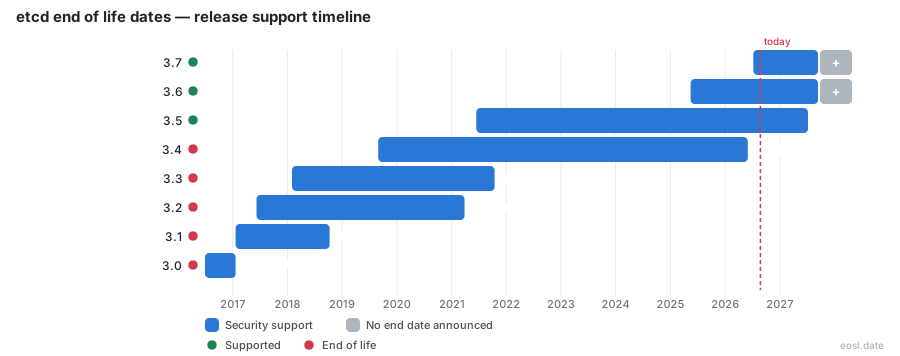
Currently Supported etcd Releases - Active EOS/EOSL Support (3)
etcd End of Life (EOL) Releases - No Longer Supported (5)
| Release | Released | Security Support | Latest |
|---|---|---|---|
| 3.4 | (7 years and 2 months ago) | (5 months ago) | 3.4.45 (5 months ago) |
| 3.3 | (8 years and 9 months ago) | (5 years and 1 month ago) | 3.3.27 (5 years and 1 month ago) |
| 3.2 | (9 years and 5 months ago) | (5 years and 7 months ago) | 3.2.32 (5 years and 7 months ago) |
| 3.1 | (9 years and 10 months ago) | (8 years and 1 month ago) | 3.1.20 (8 years and 1 month ago) |
| 3.0 | (10 years and 4 months ago) | (9 years and 10 months ago) | 3.0.17 (9 years and 10 months ago) |
Running an open-source, distributed, consistent key-value store, the database behind Kubernetes, means you need to know when your version stops getting fixes. This guide explains etcd end of life for every release line, shows which clusters still receive the latest version of upstream fixes, and helps you decide when to move a Kubernetes control plane, or any other distributed system, to a newer line.
Supported Versions and End-of-Life Dates
Only the newest lines are supported versions today. The table below combines the lifecycle data published by endoflife.date with the project's own announcements, so you can see every end-of-life dates entry and the etcd end of life dates still ahead of you.
| Release line | Released | Security support | Latest release |
|---|---|---|---|
| 3.7 | 8 Jul 2026 | Supported | 3.7.3 |
| 3.6 | 15 May 2025 | Supported | 3.6.16 |
| 3.5 | 15 Jun 2021 | Ends 8 Jul 2027 | 3.5.35 |
| 3.4 | 30 Aug 2019 | Ended 1 Jun 2026 | 3.4.45 |
| 3.3 | 1 Feb 2018 | Ended 15 Oct 2021 | 3.3.27 |
| 3.2 | 9 Jun 2017 | Ended 28 Mar 2021 | 3.2.32 |
Three lines (3.7, 3.6 and 3.5) are still maintained, while the older ones have passed the end of security support. The next date to watch is 3.5, where support ends on 8 Jul 2027. Check the running cluster before you trust any row: the endoflife.date page also lists product identifiers such as package and container names, which helps when you need to match a deployed build to a line.
How the etcd Support Policy Works
The community support policy is simple: the maintainers look after only the latest two minor versions. A patch release for each supported line arrives roughly every two weeks, and the project fixes backwards-compatible bugs on those lines. Each line has its own release branch, so a fix can be applied to a supported line without dragging in new features. Two other release branches are the previous ones, which stop receiving changes once a newer minor line ships, and the maintainers make the final decision about what gets patch releases and when.
etcd Versions and Semantic Versioning
All etcd versions follow semantic versioning (semver), written x.y.z. The first number is the major version, the second is the minor version that adds features, and the last is the patch version for fixes. You can read what a node is running with etcdctl endpoint status.
etcd 3.4 End of Life and What Changed in 3.7
The etcd 3.4 end of life was settled in the 3.7 beta announcement from SIG-etcd, and endoflife.date records 1 Jun 2026 as the final date, after one last update in the June patch release. The 3.7 line also removes v2store, adds RangeStream for large result sets, and ships newer bbolt and raft libraries alongside the gRPC APIs you already use. Anything depending on the old v2 interfaces needs testing before you move, because the upstream project removed them outright.
Security Patches After Support Ends
Once a line such as 3.4 passes its retirement date in the table above, new security fixes and bug fixes stop. A CVE disclosed afterwards stays unpatched unless a vendor handles a backport. Known vulnerabilities in a database that holds sensitive state, a reliability risk as well as a compliance one, are the strongest reason to treat the date as a deadline. The backported work is what vendors sell, not something the project promises.
Release Timeline and the Next etcd EOL
Looking at the release timeline, a new minor line has appeared about every year or two, and each one pushes an older line toward retirement. The next etcd EOL is 3.5, because 3.5 is supported for one year after a final 3.7 release. Before moving off a retiring line, remember that a cluster version is agreed by the quorum, and a downgrade is only possible within narrow limits, so a rollback plan should be tested in staging. Use the most recent stable release of the target line, not a prerelease.
Extended Support for Versions No Longer Supported
If you cannot move yet, some vendors offer extended support for lines that are no longer supported, including signed builds of patched container images. Compare etcd support offers by what they actually cover: which lines, how quickly a CVE fix is shipped, whether operations cover is included, and whether the vendor can document the setup for an audit. A managed control plane may already hide the problem, since the cloud provider upgrades etcd for you. Cross-check the CNCF project page and the GitHub releases before you rely on any vendor claim, and read the release notes on GitHub for your target line.
Upgrade Plan Before etcd End of Life Reaches Your Version
Start the upgrade while the line is still receiving patches, ideally one minor version at a time. Snapshot the data, test on a copy of the cluster, then roll the members one by one. Clients written in Go need their import path checked, or a Go build against the newer line can fail. Finally, set a calendar reminder for the next retirement date, because a line that is almost out of support is easier to fix this month than during an incident.