Dovecot End of Life (EOL) Dates and End of Support (EOS) Dates
Dovecot end of life (EOL) and end of support (EOS) dates: 3 Dovecot versions have reached EOL, including Dovecot 2.2 (EOL date: Jan 24, 2025) — no longer receiving security updates or patches. Dovecot 2.4.5 is the current supported release — 2 versions in active support. Also see BigBlueButton lifecycle dates for related end-of-life information.
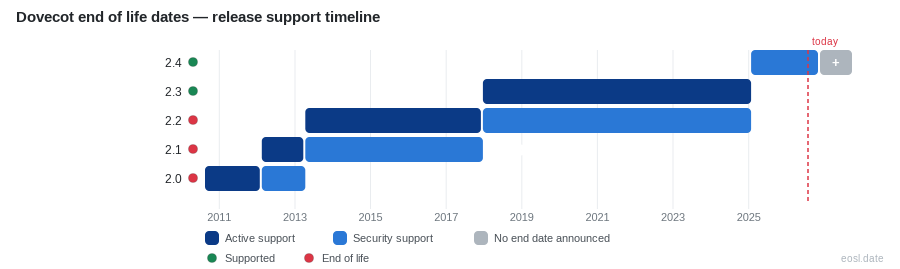
Currently Supported Dovecot Releases - Active EOS/EOSL Support (2)
Dovecot End of Life (EOL) Releases - No Longer Supported (3)
| Release | Released | Security Support | Active Support | Latest |
|---|---|---|---|---|
| 2.2 | (13 years and 7 months ago) | (1 year and 9 months ago) | (8 years and 11 months ago) | 2.2.36.4 (7 years and 2 months ago) |
| 2.1 | (14 years and 9 months ago) | (8 years and 11 months ago) | (13 years and 7 months ago) | 2.1.16 (13 years and 7 months ago) |
| 2.0 | (16 years and 3 months ago) | (13 years and 7 months ago) | (14 years and 9 months ago) | 2.0.15 (15 years and 2 months ago) |
Your Dovecot end of life deadline depends on the release you run. Dovecot is a fast, lightweight, open-source email server for Linux and other unix-like systems, serving IMAP and POP3, and today only the 2.4 branch is maintained. Dovecot CE 2.3 reached end of life (EOL) on 12 May 2025, so run dovecot --version, the version command, now.
Dovecot End of Life Dates and Version History
Dovecot publishes no fixed end-of-life dates ahead of time. This table gathers the end-of-life dates and release dates from the project's own notices, as of 27 October 2026.
| Release | Release date | Status | Last patch version |
|---|---|---|---|
| 2.4 | 24 Jan 2025 | Supported | 2.4.5 (28 Aug 2026) |
| 2.3 | 22 Dec 2017 | EOL, 12 May 2025 | 2.3.21.1 (14 Aug 2024) |
| 2.2 | 11 Apr 2013 | EOL | 2.2.36.4 (28 Aug 2019) |
| 2.1 and 2.0 | 2012 and 2010 | EOL | 2.1.16 and 2.0.15 |
Dovecot CE 2.3 End of Life: No Security Patches
The 2.3 branch no longer receives security patches or bug fixes, and there are no updates, since 2.3.21.1 shipped in August 2024. Plugins follow the same fate: FTS Flatcurve for 2.3 is EOL too, and its multi-mailbox failure is fixed only in 2.4.2+.
Dovecot Lifecycle Announcement: How Support Works
The 2018 lifecycle announcement on the Dovecot mailing list set the policy: the current release cycle gets feature, bug and security patches, while versions before 2.2 were declared EOL. Versio.io calls this a "latest version" model, where only 2.4 is current and older lines are superseded. It counts 156 versions, 131 of them affected by a CVE, which is why staying on an old line is risky, plus 23 unstable versions.
Active Support and Security Support
Active support covers bug fixes and development; security support covers only critical security fixes. Trackers can lag the project, since endoflife.date still showed security support for 2.3 at the time of writing, so trust the official notice. Under 2.2, that security support ended 24 Jan 2025.
Upgrade From an End-of-Life Release to a Supported Release
Moving to the maintained branch is the only real fix, and Dovecot never patches releases repackaged by an OS vendor. Work through this checklist:
- Download the GPG key for the 2.4 repository and import it with gpg --dearmor.
- Compare the GPG fingerprint with the published one, then add the repository for your Debian or other operating system vendor packages.
- Install the latest version, then add the module packages you use, such as Sieve, Pigeonhole, LDAP, MySQL or Solr.
- If you run its packages instead, send your operating system vendor a bug report asking which Dovecot version it ships.
Upgrading ends the exposure, because every EOL branch stays open to new vulnerabilities.
Extended Support With Dovecot Pro and Tracking EOL Status
Dovecot has no long-term support (LTS) branch in the open source community edition (CE), released under the LGPL, but Dovecot Pro sells extended support for 2.3 under a commercial agreement with its own policy. To follow the schedule, endoflife.date offers a JSON API, an RSS feed and an iCalendar feed, while Repology tracks distribution package versions. Check the documentation before each maintenance update.