NumPy End of Life (EOL) Dates and End of Support (EOS) Dates
NumPy end of life (EOL) and end of support (EOS) dates: 15 NumPy versions have reached EOL, including NumPy 2.1 (EOL date: Aug 19, 2026) — no longer receiving security updates or patches. NumPy 2.5.5 is the current supported release, with support through Jun 22, 2028 — 4 versions in active support. Also see Ansible end of life dates for related end-of-life information.
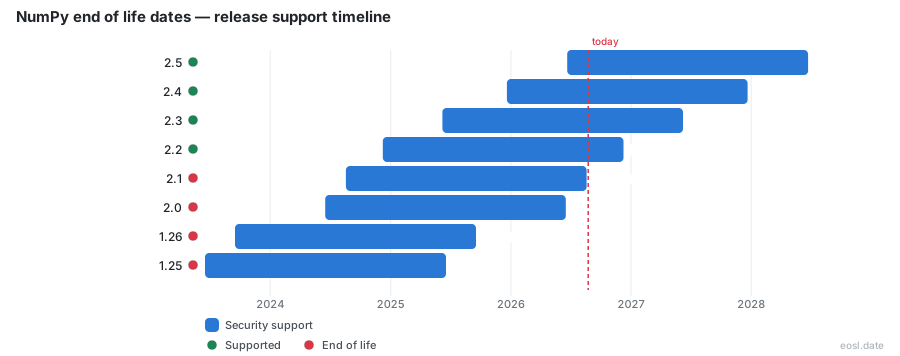
Currently Supported NumPy Releases - Active EOS/EOSL Support (4)
| Release | Released | Security Support | Latest |
|---|---|---|---|
| 2.5 | (5 months ago) | (in 1 year and 7 months) | 2.5.5 (6 days ago) |
| 2.4 | (11 months ago) | (in 1 year and 1 month) | 2.4.6 (6 months ago) |
| 2.3 | (1 year and 5 months ago) | (in 6 months) | 2.3.5 (1 year ago) |
| 2.2 | (1 year and 11 months ago) | (in 2 weeks and 4 days) | 2.2.6 (1 year and 6 months ago) |
NumPy End of Life (EOL) Releases - No Longer Supported (15)
| Release | Released | Security Support | Latest |
|---|---|---|---|
| 2.1 | (2 years and 3 months ago) | (3 months ago) | 2.1.3 (2 years ago) |
| 2.0 | (2 years and 5 months ago) | (5 months ago) | 2.0.2 (2 years and 2 months ago) |
| 1.26 | (3 years and 2 months ago) | (1 year and 2 months ago) | 1.26.4 (2 years and 9 months ago) |
| 1.25 | (3 years and 5 months ago) | (1 year and 5 months ago) | 1.25.2 (3 years and 3 months ago) |
| 1.24 | (3 years and 11 months ago) | (1 year and 11 months ago) | 1.24.4 (3 years and 4 months ago) |
| 1.23 | (4 years and 4 months ago) | (2 years and 4 months ago) | 1.23.5 (4 years ago) |
| 1.22 | (4 years and 10 months ago) | (2 years and 10 months ago) | 1.22.4 (4 years and 6 months ago) |
| 1.21 | (5 years and 4 months ago) | (3 years and 4 months ago) | 1.21.6 (4 years and 7 months ago) |
| 1.20 | (5 years and 9 months ago) | (3 years and 9 months ago) | 1.20.3 (5 years and 6 months ago) |
| 1.19 | (6 years and 5 months ago) | (4 years and 5 months ago) | 1.19.5 (5 years and 10 months ago) |
| 1.18 | (6 years and 10 months ago) | (4 years and 10 months ago) | 1.18.5 (6 years and 5 months ago) |
| 1.17 | (7 years and 3 months ago) | (5 years and 3 months ago) | 1.17.5 (6 years and 10 months ago) |
| 1.16 | (7 years and 10 months ago) | (5 years and 10 months ago) | 1.16.6 (6 years and 10 months ago) |
| 1.15 | (8 years and 3 months ago) | (6 years and 3 months ago) | 1.15.4 (8 years ago) |
| 1.14 | (8 years and 10 months ago) | (6 years and 10 months ago) | 1.14.6 (8 years and 1 month ago) |
NumPy end of life follows a fixed schedule: each minor release loses security support about two years after it is released, and the 2.0 line stopped on June 17, 2026. This guide shows which releases are still covered as of October 2026, how the EOL dates are set, and what to do if your Python stack for scientific computing still runs an older build.
What NumPy End of Life Means
When a release reaches end of life, its maintainers stop shipping bug fixes, patches and compatibility updates for it. The code keeps running and pip will still install it, but nothing changes upstream again. A release declared unsupported is on its own, and once a version is released its end date is already known. This is a planned retirement, not an abandonment: NumPy retires versions on a rolling schedule, so the release that ages out is simply the next one in line.
Security Patches Stop After Support Ends
The biggest practical change is that security patches and other security updates stop. Any CVE disclosed against the retired line afterward stays open, and you inherit the vulnerabilities. NumPy sits under pandas, scikit-learn, SciPy, PyTorch and TensorFlow, so a flaw in the base library can reach nearly every data and ML project in the wider ecosystem built on top of it. An unsupported copy anywhere in that chain is a security risk for the whole stack.
Compliance and Audit Exposure
Teams in finance, healthcare and government feel this first. An audit that finds a retired NumPy release in your dependency tree often records it as a finding, and in regulated industries "we run an EOL component" is a hard line to defend. The compliance cost, more than the code itself, usually sets the date you have to upgrade.
NumPy Support Policy and the SPEC 0 Window
The NumPy support policy follows SPEC 0, the standard shared across the scientific Python ecosystem, which replaced the older NEP 29. Under it, the project supports every minor release from the last 24 months, and at minimum the three newest. The support window for Python itself is 42 months, with at least the two latest versions covered. Both rules count from the date a version was released, so you can predict an end date long in advance, which is the point of a shared standard across the open source community. NumPy also follows semantic versioning, so its release cycle moves by minor version, and Python support is dropped only in a major or minor release, never in a patch.
Minor Version Support Table
The rule applies to the minor version, the second number in 2.4.6. A patch version (the third number) only fixes bugs inside an existing line, while a major version such as 2.0 is the rare release that can break things. Each date below follows from the 24-month rule, as of October 2026.
| NumPy release | Released | Security support ends | Status | Last patch |
|---|---|---|---|---|
| 2.5 | June 21, 2026 | June 22, 2028 | Supported | 2.5.4 |
| 2.4 | December 20, 2025 | December 21, 2027 | Supported | 2.4.6 |
| 2.3 | June 7, 2025 | June 8, 2027 | Supported | 2.3.5 |
| 2.2 | December 8, 2024 | December 9, 2026 | Ends soon | 2.2.6 |
| 2.1 | August 18, 2024 | August 19, 2026 | Ended | 2.1.3 |
| 2.0 | June 16, 2024 | June 17, 2026 | Ended | 2.0.2 |
| 1.26 | September 16, 2023 | September 17, 2025 | Ended | 1.26.4 |
Drop Schedule for Older Releases
NEP 29 published a full drop schedule in advance, for example dropping NumPy 1.14 on January 7, 2020 and NumPy 1.19 on June 21, 2022, and it paired each date with the minimum Python versions to keep. The schedule was published for the whole community, and it is why every 1.x line before 1.26 is out of date today.
Supported Versions and NumPy EOL Dates
Read the table and four releases are covered today (2.5 was released only four months ago), with 2.2 next to go on December 9, 2026. The supported versions are therefore 2.2 through 2.5, and anything older has already reached its NumPy EOL. Check which numpy versions your environment really resolves with python -c "import numpy; print(numpy.__version__)", because a lockfile or a pip cache can pin an older build than you expect. A team that treats NumPy end of life as a calendar item, rather than a surprise, upgrades one minor release at a time.
NumPy 1.x End-of-Life
The NumPy 1.x series reached end-of-life when 1.26, released on September 16, 2023, aged out on September 17, 2025. Every earlier 1.x minor had ended before it. Legacy codebases that kept running in production on 1.x have now spent more than a year on an unsupported base, and the longer the gap, the larger the eventual jump.
NumPy 2.0 Release Date and Retirement
The NumPy 2.0 release date was June 16, 2024, the first major release since 2006. It changed the ABI, the type promotion rules and parts of the Python and C APIs, which is why so many projects needed a careful upgrade after 1.x. Its retirement came on June 17, 2026, when the 24-month mark passed, and the last patch, 2.0.2, was released in August 2024. This is about NumPy 2.0 only: the rest of the 2.x series is current. Extension authors had to rebuild against the new ABI, though most code built on arrays and linear algebra kept working.
Latest Release: NumPy 2.5
The latest release, NumPy 2.5, was released on June 21, 2026 and supports Python 3.12 to 3.14. It is a transitional release: it drops Python 3.11, removes distutils, expires many old deprecations and improves free threading. NumPy 2.4, 2.3 and 2.2 were released earlier in the same cycle, each with better type annotations and free-threaded work. For Python data analysis code, 2.5 is the safest landing spot because it has the longest runway.
NumPy Versions and Python Support Matrix
Each NumPy minor version works with a band of interpreters, so a Python upgrade and a NumPy upgrade usually travel together. The Python support bands below come from the same policy, and the supported Python versions shift with every release.
| NumPy release | Python versions |
|---|---|
| 2.5 | 3.12 to 3.14 |
| 2.4 | 3.11 to 3.14 |
| 2.3 | 3.11 to 3.14 |
| 2.2 | 3.10 to 3.13 |
| 2.1 | 3.10 to 3.13 |
| 2.0 | 3.9 to 3.12 |
In practice a Python 3.9 project is capped at NumPy 2.0, which has already ended, and a Python 3.10 project is capped at 2.2, which leaves support in December.
Migrating Off an End-of-Life NumPy Release
Once a release is past its retirement date, you can upgrade to a supported release, pin the old build and accept the risk, or buy paid coverage. A migration from 2.0 to 2.5 is far gentler than the jump from 1.x, because the big break was 2.0 itself and minor upgrades inside 2.x are comparatively routine. If you must migrate from 1.x, move to the newest line your dependencies allow and test before you change the pin.
Breaking Changes and the Migration Guide
Moving off a retired 1.26 build means absorbing the 2.0 changes, so read the official migration guide before you touch the pin. The headline breaking changes in 2.0 were the ABI change, new type promotion rules and API cleanups that did not always emit warnings on 1.26. Test on 1.26 with warnings as errors first, then raise the pin to 2.x.
Pinned Transitive Dependencies
The blocker is rarely NumPy itself. It is the pinned transitive dependencies underneath: if one library caps NumPy below 2.1, you cannot choose a newer release, and a single pin can strand a whole Python environment. Run pip check and read the resolver output to find which dependency sets the ceiling, then ask its maintainers for a release or replace the package.
Extended Support for Unsupported NumPy
Teams stuck on a NumPy release past its retirement date, such as those with a validated pipeline they cannot disturb or a frozen dependency. For them, extended support from a commercial vendor keeps security coverage while the move is planned on their own terms. It is not a reason to stay put forever; it separates "unsupported upstream" from "migrate this week". For internal, low-stakes workloads, pinning and accepting the risk can be a defensible call, but for anything regulated or internet-facing it rarely is.
Never-Ending Support Options
Vendors such as HeroDevs sell never-ending support for retired NumPy lines, delivering security patches after the official EOL and watching for vulnerabilities in third-party dependencies. Weigh that recurring cost against the one-time migration cost, and treat it as a bridge, not a destination.