Bitcoin Core End of Life (EOL) Dates and End of Support (EOS) Dates
Bitcoin Core end of life (EOL) and end of support (EOS) dates: 22 Bitcoin Core versions have reached EOL, including Bitcoin Core 29 (EOL date: Oct 27, 2026) — no longer receiving security updates or patches. Bitcoin Core 32.1 is the current supported release — 3 versions in active support. Also see RabbitMQ end of life dates for related end-of-life information.
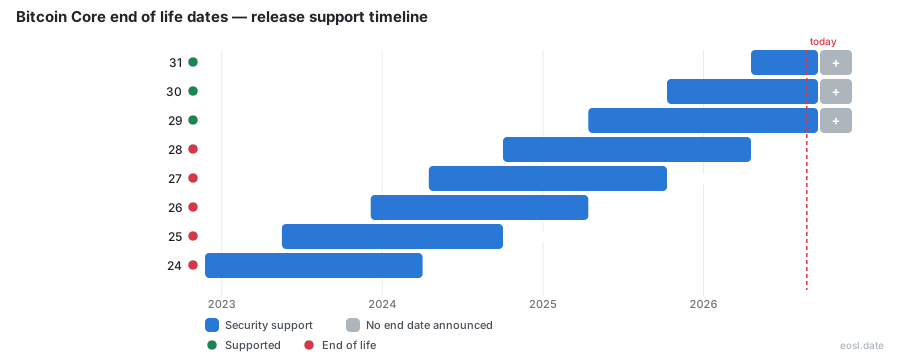
Currently Supported Bitcoin Core Releases - Active EOS/EOSL Support (3)
Bitcoin Core End of Life (EOL) Releases - No Longer Supported (22)
| Release | Released | Security Support | Latest |
|---|---|---|---|
| 29 | (1 year and 7 months ago) | (3 weeks and 4 days ago) | 29.5 (3 weeks and 3 days ago) |
| 28 | (2 years and 1 month ago) | (7 months ago) | 28.4 (7 months ago) |
| 27 | (2 years and 7 months ago) | (1 year and 1 month ago) | 27.2 (2 years ago) |
| 26 | (2 years and 11 months ago) | (1 year and 7 months ago) | 26.2 (2 years and 4 months ago) |
| 25 | (3 years and 6 months ago) | (2 years and 1 month ago) | 25.2 (2 years and 7 months ago) |
| 24 | (3 years and 11 months ago) | (2 years and 7 months ago) | 24.2 (3 years ago) |
| 23 | (4 years and 6 months ago) | (2 years and 11 months ago) | 23.2 (3 years and 6 months ago) |
| 22 | (5 years and 2 months ago) | (3 years and 7 months ago) | 22.1 (3 years and 11 months ago) |
| 0.21 | (5 years and 10 months ago) | (4 years and 1 month ago) | 0.21.2 (5 years and 1 month ago) |
| 0.20 | (6 years and 5 months ago) | (4 years and 9 months ago) | 0.20.2 (5 years and 1 month ago) |
| 0.19 | (6 years and 11 months ago) | (5 years and 3 months ago) | 0.19.2 (5 years and 10 months ago) |
| 0.18 | (7 years and 6 months ago) | (5 years and 9 months ago) | 0.18.1 (7 years and 3 months ago) |
| 0.17 | (8 years and 1 month ago) | (6 years and 3 months ago) | 0.17.2 (7 years and 1 month ago) |
| 0.16 | (8 years and 8 months ago) | (6 years and 9 months ago) | 0.16.3 (8 years and 2 months ago) |
| 0.15 | (9 years and 2 months ago) | (7 years and 3 months ago) | 0.15.2 (8 years and 1 month ago) |
| 0.14 | (9 years and 8 months ago) | (7 years and 9 months ago) | 0.14.3 (8 years and 1 month ago) |
| 0.13 | (10 years and 2 months ago) | (8 years and 3 months ago) | 0.13.2 (9 years and 10 months ago) |
| 0.12 | (10 years and 8 months ago) | (8 years and 8 months ago) | 0.12.1 (10 years ago) |
| 0.11 | (11 years and 4 months ago) | (9 years and 3 months ago) | 0.11.3 (9 years and 8 months ago) |
| 0.10 | (11 years and 9 months ago) | (9 years and 8 months ago) | 0.10.5 (9 years and 8 months ago) |
| 0.9 | (12 years and 8 months ago) | (10 years and 8 months ago) | 0.9.5 (11 years and 6 months ago) |
| 0.8 | (13 years and 9 months ago) | (10 years and 10 months ago) | 0.8.6 (12 years and 11 months ago) |
If you run a Bitcoin Core end of life check on your own bitcoin node, you are asking one thing: is the version I run still maintained? Bitcoin Core is the open-source reference implementation of the network, and the Bitcoin Core project only ships bug fixes and answers newly found vulnerabilities for its three newest major branches. Everything older stops receiving that software support.
Bitcoin Core End of Life: What It Means for Your Node
When a version reaches its end of life, the project stops issuing patches for it. Your node keeps running and keeps validating blocks, so nothing breaks overnight. What changes is that any new flaw found in that code will be fixed only in newer releases. The project's security policy says versions past the cutoff do not generally receive security fixes, which is why operators are told to run the latest maintenance release of the newest major version they can manage.
Think of the oldest supported branch as a moving line. Each time a new major version appears, the oldest one falls out of the supported set and becomes unsupported. The line moves about twice a year, so a node left untouched for a year or two ends up well behind it.
The Maintenance Window and Three Supported Branches
The maintenance window covers the three major versions released most recently at any time. If 31.x is the latest line, then 30.x and 29.x are still maintained alongside it. Once the next major arrives, the project retires the oldest of those three. Because a major release lands roughly every 6 months, each line enjoys an 18-month support cycle from its first release to its cutoff. That span is the only promise you get, so plan your upgrade around it rather than waiting for a warning.
Major Release and Maintenance Release Numbering
Bitcoin Core numbers every build as MAJOR.MINOR. A major release looks like 30.0 and arrives on the roughly six-month cadence, with release candidates labelled rc1, rc2 and so on before the final tag. A maintenance release such as 30.2 carries point releases of fixes for an existing branch. Your version number therefore tells you both which branch you are on and how current its fixes are.
Consensus Rules in Maintenance Versions
Proposed consensus rules changes are shipped first in maintenance versions, not in a new major. The smaller change set helps enterprise users review and test them, and it lets cautious operators adopt consensus rule changes sooner. Miners and full nodes must enforce a new rule for it to matter, so this path keeps the patch easy to inspect. These releases stop arriving once your branch loses support, so rule updates only reach supported nodes. Validation of blocks and transactions stays identical on every supported branch, regardless of which release carried the rule.
The Maintenance Period for Older Branches
Inside the maintenance period, the bar for backporting a change rises as a branch ages. A fix that lands on the newest line is often backported to the one before it, but the oldest supported branch only receives the important security fixes. Volunteers handle each backport, so coverage is never guaranteed once you are near the end of a branch, and the oldest line is the one closest to losing support.
Bitcoin Core Lifecycle Schedule by Version
The project publishes its lifecycle schedule as a public table. The rows below summarise the branches most operators still ask about, using the dates from that schedule.
| Branch | Released | Support ends |
|---|---|---|
| 25.x | 2023-05-18 | 2024-10-02 |
| 26.x | 2023-12-06 | 2025-04-14 |
| 27.x | 2024-04-16 | 2025-10-10 |
| 28.x | 2024-10-02 | 2026-04-19 |
| 29.x | 2025-04-14 | After 32.0 is out |
| 30.x | 2025-10-10 | After 33.0 is out |
| 31.x | 2026-04-19 | After 34.0 is out |
This Bitcoin Core lifecycle table explains why Bitcoin Core 31.0 will stay maintained longer than anything shipped before it: the cutoff follows the arrival of the version three steps later, never a calendar date. That release also shows what a major branch can change. It redesigned the Bitcoin mempool so transactions are grouped into clusters, dropped the old ancestor and descendant limits in favour of cluster policy limits, and reworked how a mempool replaces transactions, none of which a node on an older branch will get.
Release Date Versus Cutoff Date
Do not subtract from a release date to guess the cutoff for a branch that is still supported. Each cutoff depends on when the later major shows up, so the real date shifts if a release slips. The same table gives you the security support status in a single glance, and the older rows show that lines have ended consistently about 18 months after launch. Your blockchain data stays valid across all of them.
End-of-Life Versions Still Running on the Network
Many operators have not moved. Snapshots taken in autumn 2026 found somewhere between roughly 44% and 60% of visible Bitcoin Core peers on lines that had already left support or were about to, depending on whether Bitcoin Knots nodes were counted. Each snapshot uses its own method, so treat the spread as the honest answer to "how many are outdated?" and keep in mind the support cycle itself guarantees the share rises right after every new major release.
Node Operators and the Survey Snapshot
These counts cover only reachable nodes: version strings are self-reported, and anything behind Tor or a firewall is missing. Node operators who run a single-board computer in a cupboard for years are the likeliest to be underrepresented, so the true share of unsupported installs is probably higher. A supported branch can also mislead you, because an operator who skips the newest point release still misses a fix.
Security Fixes, Embargo and Disclosure
The old rule held back details of medium and high severity flaws until two weeks after the last affected branch reached its end of life, which could mean a year between a fix and its security advisories. One example is CVE-2024-52911, a use-after-free in block validation: it was fixed in 29.0 in April 2025 and disclosed in May 2026. An October 2026 change now lets developers flag a vulnerability as easily rediscoverable, so the patch is backported to every maintained line at once and a short advisory ships with it. The embargo no longer shields those flaws.
Bitcoin Core 32.0 and the Support Cycle
Bitcoin Core 32.0 is the release that moves the line next. Release candidates have been circulating since September 2026, and the lifecycle page still lists the final date as to be announced. When it is tagged, 29.x leaves the supported set and only 30.x, 31.x and 32.x remain. The release notes for the new build list changes to fee estimation, the index and the graphical interface. The new wallet defaults to a newer partially signed format, and some multisignature co-signers could not import files from the new wallet at first. Back up your wallet before testing, and note that the mempool settings in your config deserve a read, since policy limits there were reworked in 31.0.
Release Candidate and Feature Freeze
A release candidate is a build considered ready for publication, and it follows the feature freeze, after which nothing new is accepted. That makes it the right moment to test your own configuration. Download the candidate on a spare machine, check how it reads your settings, and compare against the GitHub issue tracker before you touch the node that holds your funds.
Upgrading Your Bitcoin Node Before Support Ends
Start by reading the version your node reports: run it with the version flag, or open the About dialog in the graphical app. Then pick the newest maintenance release of the newest major you can run. To upgrade, shut the old version down completely, wait for it to stop, then replace the binary. On Windows you run the installer, on macOS you copy the app over, and on Linux you replace the daemon files. Upgrading straight from a past-cutoff version is possible, but a data directory migration may take extra time and a wallet backup beforehand is cheap insurance.
Check Your Running Version First
Compare the reported version number with the schedule above. A match with a supported branch is good, but also confirm you run its latest point release, because those carry the bug fixes. If the number sits on a retired branch, the upgrade path is a straight move to the newest major.
Why Some Operators Wait
Some teams hold back so a new default has more bake time before it reaches production, and that is a reasonable call for signing setups with several parties. Waiting makes sense only while your branch is still maintained; once support ends you get no fixes at all. If you do not run a node, ask your custody provider which version its infrastructure uses, since privacy and key safety both depend on it.
Reference Implementation Versioning and Protocol Numbers
As the reference implementation, Bitcoin Core follows rules that differ from ordinary libraries. Many other parts of the system carry independent version numbers, which is why the software schedule above says nothing about them. Cryptocurrency users sometimes assume a new release changes the rules of the chain, yet most releases change none. None of these numbers decide when a branch loses support; only the major-release schedule above does.
Protocol Versioning
Each transaction holds its own version number, the P2P network protocol uses numbers so peers announce which features they support, and the built-in wallet keeps an internal one. Protocol versioning is deliberately decoupled from the release numbering, and the consensus protocol has no version number at all.
Relationship to SemVer
The SemVer standard assumes you can stay on an old library if you dislike the changes. Consensus code cannot work that way, since software that does not know a new rule may accept an invalid transaction. For that reason Bitcoin Core ships consensus changes as maintenance releases rather than as a new x.0, keeping the patch small enough for many people to inspect. It also means a branch is retired by its release schedule, not by a SemVer-style deprecation notice.