Red Hat Ansible Automation Platform End of Life (EOL) Dates and End of Support (EOS) Dates
Red Hat Ansible Automation Platform end of life (EOL) and end of support (EOS) dates: 3 Red Hat Ansible Automation Platform versions have reached EOL, including Red Hat Ansible Automation Platform 2.5 (EOL date: Oct 02, 2026) — no longer receiving security updates or patches. Red Hat Ansible Automation Platform 2.6 is the current supported release, with support through Oct 01, 2027. Also see Bitcoin Core end of support life for related end-of-life information.
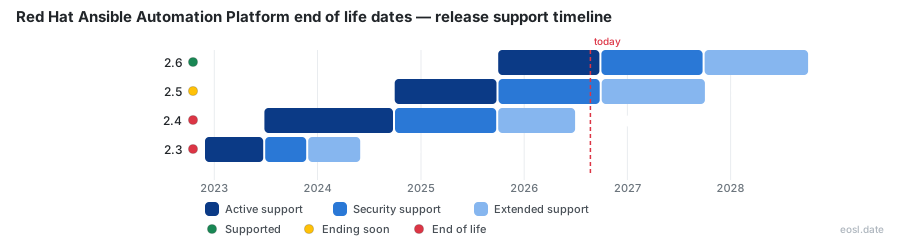
Currently Supported Red Hat Ansible Automation Platform Releases - Active EOS/EOSL Support (1)
| Release | Aap Platform Uiversion | Ansible Core Version | Automation Controller Version | Automation Hub Version | Event Driven Ansible Version | Platform Gateway Version | Released | Maintenance Support 1 | Full Support | Maintenance Support 2 |
|---|---|---|---|---|---|---|---|---|---|---|
| 2.6 | 2.6.1 | 2.16 | 4.7.10 | 4.11.7 | 1.2.7 | 2.6.20251001 | (1 year and 1 month ago) | (in 10 months) | (1 month and 2 weeks ago) | (in 1 year and 10 months) |
Red Hat Ansible Automation Platform End of Life (EOL) Releases - No Longer Supported (3)
| Release | Aap Platform Uiversion | Ansible Core Version | Automation Controller Version | Automation Hub Version | Event Driven Ansible Version | Platform Gateway Version | Released | Maintenance Support 1 | Full Support | Maintenance Support 2 |
|---|---|---|---|---|---|---|---|---|---|---|
| 2.5 | 1.1 | 2.16 | 4.6.27 | 4.10.13 | 1.1.17 | N/A | (2 years and 1 month ago) | (1 month and 2 weeks ago) | (1 year and 1 month ago) | (in 10 months) |
| 2.4 | N/A | 2.15 | 4.5.30 | 4.9.5 | 1.0.8 | N/A | (3 years and 4 months ago) | (1 year and 1 month ago) | (2 years and 1 month ago) | (4 months ago) |
| 2.3 | N/A | 2.14 | 4.3 | 4.6 | N/A | N/A | (3 years and 11 months ago) | (2 years and 11 months ago) | (3 years and 4 months ago) | (2 years and 5 months ago) |
Planning around Red Hat Ansible Automation Platform end of life means knowing when your enterprise subscription stops receiving fixes for the release you run. Customers get the dates, the phases behind them and the routes forward here, so your automation, your automation controller and every automation job stay supported before the end of life date lands.
Ansible Automation Platform Life Cycle Dates
Red Hat publishes the ansible automation platform life cycle on its customer portal. Every release follows one clock: general availability starts it, then three phases wind it down. The table lists each version, using the published life cycle data, while patch releases and release notes track fixes in between.
| Release | General availability | Full Support ends | Maintenance Support 1 ends | Maintenance Support 2 ends (end of life) |
|---|---|---|---|---|
| 2.3 | 29 Nov 2022 | 30 Jun 2023 | 29 Nov 2023 | 31 May 2024 |
| 2.4 | 27 Jun 2023 | 1 Oct 2024 | 1 Oct 2025 | 30 Jun 2026 |
| 2.5 | 30 Sep 2024 | 2 Oct 2025 | 2 Oct 2026 | 2 Oct 2027 |
| 2.6 | 1 Oct 2025 | 1 Oct 2026 | 1 Oct 2027 | 1 Oct 2028 |
To see where you stand, check the version number shown in the web console or the installer bundle, then match that version to its row. A release that has left Full Support still gets security attention, yet each later version narrows what Red Hat will do. Every new version of the platform resets the clock, which means a version you install today has a longer runway than one installed two years ago, and the next version will extend it again.
Read it by status. Releases 2.3 and 2.4 are unmaintained, with the EOL already behind them, 2.5 is in its last phase, and 2.6 is the current choice. Ansible Tower has its own retired Ansible Tower life cycle page, so customers running Tower inside the platform follow the platform schedule instead. Each date counts as end of life only after Maintenance Support 2 closes.
Production Phases in the Ansible Automation Platform Lifecycle
The ansible automation platform lifecycle splits support into production phases so each version gets less attention as newer ones arrive. The lifecycle exists to move adoption of new technology forward while keeping enterprise stability, and every release version passes through the same lifecycle stages in the same order. Features and fixes target only the latest versions of the product, though some allowance is made for high security risk items.
Full Support Phase
During Full Support you receive qualified critical security fixes, plus critical, important and moderate severity issues where the CVSS score is 7.0 or higher. Both security errata and bug fix errata ship, and select software enhancements and new features arrive. If you want new features, this is the only phase that delivers them, and a release in Maintenance Support gets no new features at all.
Maintenance Support 1 and 2 Phases
Maintenance Support 1 keeps critical and important security fixes plus critical-only bug fixes, with no new features. Maintenance Support 2 narrows this to critical security fixes only; bug fixes and enhancements stop completely.
Extended Life-Cycle Support Add-On
A paid add-on can stretch protection further. It still delivers qualified critical security fixes, but nothing else, and it requires an active contract. It is the paid way to keep receiving those fixes after the standard end of life date has passed.
End of Maintenance Support and What It Means for Your Version
When a release reaches end of maintenance support, Red Hat no longer actively develops it. The end of maintenance point arrives at the close of Maintenance Support 2, and from then on your maintenance support options are limited to advice.
Security Fixes and Bug Fixes Stop Flowing
- Routine security fixes for new CVEs are no longer backported, so known vulnerabilities stay open.
- Routine bug fixes stop too, and no software enhancements are added.
- You can still open a support ticket, but the usual answer is to move to a supported version.
For an organization subject to audits, running an unsupported release is a security and compliance gap, which is why security teams push for a move before the date arrives.
Red Hat Ansible Automation Platform End of Life: Upgrade Path
Your upgrade path depends on how you installed the platform, because the Red Hat Ansible Automation Platform end of life for 2.4 coincides with the end of RPM installs after 2.6. Treat this migration as one project, and test on non-production infrastructure first.
RPM Installation on RHEL 8
These upgrade scenarios start with the RPM installation on Red Hat Enterprise Linux 8. You first migrate 2.4 to RHEL 9, then upgrade to 2.6 RPM on that host. A legacy 2.3 environment adds a step: upgrade to 2.4 while staying on RHEL 8, move to 2.6 RPM on RHEL 9, and finally migrate to the container-based deployment.
Containerized Deployment on RHEL 9
A 2.5 setup already running in containers on RHEL 9 upgrades directly to 2.6 in place, the simplest route. Because 2.5 is already in its final phase until 2 Oct 2027, the move also extends your support window to 2028.
What 2.6 Adds Before 2.4 Reaches End of Support
Moving to 2.6 before end of support also delivers three headline capabilities for platform automation teams:
- The automation dashboard measures return on investment with real-time insight.
- The intelligent assistant adds generative AI chat to the UI for administration help.
- The self-service automation portal lets non-experts run shared workflows with point-and-click access.
The release also improves Event-Driven Ansible, the automation controller and automation hub, and the playbook content that runs on them. The multi-playbook workflow builder and visualizer still chain jobs into one workflow, and new automation features land only on the latest version. The hybrid cloud console hosts related services, so check their schedule beside your on-premise maintenance schedules.
Installation Requirements and Ansible Core Versions to Avoid EOL
Support depends on the stack beneath the platform as much as on the release. Check the requirements for each release before you plan.
| Release | Default Ansible Core | RHEL for RPM | RHEL for containers | PostgreSQL | OpenShift |
|---|---|---|---|---|---|
| 2.5 | 2.16 | 8, 9 | 9, 10 | 15 | 4.12 to 4.20 |
| 2.6 | 2.16 | 9 | 9, 10 | 15 to 17 | 4.14 to 4.22 |
The default Ansible Core release is supported for the entire life of the platform version it ships with, and the platform gateway fronts the services on 2.5 and later. Operating system and database versions must match the table too. The Ansible collections you rely on have their own versioning, so check the documentation and roadmap for them.
Execution Environment Images
Ansible Core reaches you through an execution environment image. Images carrying core 2.16 and 2.18 stay supported for the full life of 2.5 and 2.6, while 2.17 is no longer supported, so pick the image that fits your RHEL baseline.
Python and Ansible Core on Control and Managed Nodes
Python is the hidden requirement. Each Ansible Core version supports a limited range of Python versions on the control node, and a different, usually wider, range on managed targets. Python 3.10 or newer is a common floor for recent core releases, while very old Python versions on managed hosts may need an older core. Check the Python version on every host before you change core versions, because a Python mismatch breaks playbooks silently and can leave you outside the supported configuration, and the Python packages your modules need must be installed in the execution environment image rather than on the host.
Scope of Support After a Release Is Retired
The scope of support covers setup, upgrading, backup and restore, standard configuration, usage through the API and UI, and day-to-day operation. It excludes replication and failover, custom content and collection debugging, custom API integrations and third-party integrations. Once a release is retired, even those supported activities end.
Customer Provided Database
If you supply your own database, Red Hat offers commercially reasonable support, and may ask you to reproduce an issue on the shipped one. This limited help applies only while the release is in a support phase and ends with it.
Customer Provided Kubernetes
Container groups can run on cloud Kubernetes services such as EKS, AKS or GKE, when the API matches a supported OpenShift release, and only while the platform release itself is in a support phase.
Ansible Community Release Cycle and Unmaintained Versions
The upstream community follows a separate release cycle than the subscription product. The community package uses semantic versioning, while ansible-core does not and maintains the latest release plus two older ones. Each core version sets which Python the control node and the managed node need, and once a community version is marked unmaintained, it can contain unfixed vulnerabilities. The community maintains one package version at a time, and the community announces each end of life through its release pages and forum. Community members may keep older versions alive, but you should upgrade community installs promptly, and check the community porting guides for breaking changes in each version. A version of the community project is not covered by Red Hat support; only the subscription product is.