RabbitMQ End of Life (EOL) Dates and End of Support (EOS) Dates
RabbitMQ end of life (EOL) and end of support (EOS) dates: 17 RabbitMQ versions have reached EOL, including RabbitMQ 4.2 (EOL date: Jul 31, 2026) — no longer receiving security updates or patches. RabbitMQ 4.3 reaches its End of Support date on Jan 31, 2027 — plan your upgrade path now. RabbitMQ 4.4.1 is the current supported release, with support through Jul 31, 2027. Also see Apache Subversion end of support life for related end-of-life information.
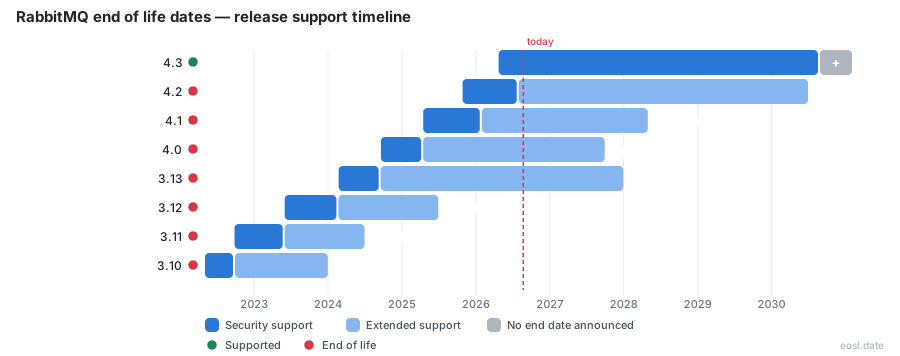
Currently Supported RabbitMQ Releases - Active EOS/EOSL Support (1)
| Release | Released | Community Support | Extended Commercial Support | Latest |
|---|---|---|---|---|
| 4.4 | (1 month and 1 day ago) | (in 8 months) | (in 1 year and 11 months) | 4.4.1 (5 days ago) |
RabbitMQ Releases Nearing End of Life - Support Ending Soon (1)
| Release | Released | Community Support | Extended Commercial Support | Latest |
|---|---|---|---|---|
| 4.3 | (6 months ago) | (in 2 months) | (in 1 year and 5 months) | 4.3.8 (5 days ago) |
RabbitMQ End of Life (EOL) Releases - No Longer Supported (17)
| Release | Released | Community Support | Extended Commercial Support | Latest |
|---|---|---|---|---|
| 4.2 | (1 year ago) | (3 months ago) | (in 3 years and 7 months) | 4.2.9 (4 months ago) |
| 4.1 | (1 year and 7 months ago) | (9 months ago) | (in 5 months) | 4.1.8 (10 months ago) |
| 4.0 | (2 years and 2 months ago) | (1 year and 6 months ago) | (1 month and 3 weeks ago) | 4.0.9 (1 year and 7 months ago) |
| 3.13 | (2 years and 8 months ago) | (2 years and 1 month ago) | (in 3 years and 1 month) | 3.13.7 (2 years and 2 months ago) |
| 3.12 | (3 years and 5 months ago) | (2 years and 8 months ago) | (1 year and 4 months ago) | 3.12.14 (2 years and 6 months ago) |
| 3.11 | (4 years and 1 month ago) | (3 years and 5 months ago) | (2 years and 4 months ago) | 3.11.28 (2 years and 11 months ago) |
| 3.10 | (4 years and 6 months ago) | (4 years and 1 month ago) | (2 years and 10 months ago) | 3.10.25 (3 years and 4 months ago) |
| 3.9 | (5 years and 3 months ago) | (3 years and 9 months ago) | (3 years and 3 months ago) | 3.9.29 (3 years and 8 months ago) |
| 3.8 | (7 years and 1 month ago) | (4 years and 3 months ago) | (4 years and 3 months ago) | 3.8.35 (4 years and 4 months ago) |
| 3.7 | (8 years and 11 months ago) | (6 years and 1 month ago) | (6 years and 1 month ago) | 3.7.28 (6 years and 3 months ago) |
| 3.6 | (10 years and 10 months ago) | (8 years and 5 months ago) | (8 years and 5 months ago) | 3.6.16 (8 years and 5 months ago) |
| 3.5 | (11 years and 8 months ago) | (10 years ago) | (10 years ago) | 3.5.8 (10 years ago) |
| 3.4 | (12 years and 1 month ago) | (11 years ago) | (11 years ago) | 3.4.4 (11 years and 9 months ago) |
| 3.3 | (12 years and 7 months ago) | (11 years and 7 months ago) | (11 years and 7 months ago) | 3.3.5 (12 years and 3 months ago) |
| 3.2 | (13 years ago) | (12 years ago) | (12 years ago) | 3.2.4 (12 years and 8 months ago) |
| 3.1 | (13 years and 6 months ago) | (12 years and 6 months ago) | (12 years and 6 months ago) | 3.1.5 (13 years and 3 months ago) |
| 3.0 | (14 years ago) | (12 years and 11 months ago) | (12 years and 11 months ago) | 3.0.4 (13 years and 8 months ago) |
If you run this open source message broker in production, RabbitMQ end of life dates decide how long your current version keeps receiving patches, and as of 27 October 2026 only the 4.4 and 4.3 series still get community support. Below you will find the support dates for every release series, the Erlang version each one needs, what breaks when you upgrade, and what to do if you are stuck on an older release.
RabbitMQ End of Life Dates by Release Series
The project publishes a support window for each release series (a minor line such as 4.3 or 3.13), not for each individual patch. The table below is built from the official release information page and the project's GitHub release list, and it was current in late October 2026. Community dates are firm; the commercial dates are indicative, and the Broadcom support portal remains the authority for contracts.
| Release series | First release | End of community support | End of commercial support |
|---|---|---|---|
| 4.4 | 20 Oct 2026 | 31 Jul 2027 | 31 Oct 2028 |
| 4.3 | 23 Apr 2026 | 31 Jan 2027 | 30 Apr 2028 |
| 4.2 | 28 Oct 2025 | 31 Jul 2026 | 30 Jun 2030 |
| 4.1 | 15 Apr 2025 | 31 Jan 2026 | 30 Apr 2027 |
| 4.0 | 18 Sept 2024 | 30 Apr 2025 | 30 Sept 2026 |
| 3.13 | 22 Feb 2024 | 30 Sept 2024 | 31 Dec 2029 |
| 3.12 | 2 Jun 2023 | 29 Feb 2024 | 30 Jun 2025 |
Read the table by the series you run. A 4.2 deployment passed its free patch window on 31 Jul 2026, yet paid coverage lasts until mid-2030, which is why paying customers often standardize on 4.2 or 3.13 when they need time. The final patch for a series is simply the last release it received, such as 3.12.14 for the 3.12 line, and the last release of a series is the point where your fixes stop for good.
How to Check Your Running Version Against EOL Dates
Before you plan anything, confirm what you actually run. On any node, rabbitmqctl --version prints the broker version, and rabbitmqctl status also shows the Erlang/OTP release underneath it. Match the first two numbers (for example 3.13) to the table above to find your series, then compare today's date with its dates. Compare versions across every environment, because staging and production often drift apart.
Patch levels inside a supported series
Being on a supported series is not the same as being patched. A node on 4.3.0 sits inside an active line, yet it misses every fix shipped in later patch releases of the line. Always compare your full version with the newest patch listed on the release page. Patch level only matters while the series is supported: once a series passes its community end date, its newest patch is the last fix you will ever get.
RabbitMQ Support Timelines: Community and Commercial Support
The project describes support timelines in two layers. Community support is free and comes with the open source release: security updates and bugfixes from the maintainers and contributors, tracked openly on GitHub. Commercial support runs through Broadcom for customers who hold a valid commercial license, and it continues after the end of community support as extended commercial support. It is also called long term support when a series is covered for years, and the same offer includes expert services that help with patching and upgrade work long after standard timelines have ended.
What community support covers
While a series is in community support, the maintainers ship security patches, regular maintenance release builds and bug fixes. Once that date passes, no more patches arrive for that series from the community, even if a serious vulnerability is found.
How commercial support extends a series
The end of commercial support date is always later than the community date. Tanzu RabbitMQ is the commercial distribution, sold by the vendor that now owns the project, and it comes with support engineers, fixes for high-severity issues and security patches. Treat the dates as a ceiling on how long you can stay put, not as a plan.
Older Unsupported Series: RabbitMQ 3.0 to 3.12
The release page now lists nothing older than 3.12, and it states that any release missing from the table is unsupported. That means the 3.x lines, each well past end of life, before 3.13 have gone years without upstream fixes. The community dates for the oldest series, taken from the end-of-life tracker, are below.
| Series | Released | Community support ended | Final patch |
|---|---|---|---|
| 3.9 | 23 Jul 2021 | 31 Jan 2023 | 3.9.29 |
| 3.8 | 1 Oct 2019 | 31 Jul 2022 | 3.8.35 |
| 3.7 | 28 Nov 2017 | 30 Sept 2020 | 3.7.28 |
| 3.6 | 22 Dec 2015 | 31 May 2018 | 3.6.16 |
| 3.0 | 19 Nov 2012 | 30 Nov 2013 | 3.0.4 |
Why 3.6 to 3.11 get no fixes
Every CVE published against RabbitMQ or Erlang since those dates stays unpatched on those lines, and the list of CVEs only grows. If you cannot move yet, reduce exposure by keeping the broker off public networks and restricting the management and AMQP protocol ports, but treat that as a stopgap, since its dependencies and the Erlang runtime age as well.
Latest RabbitMQ Version: Release Notes and the Support Lifecycle
The newest series is 4.4 (see the GitHub releases page), a feature release published on 20 Oct 2026, and the newest patch of the previous line, 4.3.7, followed a day earlier on the project's GitHub releases page. Each release carries release notes that you should read before moving, since the notes list breaking changes, the minimum Erlang version and every plugin change. The project does not use a fixed calendar, so the support lifecycle of a series follows the release cadence: community support lasts until newer series supersede it, which is why the dates above can shift.
Reading release notes for patch release changes
Each patch release groups its fixes by component and splits them into bug fixes and enhancements; the same notes appear on the GitHub release list and on the project site. The bug fixes section tells you whether a patch touches your workload, and the release notes of a feature release add a compatibility section. A typical maintenance release corrects behavior in the core server, the command line tools and a handful of plugins, such as Shovel, Federation and MQTT. Use the notes to confirm a series is still supported and to see what its last patch contains before it ages out. Scan the bug fixes first, then the GitHub issue numbers linked beside them: if one touches a feature you use, that alone can justify patching this week.
The project is developed in the open on GitHub, so GitHub is the most current place to follow a series. These GitHub pages help you track a series' support status and patch level:
- GitHub release list: every tagged release of the server on GitHub, newest first, with the GitHub release notes for each tag.
- GitHub release notes for 4.4.0: the GitHub page lists breaking changes and compatibility notes before the enhancements.
- GitHub release notes for 4.3.7: a maintenance release on GitHub whose notes name the minimum Erlang version.
- GitHub issues: each fix links a GitHub issue, so a GitHub search shows the original report and the discussion.
- GitHub pull requests: contributors are credited through their GitHub pull requests, and a GitHub diff shows exactly what changed.
- GitHub stream issues: stream bugs and stream enhancements are tracked on GitHub, so one stream search covers a feature's history.
- GitHub discussions: questions from stream, MQTT and quorum queue users are answered in GitHub discussions.
- GitHub tags: a GitHub tag such as v4.4.0 pins the exact source, which helps when you build the stream plugin from source.
- GitHub security advisories: a GitHub advisory lists the CVE, the affected versions and the patched version.
- GitHub watch settings: watch releases on GitHub to get an email for each new patch, and follow the GitHub feed for stream changes.
- GitHub release-notes folder: the repository keeps notes for each series, so GitHub still shows older series that the website no longer lists.
Plugin and Protocol Changes Over a Series Lifecycle
When you leave a series that is out of support, most of your testing time goes to the plugin layer rather than the broker core. The stream plugin, the MQTT plugin, the STOMP plugin and the management plugin each get their own notes in every release, and a plugin that works on 3.13 may behave differently on 4.x. A few changes to expect between supported lines:
- The AMQP 1.0 implementation is part of the core server and is no longer a separate add-on, so AMQP 1.0 clients and AMQP 0-9-1 clients exchange converted messages, and the conversion rules change between series.
- Stream and streams-based workloads gain features in each new minor series, so read the release notes for the stream plugin, and test each stream consumer, before moving it.
- TLS defaults get stricter with newer Erlang releases, so an OpenSSL or certificate setup that was fine earlier may fail peer verification.
Management, Shovel and Federation plugins
Shovel and Federation links move messages between clusters, so when you migrate off an old series a mixed-version fleet is normal. Both plugins receive regular fixes for confirms and reconnection, and both are worth testing on a staging pair before the production switch.
Risks of Running a Broker Past EOL
Nothing stops working on the day a series reaches end of life, and that is the danger. The risk is gradual, and four things build up:
- Security exposure: every new CVE in the broker or in Erlang stays open on your version.
- Compliance gaps: auditors expect a supported release with a documented patch path, and "it still works" does not satisfy them.
- Slower incident response: community answers on a broken production cluster tend to start with "upgrade first".
- A growing upgrade bill: each series you fall behind adds another hop to a future migration.
Security patches are the part auditors care about most, so keep a record of which version each cluster runs and when its support window closes.
Erlang Version Requirements Before RabbitMQ End of Support
This broker runs on the Erlang VM, so the runtime has its own timeline. When an Erlang series reaches end of support, everything on it inherits the exposure, even a broker whose own release looks current. Erlang 26 is no longer supported, Erlang 27 is supported, Erlang 28 is supported by RabbitMQ 4.3.7 and 4.4.0 onward, and Erlang 29 is supported by RabbitMQ 4.4.0 and 4.3.7. Newer Erlang releases also bring TLS and OpenSSL improvements, and Erlang 28.5 adds several post-quantum cryptography algorithms.
Getting a supported Erlang in place before the broker upgrade is straightforward. Use the official Debian and Ubuntu repositories or the zero-dependency RPM package for RHEL-family systems, or pull the version bundled in the Docker image. When a suitable package does not exist, build Erlang from source with kerl. Ask which Erlang release your operating system packages, because distribution repositories often lag behind.
Erlang/OTP compatibility matrix for current series
The compatibility matrix below shows the minimum supported Erlang version for each current line. The minimum supported Erlang version for the 4.3 and 4.4 series is 27.0, and since Erlang 26 the TLS implementation verifies client peers by default, so TLS-enabled Shovel, Federation and LDAP connections fail until a client certificate is configured.
| RabbitMQ series | Minimum Erlang/OTP | Maximum supported Erlang/OTP |
|---|---|---|
| 4.4 | 27.0 | 29.x |
| 4.3 (4.3.7 and later) | 27.0 | 29.x |
| 4.3 (before 4.3.7), 4.2 | 27.0 | 27.x |
| 4.1, 4.0 (4.0.4 and later) | 26.2 | 27.x |
| 3.13 | 26.0 | 26.2.x |
The Erlang version requirement is enforced: nodes fail to start on an older Erlang than a release's minimum, so the runtime upgrade usually happens before the broker upgrade.
Keeping Erlang consistent across cluster nodes
Use the same major Erlang version on every node in a cluster. A node checks the internal protocol versions when it joins a cluster and refuses to join when the combination looks incompatible. Mixed-version clusters are acceptable only during a rolling upgrade window, and Erlang 28 is currently safe only for new clusters, because a known issue can hit a Khepri cluster moving from Erlang 27 to 28 mid-upgrade.
Auditing Your Estate for Unsupported Brokers
Large enterprise teams rarely run one cluster. Build a simple inventory: cluster name, node count, RabbitMQ version, Erlang/OTP version, owner and the date its support window ends. Sort it by end date and you have your migration queue. Teams that skip this step usually discover an old broker only when an auditor or a security scan finds it.
Rolling upgrade order for a cluster
Moving a cluster off an old series is safest as a rolling upgrade, which keeps the cluster serving while you restart one node at a time. Restart nodes one at a time: upgrade the runtime first, then the broker, then confirm each node has rejoined before touching the next one. Several rolling upgrades in a row are safer than one large jump.
Breaking Changes When You Leave an Unsupported Line
Going from 3.x to 4.x is a project, not a version bump, because the newer major line removed features that older deployments rely on. The breaking changes that stop most teams are below, and each is a reason to plan the upgrade early.
- Classic queue mirroring was removed in 4.0, so every mirrored classic queue has to become a quorum queue.
- Quorum queues have a default delivery limit of 20, so messages that once redelivered forever now stop being retried.
- The metadata store changed from Mnesia to Khepri.
- Client libraries may need updating, and AMQP 1.0 support has matured, which changes how some messages convert.
- The 4.4 series stopped parsing some old AMQP 0-9-1 headers and tightens OpenID Connect discovery checks, so review its notes before you upgrade to it.
Quorum queues replace mirrored queues
Mirrored queues were removed in 4.0, so any 3.x cluster must make this move before it can reach a current line. A quorum queue replicates with Raft consensus and is the supported redundancy option. Move each classic queue deliberately: declare the new queue type, drain the old queue, and redirect publishers, because you cannot convert a queue type in place. The sort of workload that relied on classic queues with mirroring is the single biggest blocker teams meet.
Khepri replaces Mnesia
Khepri is the new metadata store and holds cluster state such as users, virtual hosts and queue definitions. It changes how nodes agree on state, which is why mixed-version cluster behavior and Erlang releases matter during rolling upgrades. Mnesia remains in the older lines you are leaving behind.
What Not to Do on an Unsupported Release
- Do not assume silence means safety; a broker that never fails can still carry known vulnerabilities.
- Do not jump across several series in one maintenance window.
- Do not upgrade Erlang and the broker together without first reading the release notes for both.
- Do not trust a third-party table, including this one, for a compliance decision without checking the official page.
Three Options When a Series Reaches EOL
When your series nears end of life, you have three realistic paths, and the right one depends on how much risk and change your team can absorb.
- Upgrade to a supported release. This is the default answer. Roll through the cluster one node at a time, and step through intermediate patch releases when you are far behind. Good upgrade planning includes a rollback path and a rehearsal on staging.
- Build a new cluster and migrate. A blue-green cutover avoids stepping through intermediate series. You stand up a new cluster on a current series, move publishers and consumers across, and retire the old cluster, with downtime limited to the final cutover. The cost is a migration with its own risk.
- Buy extended support. If code changes are impossible for now, put the existing cluster under extended commercial support while you plan the migration. This buys time for a supported release target, but it does not remove the need to move.
Who Owns RabbitMQ: Broadcom, VMware and the Lifecycle
The open source message queue and messaging platform began in 2007 at Rabbit Technologies and later passed through SpringSource, VMware and Pivotal. It now sits with Broadcom, which maintains the project in the GitHub repository, publishes every release on GitHub, and sells Tanzu RabbitMQ; the GitHub history shows who changed what and when. Ownership matters because commercial support terms have changed hands several times, so what your organization bought years ago may not match what is available now. Confirm your current entitlement before relying on it.