authentik End of Life (EOL) Dates and End of Support (EOS) Dates
authentik end of life (EOL) and end of support (EOS) dates: 10 authentik versions have reached EOL, including authentik 2026.2 (EOL date: Aug 18, 2026) — no longer receiving security updates or patches. authentik 2026.8.5 is the current supported release — 3 versions in active support. Also see BigBlueButton EOSL information for related end-of-life information.
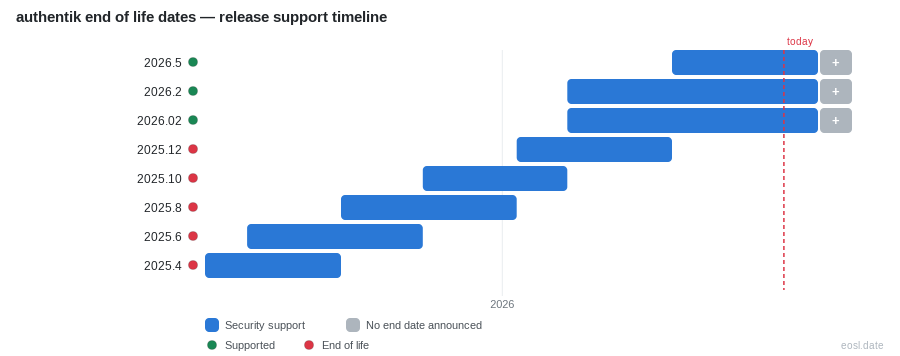
Currently Supported authentik Releases - Active EOS/EOSL Support (3)
authentik End of Life (EOL) Releases - No Longer Supported (10)
| Release | Released | Supported | Latest |
|---|---|---|---|
| 2026.2 | (8 months ago) | (2 months ago) | 2026.2.7 (2 months ago) |
| 2025.12 | (9 months ago) | (5 months ago) | 2025.12.6 (5 months ago) |
| 2025.10 | (1 year ago) | (8 months ago) | 2025.10.4 (9 months ago) |
| 2025.8 | (1 year and 2 months ago) | (9 months ago) | 2025.8.6 (9 months ago) |
| 2025.6 | (1 year and 5 months ago) | (1 year ago) | 2025.6.4 (1 year and 3 months ago) |
| 2025.4 | (1 year and 6 months ago) | (1 year and 2 months ago) | 2025.4.4 (1 year and 3 months ago) |
| 2024.12 | (1 year and 10 months ago) | (1 year and 6 months ago) | 2024.12.5 (1 year and 7 months ago) |
| 2023.10 | (3 years ago) | (2 years and 6 months ago) | 2023.10.7 (2 years and 9 months ago) |
| 2022.12 | (3 years and 10 months ago) | (3 years and 8 months ago) | 2022.12.3 (3 years and 8 months ago) |
| 2021.12 | (4 years and 10 months ago) | (4 years and 8 months ago) | 2021.12.5 (4 years and 10 months ago) |
Running an IdP that no longer gets patches is a quiet risk, so this page tracks authentik end of life dates for every open source build. It shows when each build was released, when support stops, and what to do before your SSO logins go unpatched. As of late October 2026, 2026.8 is the latest build.
authentik End of Life Dates by Version
Support follows a rolling window: only the newest builds stay patched, and an older line gets its end date the day its successor ships. Everything older than the rows marked open has ended. Maintenance stops on the date shown, and the tracker behind these dates is free to follow through an RSS feed or a calendar feed. The dates below were checked on 22 October 2026.
| Release | Released | Support end date |
|---|---|---|
| 2026.8 | 18 Aug 2026 | Open |
| 2026.5 | 22 May 2026 | Open |
| 2026.2 | 24 Feb 2026 | 18 Aug 2026 |
| 2025.12 | 13 Jan 2026 | 22 May 2026 |
| 2025.10 | 27 Oct 2025 | 24 Feb 2026 |
| 2025.8 | 20 Aug 2025 | 13 Jan 2026 |
Which Supported Release Still Gets Security Fixes
The policy is simple: the current release and one version back get security fixes, and nothing older does. With a new release every 3 months, a build you install today stays patched for roughly six months. Users on 2026.2 or earlier now run a server with no upstream patches, so treat 2026.5 as your floor.
How the Release Cadence Works for authentik Upgrades
Around 2024 the team said it was moving to a release every two months, so new features would ship sooner and bundles would stay small. The calendar has since settled near quarterly. Each release adds new features and performance work, and community feedback shapes what lands next, so the release cadence is worth budgeting for like any other maintenance task. Each new feature release reaches customers on the enterprise plan along the same line.
Reading the Release Notes Before You Upgrade
Read the release notes first. Each one lists the changelog and upgrade steps, and some come with a release walkthrough video. Then check the documentation for the api, blueprints, integrations, providers, policies and flows you rely on, because a changed configuration key is the usual cause of a failed upgrade.
Breaking Changes: Redis, PostgreSQL and Logout
Release 2025.10 removed Redis as a required service, the biggest infrastructure shift in recent history. The work took four releases: PostgreSQL advisory locks first, then session storage, then the worker, and finally the cache and websocket traffic. Since 2025.10, authentik needs only PostgreSQL as its database, so any Redis container left in your stack is dead weight, and the old Redis settings can simply be deleted. A stack that skipped that release should step through it during migration rather than jump straight to a newer build.
The same release added single logout. SAML single logout and OIDC front-channel and back-channel logout mean ending a session in authentik can sign you out of every connected app. Test it with your SCIM-provisioned apps before you rely on it.
Choosing an authentik Release to Run
Pick the newest stable build you can test, not the oldest one that is still supported. Whether you deploy with Docker Compose or Kubernetes, the installation steps stay the same between lines, so a self-hosted administrator can rehearse the upgrade on a staging deployment first. Check that your LDAP and OAuth2 setups behave the same afterwards. When your build is within one release of falling out of the window, plan the move before authentik end of life reaches it.
- Back up your PostgreSQL database.
- Read the notes for every line you skip.
- Upgrade a staging copy and log in with a test account.
- Roll production once the staging login works.
Identity Provider and Single Sign-On Risk on Old Builds
An identity provider sits in front of every login, so a stale build exposes more than one app. Once the platform stops getting security patches, a flaw in its authentication code can give an attacker access to all your connected applications, including those behind MFA or passkeys. The admin interface is the prize, and one weak spot is enough to gain access to it. Teams on the source available enterprise tier get support contacts, but the open source project sets the end dates above, and the protocol and identity layer is the part that must stay current. A single sign-on outage on an old build is also harder to recover from, since no one upstream will still be fixing it.