BIND 9 End of Life (EOL) Dates and End of Support (EOS) Dates
BIND 9 end of life (EOL) and end of support (EOS) dates: 2 BIND 9 versions have reached EOL, including BIND 9 9.18 (ESV) (LTS) (EOL date: Jun 30, 2026) — no longer receiving security updates or patches. BIND 9 9.21.28 is the current supported release — 2 versions in active support. Also see BigBlueButton lifecycle dates for related end-of-life information.
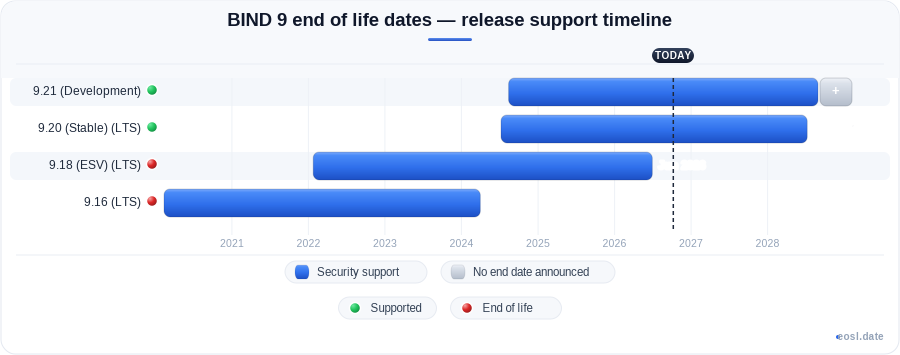
Currently Supported BIND 9 Releases - Active EOS/EOSL Support (2)
BIND 9 End of Life (EOL) Releases - No Longer Supported (2)
If you run a DNS server on BIND, the BIND 9 end of life schedule tells you how long your name server keeps receiving fixes from the Internet Systems Consortium (ISC). This guide lists the date each branch stops being maintained, explains how ISC picks those dates, and shows what to do before your branch is retired. The headline for 2026: the 9.18 branch has closed, so any DNS setup still on it now runs without upstream security help.
BIND 9 End of Life Dates by Branch
ISC maintains BIND 9 as overlapping branches, and every branch carries its own retirement date. The table gathers the branches people ask about most, using ISC's published schedule and the endoflife.date tracker as of late October 2026.
| Branch | Type | First release | Retirement | Last release seen |
|---|---|---|---|---|
| 9.21 | Development | 13 Aug 2024 | 24 months, then re-labelled | 9.21.27 (9 Oct 2026) |
| 9.20 | Current | 8 Jul 2024 | Q2 2028 | 9.20.30 (12 Oct 2026) |
| 9.18 | ESV | 24 Jan 2022 | June 2026 (closed) | 9.18.50 (8 Jun 2026) |
| 9.16 | Retired | 12 Feb 2020 | 31 Mar 2024 | 9.16.50 (3 Apr 2024) |
| 9.11 | Retired | Older | March 2022 | None tracked |
BIND 9.18 retired in June 2026
The 9.18 line served for about four and a half years. Its final point release, 9.18.50, shipped on 8 June 2026 and security support lapsed on 30 June 2026. Treat every 9.18 install as unmaintained: from now on a newly found flaw is fixed in 9.20 and newer only. The release notes for the last 9.18 builds carry the closing statement, and ISC's own site now marks the branch as finished.
BIND 9.20 and 9.21 outlook
The 9.20 branch is the one to be on today, with upstream coverage planned through Q2 2028. The 9.21 branch is the odd-numbered line that feeds the next major version. A 9.22 release was expected in 2026, but ISC pushed it to at least Q4 2026, so 9.21 stays the working branch longer than the usual 24 months.
Older branches: 9.16 and 9.11
The 9.16 branch closed on 31 March 2024, and 9.11 was retired in March 2022. A DNS machine on 9.11 or 9.16 is missing years of fixes for every zone it serves. Distribution builds are the one wrinkle, which the vendor section below covers, because Red Hat kept patching its own 9.11 packages after ISC stopped.
How the EOL Policy and Release Cycle Work
Once you see the cycle, you can predict the next retirement instead of waiting for an announcement. BIND is open source DNS software, and ISC publishes the rules in its Software Support Policy and Version Numbering knowledgebase article, which also explains the lifecycle every major version follows. A feature matrix in the same knowledgebase shows what each branch added or removed.
Stable branches and the extended support version
Even-numbered branches (9.16, 9.18, 9.20) are the stable lines meant for real traffic. A new stable branch gets feature updates and bug fixes for roughly twelve months, then moves to the extended support version, where only critical fixes arrive, and finally to security patches only. The whole stable branch lifetime is about four years. The ESV phase is why 9.18 ran longer than a plain twelve-month window.
Development releases
Odd-numbered lines (9.19, 9.21) come off the main branch and are kept for 24 months. They are not for production: a point release may break backward behavior, and a flaw is handled as an ordinary bug, without a separate advisory. After the window, the stabilised line is re-labelled and released as the next stable branch. The 24-month retirement window applies equally whether BIND acts as an authoritative name server for a DNS zone, a recursive resolver, or both.
Security fixes and CVE patches
Once a branch retires, ISC stops investigating vulnerabilities in that DNS software. Compare two flaws fixed in 9.18.16: CVE-2023-2828, where cache memory could exceed the configured max-cache-size limit, and CVE-2023-2911, where a stale-data lookup could loop until named crashed. Both were fixed while 9.18 was supported. A comparable CVE found today gets no 9.18 fix, and any security support you need must come from a newer branch or a vendor. The same goes for a vulnerability in DNSSEC validation of a signed zone: the fix lands only in live branches. In short, treat security fixes as the real deadline.
Bug fixes and feature updates
Before retirement, a branch still collects bug fixes: 9.18.18, for example, closed a TCP assertion failure and a dnssec-policy problem with zones whose TTL exceeded one day. As a branch ages, feature updates stop first when it enters the ESV phase, then only critical fixes follow, and after retirement nothing ships.
Supported Platforms Before an End-of-Life Date
ISC tests each new branch against the major operating systems of the day and checks that it can still load and serve a DNS zone. In general, a branch supports an OS until either the branch or that OS reaches EOL, whichever comes first. The supported platforms table in ISC's knowledgebase lists 9.18 as ending Q2 2026 and 9.20 as ending Q2 2028, so check it before choosing a host.
Debian and Ubuntu LTS releases
A Debian release is officially covered until one year after the next stable version appears, then it moves to Debian LTS. ISC does not officially support running released BIND builds on Debian LTS, though a regression found in an ESV there is fixed at low priority. Ubuntu works similarly: BIND covers an Ubuntu Long Term Support (LTS) release through its maintenance updates period, while Extended Security Maintenance is unsupported. Ubuntu interim releases last only nine months, so ISC makes no promise for them.
RHEL, CentOS and Fedora
For Red Hat Enterprise Linux (RHEL), an ESV supports a release until the end of Maintenance Support 2, or the branch EOL, whichever is first. RHEL 8 left that window in May 2024, while RHEL 9 runs to May 2027 and RHEL 10 to May 2030. CentOS 8 Stream ended in May 2024, and Fedora simply tracks its latest release.
Operating system requirements
A retired OS or an old OpenSSL can block an upgrade, so check the baseline: a C11 compiler, POSIX threads, IPv6 with the RFC 3542 advanced socket API, OpenSSL 1.0.2 or newer, and libuv. Any Unix-like system meeting that may build BIND, but only platforms in ISC's continuous integration runs count as fully supported. Windows Server and Linux without NPTL are listed as unsupported. If your OpenSSL is older than the minimum, the host cannot run current BIND at all, so the OS upgrade may come before the BIND upgrade.
Extended Support, Security Patches and Upgrade Planning
When your branch closes you have two roads: pay someone to carry it, or move to a live branch. Most teams do the second, and the first is a bridge, not a plan.
Support options and subscriptions
ISC sells a support subscription in three paid tiers. Gold support promises a 30-minute critical response around the clock, silver support one hour around the clock, and bronze support two hours in business hours. The free basic tier relies on the community mailing list. Paid tiers also get vulnerability warnings five days ahead, against three for basic users. Subscribers can use the Supported Preview edition too, which the public trackers leave out. Compare the support options against what an outage on your resolvers would cost.
Vendor backports of security patches
Distribution packages follow their own clocks. When ISC announced the 9.11 retirement, Red Hat's support article explained that the 9.11.4 package in Red Hat Enterprise Linux 7 stays supported as long as that release does. Backported security patches mean your package number can look old while one specific patch is present. Ask the vendor, because the ISC version tells you little. Still, a vendor build only helps with the flaws the vendor chooses to cover, so one patch note is not a full guarantee.
Upgrading from 9.18 to 9.20
Plan the move as a staged change, because DNSSEC settings are where upgrades bite. A known 9.18 issue: type primary zones using dnssec-policy without allow-update or update-policy, and any type secondary zone using dnssec-policy, need inline-signing yes; or named will not start. Read ISC's article on changes between 9.18 and 9.20 first, then follow this order:
- List every zone that uses dnssec-policy and add inline-signing where required.
- Run
named-checkconf -zagainst the new version to load each zone file. - Upgrade a secondary first and watch zone transfers and DNSSEC logs.
- Upgrade the primary once the secondary has stayed clean for a full refresh cycle.
Backward compatibility is good within a line, but a major version can drop deprecated options, so retest each zone before the final cutover.
Mailing list, knowledgebase and GitLab
Retirement news arrives first on the bind-announce mailing list, which also carries version and vulnerability notices; use the bind-users list for questions. The ISC knowledgebase holds the retirement table and the Administrator Reference Manual covers configuration. Download source from the ISC site, or install packages for Ubuntu, Debian, CentOS and Fedora, or pull the official Docker image. Open bugs and fixes are public on ISC's GitLab, and ISC's documentation lists known issues per branch.
Bug fixes in retired branches
Do not wait for a back-port: after the retirement date no 9.18 fix will ship. A DNS outage reaches mail, web and every API behind a zone you host. A crash fixed in 9.20 stays unfixed in 9.18, so the bug fixes you need are an upgrade trigger, not something to request from upstream.