Apache Maven End of Life (EOL) Dates and End of Support (EOS) Dates
Apache Maven end of life (EOL) and end of support (EOS) dates: 9 Apache Maven versions have reached EOL, including Apache Maven 3.8 (EOL date: Jun 14, 2025) — no longer receiving security updates or patches. Apache Maven 3.10.2 is the current supported release — 2 versions in active support. Also see Apache Ant EOSL information for related end-of-life information.
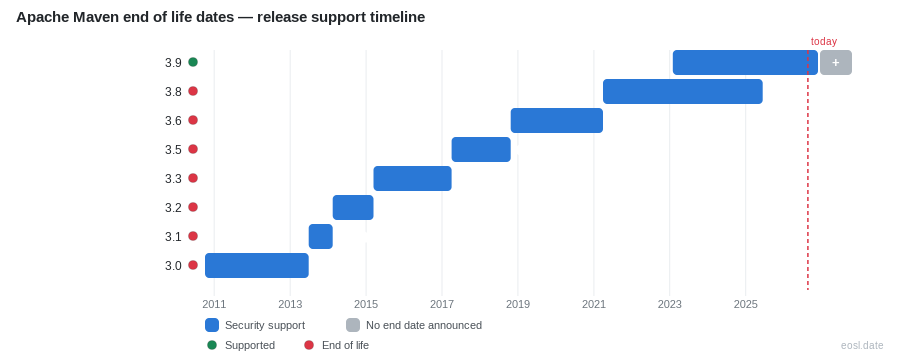
Currently Supported Apache Maven Releases - Active EOS/EOSL Support (2)
Apache Maven End of Life (EOL) Releases - No Longer Supported (9)
| Release | Released | Support | Latest |
|---|---|---|---|
| 3.8 | (5 years and 7 months ago) | (1 year and 5 months ago) | 3.8.9 (1 year and 5 months ago) |
| 3.6 | (8 years ago) | (5 years and 7 months ago) | 3.6.3 (7 years ago) |
| 3.5 | (9 years and 7 months ago) | (8 years ago) | 3.5.4 (8 years and 5 months ago) |
| 3.3 | (11 years and 8 months ago) | (9 years and 7 months ago) | 3.3.9 (11 years ago) |
| 3.2 | (12 years and 9 months ago) | (11 years and 8 months ago) | 3.2.5 (11 years and 11 months ago) |
| 3.1 | (13 years and 4 months ago) | (12 years and 9 months ago) | 3.1.1 (13 years and 2 months ago) |
| 3.0 | (16 years and 1 month ago) | (13 years and 4 months ago) | 3.0.5 (13 years and 9 months ago) |
| 2 | (20 years and 6 months ago) | (12 years and 9 months ago) | 2.2.1 (17 years and 3 months ago) |
| 1 | (22 years and 4 months ago) | (12 years and 9 months ago) | 1.1 (19 years and 4 months ago) |
Your build tool needs fixes as much as your code does, so Apache Maven end of life is the date after which a version stops getting them. The Maven team backs only the newest Maven 3.10 and Maven 3.9 lines, and every older Java release is on its own. This guide shows where your installation stands, what each series status means and how to move forward.
Apache Maven End of Life: Bug Fixes and Security Fixes Policy
The Apache Maven team maintains the last version of the last two series of GA releases. Anything older has reached its end of life, and no bug fixes, no security fixes and no new features are produced for it. A newly reported security vulnerability is only checked against lines that are still maintained, so an old installation can stay exposed indefinitely.
Maven does not distinguish between EOL and end of support; it uses only the first term. The project follows semantic versioning, which makes a move inside the same series fairly safe. The Apache Software Foundation publishes every notice on its project site, and routine maintenance of the active lines continues as usual.
For any software project this matters in three ways:
- The build tool resolves dependencies from a remote repository, runs the plugins listed in your POM and packages every artifact, so one flaw reaches the whole software project.
- Plugin maintainers raise their minimum Maven level, so retired Maven releases cannot use updated plugins, and the parent POM of shared software keeps drifting.
- Build agents in CI pipelines keep repeating the same exposure on every run.
Maven EOL Dates by Release Date and Version
Use the table below to match your installed version against its status. The release date comes from the official history page, and the status shows whether that line still receives updates.
| Version | Released | Required Java | Status |
|---|---|---|---|
| 4.0.0-rc-7 | 2026-09-24 | 17 | Release candidate |
| 3.10.0 | 2026-09-27 | 8 | Supported |
| 3.9.16 | 2026-05-13 | 8 | Supported |
| 3.8.9 | 2025-06-14 | 7 | Ended |
| 3.6.3 | 2019-11-25 | 7 | Ended |
| 3.3.9 | 2015-11-14 | 7 | Ended |
| 2.2.1 | 2009-08-06 | 5 | Ended |
| 1.1 | 2007-06-25 | 1.4 | Ended |
Maven 3.10 and Maven 3.9 Release Lines
The newest GA release is 3.10.0, published on 27 September 2026, and the previous series continues with 3.9.16. Both need Java 8 as the Java version, and the project's plugin family stays compatible down to 3.9.0. Each of the Maven releases comes with an announce post, release notes and reference documentation.
Early Version History
Jason van Zyl created the tool in 2002, and Wikipedia records the first critical milestone in July 2004. Each later major version stayed mostly backward compatible. The official release history page links the announce post, the release notes and the reference documentation of every build, so it is the first place to look for any date.
Maven Versions No Longer Supported
Version 3.8.9 and everything before it is no longer supported in any way. New releases of each plugin need 3.9.0 or later, and the old pages remain online purely for reference. Upgrade first; unlike a living tool, a retired one cannot be patched. Then ask the mailing list for help if your project breaks. Maven 3.8.9 itself still ran on Java 7, which is one reason many teams stayed on it so long.
Maven 3.8 Plugin Compatibility
Plugin authors target 3.9.0 as the compatibility floor. A project stuck on that older series can keep running its current plugin versions, but plugins stop gaining capabilities, and a future dependency bump may stop resolving. Pin the version of all plugins in the POM and in the parent POM so the build stays reproducible until you upgrade.
Maven 2 Last Plugin Versions
The official notice titled "End Of Life Apache Maven 2.x" states that the last release was 2.2.1 in 2009. Security vulnerability reports are not checked against that branch, the download pages are removed and the documentation moved to an archive. Anyone forced to stay can read the list of final plugin versions that still work; the table below shows a sample.
| Plugin | Last version for Maven 2 | Date |
|---|---|---|
| compiler | 3.3 | 2015-03-26 |
| surefire | 2.19.1 | 2016-01-03 |
| jar | 2.6 | 2015-03-09 |
| clean | 2.6.1 | 2014-10-26 |
Maven 1 Original Release Line
Maven 1 shipped in 2004, and its last release was 1.1 in June 2007. Its artifacts still sit in the central repository, and you can download them from a mirror, but the line is not maintained. This early era is also tied to Ant scripts, which is why many teams later moved to Gradle for a software project that outgrew XML.
Maven 4 New Features and End of Support Outlook
Maven 4 is a major release that is still a release candidate, with 4.0.0-rc-7 published on 24 September 2026 and a GA release expected once feedback settles. Because Maven 4 needs Java 17, retiring an older runtime comes closer when you adopt it, and the new JDK baseline is a project decision you should schedule early. The table lists the latest builds; every row has an announce post, release notes and reference documentation.
| Build | Announce | Release notes | Reference documentation |
|---|---|---|---|
| 4.0.0-rc-7 | announce | release notes | reference documentation |
| 4.0.0-rc-6 | announce | release notes | reference documentation |
| 4.0.0-rc-5 | announce | release notes | reference documentation |
| 4.0.0-rc-4 | announce | release notes | reference documentation |
| 3.10.0 | announce | release notes | reference documentation |
| 3.10.0-rc-1 | announce | release notes | reference documentation |
| 3.9.16 | announce | release notes | reference documentation |
| 3.9.15 | announce | release notes | reference documentation |
| 3.9.14 | announce | release notes | reference documentation |
| 3.9.13 | announce | release notes | reference documentation |
| 3.8.9 | announce | release notes | reference documentation |
| 3.8.8 | announce | release notes | reference documentation |
Known Compatibility Issues in Maven 4 Release Candidates
The GitHub release pages for Maven 4 list stricter POM validation, changes to transitive dependency resolution and classloading breaking changes. Every plugin and extension written for older APIs needs testing against the candidate, along with the dependencies it resolves from the central repository, and the dependency updates in each candidate can shift results. GitHub also shows the known issues, such as a macOS library blocked on first use.
Check Which Maven You Run
Open a terminal and run the command below; it prints the Maven version and the JDK in use. Use mvn -v as the short form on any machine, including a CI agent.
mvn --versionMove to a Supported Release
Start with an upgrade in a branch, so the main project keeps shipping while you test.
- Pick the 3.9 or 3.10 series as the target; both run on Java 8 and a recent JDK.
- Read your POM for old plugin pins. The project object model keeps its convention over configuration defaults, so the pom should need little change.
- Check
settings.xmlfor repository entries and keep the wrapper script aligned with the new version. - Run
mvn clean verify, compare the build artifact outputs and the dependencies resolved from your repository with the old run, then update the project documentation.
The upgrade is done once the full build lifecycle passes on the target version, every plugin is current and the XML in the parent POM carries no retired settings. Check the lifecycle bindings in each POM, and keep a second repository mirror ready for offline builds. A Maven 4 trial can follow later in a separate branch.