Apache Ant End of Life (EOL) Dates and End of Support (EOS) Dates
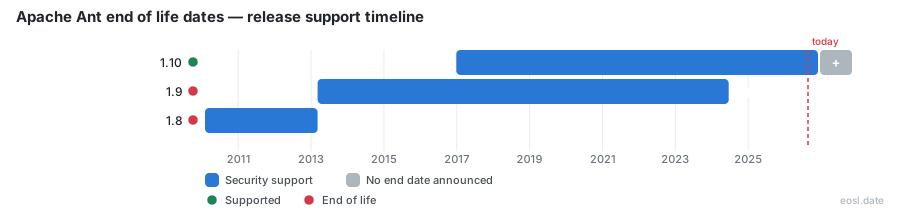
Apache Ant end of life (EOL) and end of support (EOS) dates: 2 Apache Ant versions have reached EOL, including Apache Ant 1.9 (EOL date: Jun 19, 2024) — no longer receiving security updates or patches. Apache Ant 1.10.18 is the current supported release. Also see Apache Tomcat EOSL information for related end-of-life information.
Currently Supported Apache Ant Releases - Active EOS/EOSL Support (1)
| Release | Released | Security Support | Latest |
|---|---|---|---|
| 1.10 | (9 years and 10 months ago) | Active | 1.10.18 (2 months ago) |
Apache Ant End of Life (EOL) Releases - No Longer Supported (2)
Wondering about Apache Ant end of life for your stack? In short, only the 1.10 line still receives fixes, and the 1.9 series ended in 2024. Ant is a Java build tool and command-line tool for building Java applications, so a stale copy leaves your pipeline exposed. Below you will see which releases are covered, how the project decides, and where related tools stand.
Apache Ant End of Life Status for Each Release Series
Ant publishes no fixed schedule, so the clearest view comes from the support table kept on endoflife.date. Here is the newest build of every release series:
| Release series | Released | Security support | Latest |
|---|---|---|---|
| 1.10 | 27 Dec 2016 | Yes | 1.10.18 (6 Sep 2026) |
| 1.9 | 7 Mar 2013 | Ended 19 Jun 2024 | 1.9.16 (13 Jul 2021) |
| 1.8 | 2 Feb 2010 | Ended 7 Mar 2013 | 1.8.4 (22 May 2012) |
Treat the 1.10 line as your only supported release. Every older version has fallen out of security support, and each year it stays in production widens the gap.
Ant 1.10: The Only Supported Release
Ant 1.10 arrived in December 2016 and still gets regular bug fixes and enhancements. Version 1.10.18, shipped on 6 September 2026, closes a potential path traversal flaw in the ftp and scp tasks, a security vulnerability worth patching quickly if your builds touch remote servers.
Ant 1.9.x EOL Arrived in June 2024
The Ant PMC voted on 19 June 2024 to end this series and urged users to move to 1.10.x. The final 1.9 build, 1.9.16, appeared in July 2021, so a copy that old is missing years of fixes.
Ant 1.8 Is Obsolete and No Longer Supported
Security support for 1.8 stopped on 7 March 2013, and its last build dates from May 2012. If Ant 1.8 still lurks in an old CI image, replace it instead of working around it.
How the Ant PMC Sets End-of-Life Dates
Unlike a commercial vendor, Ant has no formal support policy. Status changes come from a vote by the project management committee, announced afterwards in the news section of the Apache Ant site. As a volunteer-driven, open-source effort under the Apache Software Foundation, it moves when maintainers agree, not when a contract says so.
No Strict Release Cadence for Ant Releases
Ant ships when maintainers have fixes ready, not on a calendar. Because there is no fixed cadence, there is also no fixed end date: a series stays supported until the PMC votes to end it, as it did for 1.9.x. Watch the news page rather than guessing.
Retired Apache Ant Subprojects and Antlibs
Ant's ecosystem has shrunk over time. When the PMC votes to archive a subproject, its resources are removed or made read only and development stops, although a growing community could reactivate it. In June 2026 the .NET and VSS antlibs received this treatment. Apache Ivy, the usual companion for dependency management, and the Props Antlib remain active (the latter openly declines to promise backwards compatibility), so only the archived projects are left without support. Ask the Ant mailing lists about any archived project.
IvyDE Retired in 2023
On 26 November 2023 the PMC voted to archive IvyDE, the IDE-side companion to Ivy. If a plugin in your editor still depends on it, expect no further updates.
EasyAnt Retired in 2016
The oldest casualty is EasyAnt, archived on 13 December 2016. Any build still leaning on its modules has been unsupported for close to a decade.
Salesforce Ant Migration Tool Is No Longer Supported
A different kind of Ant news shook Salesforce teams. Its end-of-life notice arrived with the Spring '24 release: the last update came with Winter '24, and the tool receives no new functionality. It still runs against future API versions, so nothing breaks overnight, but you should watch for limits after v59.0.
What Is the Ant Migration Tool?
It is a Java and Ant-based command-line utility for moving metadata between a local directory and a Salesforce org. Compared with change sets or manual setup, deploying to several environments became simpler, including scheduled and repeated runs.
Alternative: Migrate to the Salesforce CLI
Salesforce names its Salesforce CLI as the recommended replacement: fully supported, easier to set up and richer in options. An extension pack brings it into VS Code, and Code Builder users need no setup at all. Because the old tool still works, plan to migrate soon rather than in a rush.
Is Apache Ant Obsolete? Linux Package Notes
No. Ant keeps shipping releases on the 1.10 line and is still maintained. Confusion usually starts elsewhere: in July 2017 an Arch Linux forum member found the apache-ant package marked obsolete, with no alternative named. The upstream effort is still supported on the 1.10 line, whose build files and targets work as they always have.
What a Flagged Linux Package Tells You
Distribution flags describe how a package is shipped, not whether the upstream effort has stopped. Before replacing Ant, compare the table above with your packaged version and read the news on the project site.
Security Reports for Releases That Reach End-of-Life
Ant lists each fixed issue on its security reports page, and every security report names the versions affected. The ftp and scp path traversal fix landed in the supported 1.10 line, so anyone on an ended series must upgrade to receive it. Ivy 2.6.0 likewise fixed a vulnerability, which is a reminder to update companion tools along with Ant itself.
What to Do Before Your Ant Version Reaches EOL
- Check which version you run and compare it with the status table.
- Download the latest 1.10 binary or source distribution from the Apache site.
- Move off any series without support, then skim the documentation bundled with each distribution for changed behaviour.
- Re-run your builds on a branch before switching production pipelines.
Check Your Installed Version with ant -version
Run ant -version in a terminal. If the reply starts with 1.9 or lower, schedule the upgrade now, because that version already sits outside support.