Apache Artemis End of Life (EOL) Dates and End of Support (EOS) Dates
Apache Artemis end of life (EOL) and end of support (EOS) dates: 58 Apache Artemis versions have reached EOL, including Apache Artemis 2.56 (EOL date: Sep 09, 2026) — no longer receiving security updates or patches. Apache Artemis 2.57.0 is the current supported release. Also see Apache Ant end of life dates for related end-of-life information.
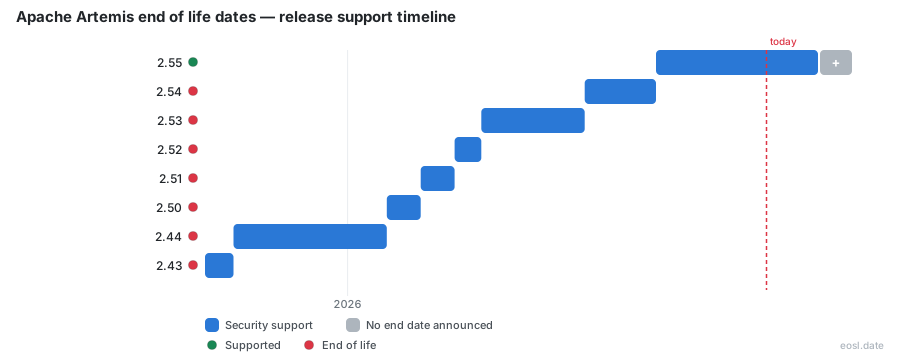
Currently Supported Apache Artemis Releases - Active EOS/EOSL Support (1)
| Release | Released | Security Support | Latest |
|---|---|---|---|
| 2.57 | (2 months ago) | Active | 2.57.0 (2 months ago) |
Apache Artemis End of Life (EOL) Releases - No Longer Supported (58)
| Release | Released | Security Support | Latest |
|---|---|---|---|
| 2.56 | (2 months ago) | (2 months ago) | 2.56.0 (3 months ago) |
| 2.55 | (4 months ago) | (2 months ago) | 2.55.0 (4 months ago) |
| 2.54 | (6 months ago) | (4 months ago) | 2.54.0 (6 months ago) |
| 2.53 | (8 months ago) | (6 months ago) | 2.53.0 (8 months ago) |
| 2.52 | (8 months ago) | (8 months ago) | 2.52.0 (8 months ago) |
| 2.51 | (9 months ago) | (8 months ago) | 2.51.0 (9 months ago) |
| 2.50 | (9 months ago) | (9 months ago) | 2.50.0 (10 months ago) |
| 2.44 | (1 year ago) | (9 months ago) | 2.44.0 (1 year ago) |
| 2.43 | (1 year and 1 month ago) | (1 year ago) | 2.43.0 (1 year and 1 month ago) |
| 2.42 | (1 year and 4 months ago) | (1 year and 1 month ago) | 2.42.0 (1 year and 4 months ago) |
| 2.41 | (1 year and 6 months ago) | (1 year and 4 months ago) | 2.41.0 (1 year and 6 months ago) |
| 2.40 | (1 year and 8 months ago) | (1 year and 6 months ago) | 2.40.0 (1 year and 8 months ago) |
| 2.39 | (1 year and 11 months ago) | (1 year and 8 months ago) | 2.39.0 (1 year and 11 months ago) |
| 2.38 | (2 years and 1 month ago) | (1 year and 11 months ago) | 2.38.0 (2 years and 1 month ago) |
| 2.37 | (2 years and 3 months ago) | (2 years and 1 month ago) | 2.37.0 (2 years and 3 months ago) |
| 2.36 | (2 years and 3 months ago) | (2 years and 3 months ago) | 2.36.0 (2 years and 3 months ago) |
| 2.35 | (2 years and 5 months ago) | (2 years and 3 months ago) | 2.35.0 (2 years and 5 months ago) |
| 2.34 | (2 years and 5 months ago) | (2 years and 5 months ago) | 2.34.0 (2 years and 5 months ago) |
| 2.33 | (2 years and 8 months ago) | (2 years and 5 months ago) | 2.33.0 (2 years and 8 months ago) |
| 2.32 | (2 years and 9 months ago) | (2 years and 8 months ago) | 2.32.0 (2 years and 9 months ago) |
| 2.31 | (3 years and 2 months ago) | (2 years and 9 months ago) | 2.31.2 (3 years ago) |
| 2.30 | (3 years and 4 months ago) | (3 years and 2 months ago) | 2.30.0 (3 years and 4 months ago) |
| 2.29 | (3 years and 5 months ago) | (3 years and 4 months ago) | 2.29.0 (3 years and 5 months ago) |
| 2.28 | (3 years and 9 months ago) | (3 years and 5 months ago) | 2.28.0 (3 years and 9 months ago) |
| 2.27 | (4 years ago) | (3 years and 9 months ago) | 2.27.1 (3 years and 11 months ago) |
| 2.26 | (4 years and 2 months ago) | (4 years ago) | 2.26.0 (4 years and 2 months ago) |
| 2.25 | (4 years and 2 months ago) | (4 years and 2 months ago) | 2.25.0 (4 years and 2 months ago) |
| 2.24 | (4 years and 3 months ago) | (4 years and 2 months ago) | 2.24.0 (4 years and 3 months ago) |
| 2.23 | (4 years and 5 months ago) | (4 years and 3 months ago) | 2.23.1 (4 years and 5 months ago) |
| 2.22 | (4 years and 6 months ago) | (4 years and 5 months ago) | 2.22.0 (4 years and 6 months ago) |
| 2.21 | (4 years and 8 months ago) | (4 years and 6 months ago) | 2.21.0 (4 years and 8 months ago) |
| 2.20 | (4 years and 11 months ago) | (4 years and 8 months ago) | 2.20.0 (4 years and 11 months ago) |
| 2.19 | (5 years and 1 month ago) | (4 years and 11 months ago) | 2.19.1 (4 years and 9 months ago) |
| 2.18 | (5 years and 3 months ago) | (5 years and 1 month ago) | 2.18.0 (5 years and 3 months ago) |
| 2.17 | (5 years and 9 months ago) | (5 years and 3 months ago) | 2.17.0 (5 years and 9 months ago) |
| 2.16 | (6 years ago) | (5 years and 9 months ago) | 2.16.0 (6 years ago) |
| 2.15 | (6 years and 2 months ago) | (6 years ago) | 2.15.0 (6 years and 2 months ago) |
| 2.14 | (6 years and 4 months ago) | (6 years and 2 months ago) | 2.14.0 (6 years and 4 months ago) |
| 2.13 | (6 years and 6 months ago) | (6 years and 4 months ago) | 2.13.0 (6 years and 6 months ago) |
| 2.12 | (6 years and 7 months ago) | (6 years and 6 months ago) | 2.12.0 (6 years and 7 months ago) |
| 2.11 | (6 years and 10 months ago) | (6 years and 7 months ago) | 2.11.0 (6 years and 10 months ago) |
| 2.10 | (7 years and 2 months ago) | (6 years and 10 months ago) | 2.10.1 (7 years and 1 month ago) |
| 2.9 | (7 years and 5 months ago) | (7 years and 2 months ago) | 2.9.0 (7 years and 5 months ago) |
| 2.8 | (7 years and 6 months ago) | (7 years and 5 months ago) | 2.8.1 (7 years and 6 months ago) |
| 2.7 | (7 years and 8 months ago) | (7 years and 6 months ago) | 2.7.0 (7 years and 8 months ago) |
| 2.6 | (8 years and 6 months ago) | (7 years and 8 months ago) | 2.6.4 (7 years and 10 months ago) |
| 2.5 | (8 years and 8 months ago) | (8 years and 6 months ago) | 2.5.0 (8 years and 8 months ago) |
| 2.4 | (9 years ago) | (8 years and 8 months ago) | 2.4.0 (9 years ago) |
| 2.3 | (9 years and 2 months ago) | (9 years ago) | 2.3.0 (9 years and 2 months ago) |
| 2.2 | (9 years and 3 months ago) | (9 years and 2 months ago) | 2.2.0 (9 years and 3 months ago) |
| 2.1 | (9 years and 6 months ago) | (9 years and 3 months ago) | 2.1.0 (9 years and 6 months ago) |
| 2.0 | (9 years and 8 months ago) | (9 years and 6 months ago) | 2.0.0 (9 years and 8 months ago) |
| 1.5 | (10 years ago) | (8 years and 8 months ago) | 1.5.6 (8 years and 9 months ago) |
| 1.4 | (10 years and 2 months ago) | (10 years ago) | 1.4.0 (10 years and 2 months ago) |
| 1.3 | (10 years and 5 months ago) | (10 years and 2 months ago) | 1.3.0 (10 years and 5 months ago) |
| 1.2 | (10 years and 10 months ago) | (10 years and 5 months ago) | 1.2.0 (10 years and 10 months ago) |
| 1.1 | (11 years and 2 months ago) | (10 years and 10 months ago) | 1.1.0 (11 years and 2 months ago) |
| 1.0 | (11 years and 6 months ago) | (11 years and 2 months ago) | 1.0.0 (11 years and 6 months ago) |
If you run this open source, Java-based message broker in production, the question behind Apache Artemis end of life is simple: which release of Apache ActiveMQ Artemis still gets fixes, and which one are you on? This open-source messaging project ships a new minor version every few weeks, and the community only keeps the newest line patched, so the software you deployed last spring may already be out of support today.
Apache Artemis End of Life: Current Status
The project itself is alive and moving fast. As of 26 October 2026 the newest minor line is 2.57, with 2.57.0 published on 9 September 2026, and it is the only line that still receives security fixes. Nobody has announced a shutdown of the broker, so "is it dead?" has a clear answer: no. The real question is narrower and more useful for you: is your version still supported?
Three different ideas hide behind the phrase, and mixing them up causes most of the confusion you see in forum threads:
- Project end: the whole broker is discontinued. This has not happened.
- Version end: a specific minor line stops receiving patches. This happens every time a new minor release ships.
- Investment end: new features stop landing. Artemis is the opposite, since it carries the bulk of the roadmap.
Artemis EOL Support Schedule and Version Support Status
Because the project publishes releases rather than a formal lifecycle policy, trackers such as endoflife.date infer each line's support status from the release calendar: a minor line is supported until the next minor line is published. That rule makes the schedule easy to read. The table below shows the recent lines and the date the support window closed for each, using the tracker's dates.
| Release line | Released | Security support | Support ended |
|---|---|---|---|
| 2.57 | 9 Sep 2026 | Yes (latest) | Still supported |
| 2.56 | 27 Aug 2026 | Ended | 9 Sep 2026 |
| 2.55 | 23 Jun 2026 | Ended | 27 Aug 2026 |
| 2.54 | 14 May 2026 | Ended | 23 Jun 2026 |
| 2.53 | 17 Mar 2026 | Ended | 14 May 2026 |
| 2.50 | 23 Jan 2026 | Ended | 11 Feb 2026 |
| 2.44 | 29 Oct 2025 | Ended | 23 Jan 2026 |
Read it as a clock that applies to all older versions at once. If your broker runs a line with "Ended" in the third column, every version upgrade you skipped is also a set of patches you never received. A broker on 2.44, for example, lost support on 23 January 2026, so by 26 October 2026 it has been unsupported for 276 days.
End of Support: How the Release Policy Works
The release policy is short: new work lands in the newest minor line, and bug fixes ship as the next minor or in point releases from the Apache Artemis team. Older versions are not maintained in parallel the way a long-term support branch would be, so the practical life of any given line of the Apache server is the gap between two minor releases, often only a few weeks to a few months. This is why end of support arrives so quickly for Artemis compared with older, slower-moving brokers.
Release lines are not all equal in length. Between 2.54 and 2.57 the gaps were roughly six weeks, nine weeks and two weeks. Plan for the shortest gap, not the average, when your DevOps team schedules maintenance windows, and read the Apache Artemis release notes before each one.
What Community Supported Really Means
You will sometimes read that an older line is "community supported". In practice that means volunteers may answer a question on the mailing list, not that anyone will cut a patch for you. Treat a community supported line, whether it runs on a single server or a whole cluster, as maintenance mode at best: you should not expect a new point release, bug fixes or security fixes for it.
Java Compatibility and Downloads for Past Releases
If you must keep running a line whose support window has closed, its build stays on the past releases page, so you can still reproduce that environment. Check the Java compatibility note on each entry before you pick a build, because Java compatibility changes between lines: the Apache Artemis releases from 2.44.0 onward list Java 17 or newer, while 2.43 and 2.42 list Java 17 to 22, and the release notes call out any Java compatibility change. You can pull the binary as a tar.gz or a ZIP, grab a Docker image, or resolve the artifacts through Maven. If you run containers, the Docker link on each entry is the quickest way to rebuild an old environment, and a Docker image saves you a manual install. The Apache Artemis documentation and release notes for each line sit beside the download links, and the documentation also covers the upgrade steps.
| Release | Published | Binary archive | Source distribution |
|---|---|---|---|
| 2.56.0 | 27 Aug 2026 | apache-artemis-2.56.0-bin.tar.gz | apache-artemis-2.56.0-source-release.tar.gz |
| 2.55.0 | 29 Jun 2026 | apache-artemis-2.55.0-bin.tar.gz | apache-artemis-2.55.0-source-release.tar.gz |
| 2.54.0 | 19 May 2026 | apache-artemis-2.54.0-bin.tar.gz | apache-artemis-2.54.0-source-release.tar.gz |
| 2.53.0 | 20 Mar 2026 | apache-artemis-2.53.0-bin.tar.gz | apache-artemis-2.53.0-source-release.tar.gz |
The download page and the tracker can differ by a few days for the same release, so rely on the page you are quoting. The source distribution is the archive to pick when you need to inspect or rebuild; only the source distribution lets you audit exactly what you run, which matters if you must rebuild a patched artifact yourself.
Apache ActiveMQ Artemis and the 2025 Project Split
Much of the end-of-life noise comes from a governance change. On 19 November 2025 the Apache ActiveMQ PMC voted to make Apache Artemis its own top-level project, with its own domain, mailing lists and issue tracker. Many engineers read that as Apache ActiveMQ being phased out, and Apache ActiveMQ documentation never said so. The opposite is closer to the truth: the Apache foundation removed the old "two flavors of one project" ambiguity, and each codebase now has its own community and governance.
What the split does signal is where the energy is. Apache Artemis carries most of the new architecture work, so it is the natural successor in practice even though it is no longer formally "ActiveMQ Next". The classic Apache ActiveMQ line, with its 6.2.x and 5.19.x streams, is stable, still ships point releases, and supported but sits closer to maintenance. If you manage middleware for a larger team, that difference matters more for your roadmap than any single end-of-support notice.
Feature Parity Between ActiveMQ Classic and Artemis
The two brokers overlap heavily but are not identical, so feature parity is never complete. Classic stores messages in KahaDB, while Artemis uses an asynchronous journal and offers high availability through replication. On the wire, Artemis is protocol-native and speaks several protocols at once:
- AMQP 1.0 and MQTT for device and cloud traffic
- STOMP and OpenWire for existing clients
- JMS, including Jakarta Messaging, for Java applications
Check each of those protocols against your clients: parity gaps decide whether moving off a line past its support date is feasible.
End-of-Life Vulnerability Example: CVE-2026-49364
A real advisory shows why running behind matters. CVE-2026-49364 is a critical information exposure in cluster discovery. When a cluster connection finds its peers through a discovery group, the broker listens for broadcasts on a UDP multicast address or a JGroups channel and trusts every one it receives. Nothing authenticates the sender, so an unauthenticated attacker on the discovery network can capture the cluster credentials during the first handshake and then connect to any broker as the cluster user.
The affected ranges explain the stakes. Maven artifacts published under org.apache.activemq through 2.44.0 are affected, and so are the ones under org.apache.artemis from 2.50.0 through 2.56.0. The upstream fix arrived in 2.57.0. A broker on 2.44.0 is therefore both out of support and vulnerable.
Mitigation Options for Affected Brokers
For brokers on lines past their support date, the cleanest mitigation is to upgrade to 2.57.0. If you cannot, HeroDevs offers Never-Ending Support, a commercial patch for old lines such as 2.19.4, and you can also remove the exposure by dropping the discovery group and listing static connectors for your brokers instead. Whichever route you choose, treat the cluster credentials on any exposed network as compromised and rotate them.
Unsupported Version Risk and the Stay, Upgrade or Migrate Decision Framework
Running an unsupported version rarely breaks on a specific day. The cost builds quietly in three places, and the Apache Artemis docs do not shield you from any of them; each one has a different owner in your organization.
Security Exposure
Brokers on lines past their support date receive no patches, so every new CVE stays open, and a published CVE is a public to-do list for attackers. The discovery-group advisory above is the proof: the fix never reached the older lines.
Compliance and Audit Findings
An enterprise audit will flag a message broker running an out-of-support Artemis release, because it no longer receives security fixes, and the finding often lands on whoever owns the production platform rather than on the application team.
Operational Cost and Staffing
Once a line is past its support window, each incident has no upstream fix, and the jump to a supported line keeps growing. An architect or engineer who has to cross several minor lines at once must read every set of upgrade notes in between, and each incident in the meantime has no vendor fix to point to.
Upgrading from One Artemis Version to the Next
Each release's notes include an "Upgrading from" section, and those sections are the real upgrade guide. Take our 2.44.0 broker moving to 2.57.0: it crosses the 2.50 line, where the Maven group changed from org.apache.activemq to org.apache.artemis, so build files need editing as well as the broker. Read the notes for every line you cross, in order, and upgrade a staging cluster first.
Migration Planning from ActiveMQ Classic
If you are still on classic Apache ActiveMQ, ask whether the Apache team still ships fixes for your Apache ActiveMQ line, since a migration to Apache Artemis is a bigger decision than a version bump. Use this order:
- Inventory every client, protocol and persistence setting you depend on.
- Test those clients against a staging Artemis broker.
- Move one low-risk queue and run both brokers in parallel.
- Cut over the rest once the numbers match.
Next Steps for Your Brokers
Pick the path by risk. If you are on the current line, stay and keep pace with each new minor release. If you are a few lines behind, upgrade now. If you are far behind or on classic Apache ActiveMQ, plan the migration in the same quarter. Either way, find out which version every one of your brokers is running before the next advisory does it for you.