Apache Kafka End of Life (EOL) Dates and End of Support (EOS) Dates
Apache Kafka end of life (EOL) and end of support (EOS) dates: 27 Apache Kafka versions have reached EOL, including Apache Kafka 4.0 (EOL date: Jul 03, 2026) — no longer receiving security updates or patches. Apache Kafka 4.4.0 is the current supported release — 4 versions in active support. Also see Apache ActiveMQ Classic end of life dates for related end-of-life information.
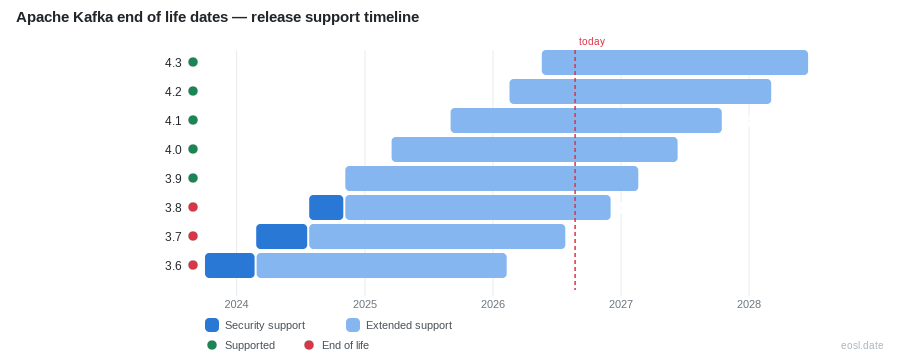
Currently Supported Apache Kafka Releases - Active EOS/EOSL Support (4)
| Release | Released | Support | Confluent Community software End of Support | Latest |
|---|---|---|---|---|
| 4.4 | (4 weeks and 2 days ago) | Active | (in 1 year and 11 months) | 4.4.0 (4 weeks and 2 days ago) |
| 4.3 | (5 months ago) | Active | (in 1 year and 7 months) | 4.3.2 (3 weeks and 2 days ago) |
| 4.2 | (8 months ago) | Active | (in 1 year and 3 months) | 4.2.2 (1 month and 2 weeks ago) |
| 4.1 | (1 year and 2 months ago) | Active | (in 11 months) | 4.1.2 (7 months ago) |
Apache Kafka End of Life (EOL) Releases - No Longer Supported (27)
| Release | Released | Support | Confluent Community software End of Support | Latest |
|---|---|---|---|---|
| 4.0 | (1 year and 7 months ago) | (4 months ago) | (in 6 months) | 4.0.2 (7 months ago) |
| 3.9 | (2 years ago) | (4 months ago) | (in 3 months) | 3.9.2 (8 months ago) |
| 3.8 | (2 years and 3 months ago) | (2 years ago) | (in 2 weeks and 6 days) | 3.8.1 (2 years ago) |
| 3.7 | (2 years and 8 months ago) | (2 years and 3 months ago) | (3 months ago) | 3.7.2 (1 year and 11 months ago) |
| 3.6 | (3 years and 1 month ago) | (2 years and 8 months ago) | (9 months ago) | 3.6.2 (2 years and 7 months ago) |
| 3.5 | (3 years and 4 months ago) | (3 years and 1 month ago) | (1 year and 2 months ago) | 3.5.2 (2 years and 11 months ago) |
| 3.4 | (3 years and 9 months ago) | (3 years and 4 months ago) | (1 year and 6 months ago) | 3.4.1 (3 years and 5 months ago) |
| 3.3 | (4 years and 1 month ago) | (3 years and 9 months ago) | (2 years ago) | 3.3.2 (3 years and 10 months ago) |
| 3.2 | (4 years and 6 months ago) | (4 years and 1 month ago) | (2 years and 4 months ago) | 3.2.3 (4 years and 1 month ago) |
| 3.1 | (4 years and 9 months ago) | (4 years and 1 month ago) | (2 years and 7 months ago) | 3.1.2 (4 years and 2 months ago) |
| 3.0 | (5 years and 1 month ago) | (4 years and 1 month ago) | (3 years ago) | 3.0.2 (4 years and 2 months ago) |
| 2.8 | (5 years and 6 months ago) | (4 years and 1 month ago) | (3 years and 5 months ago) | 2.8.2 (4 years and 2 months ago) |
| 2.7 | (5 years and 10 months ago) | (4 years and 11 months ago) | (3 years and 9 months ago) | 2.7.2 (5 years and 1 month ago) |
| 2.6 | (6 years and 3 months ago) | (4 years and 11 months ago) | (4 years and 1 month ago) | 2.6.3 (5 years ago) |
| 2.5 | (6 years and 6 months ago) | (6 years and 3 months ago) | (4 years and 6 months ago) | 2.5.1 (6 years and 3 months ago) |
| 2.4 | (6 years and 10 months ago) | (6 years and 6 months ago) | (4 years and 10 months ago) | 2.4.1 (6 years and 8 months ago) |
| 2.3 | (7 years and 4 months ago) | (6 years and 10 months ago) | (5 years and 3 months ago) | 2.3.1 (7 years ago) |
| 2.2 | (7 years and 7 months ago) | (6 years and 11 months ago) | (5 years and 7 months ago) | 2.2.2 (6 years and 11 months ago) |
| 2.1 | (7 years and 11 months ago) | (7 years and 7 months ago) | (5 years and 10 months ago) | 2.1.1 (7 years and 8 months ago) |
| 2.0 | (8 years and 3 months ago) | (7 years and 11 months ago) | (6 years and 3 months ago) | 2.0.1 (8 years ago) |
| 1.1 | (8 years and 7 months ago) | (8 years and 3 months ago) | (6 years and 6 months ago) | 1.1.1 (8 years and 3 months ago) |
| 1.0 | (9 years ago) | (8 years and 4 months ago) | (6 years and 11 months ago) | 1.0.2 (8 years and 4 months ago) |
| 0.11 | (9 years and 4 months ago) | (8 years and 4 months ago) | (7 years and 3 months ago) | 0.11.0.3 (8 years and 4 months ago) |
| 0.10 | (10 years and 5 months ago) | (8 years and 4 months ago) | (7 years and 8 months ago) | 0.10.2.2 (8 years and 4 months ago) |
| 0.9 | (10 years and 11 months ago) | (10 years and 5 months ago) | (8 years and 11 months ago) | 0.9.0.1 (10 years and 8 months ago) |
| 0.8 | (12 years and 11 months ago) | (10 years and 11 months ago) | Active | 0.8.2.2 (11 years and 1 month ago) |
| 0.7 | (14 years and 10 months ago) | (12 years and 11 months ago) | Active | 0.7.2 (14 years and 1 month ago) |
Wondering whether your cluster is safe to leave alone? Apache Kafka end of life works differently from most open-source projects: the community never publishes fixed dates, it simply supports the three newest minor lines and lets everything older fall away. This guide shows which versions are still maintained, how Confluent Platform and MSK stretch that window, and what a stale cluster costs you in event streaming, streaming analytics and data integration work.
Apache Kafka EOL Policy and the Three-Release Rule
The project follows a time-based release plan: roughly three releases a year, so a new minor release arrives about every four months. Its support policy is only two sentences long. The community tests a rolling upgrade from each of the last three lines to the newest one, and it attempts a bug fix whenever one of those three needs it. Bug fixes ship for supported releases only, and the download page lists them.
In practice, each line gets about twelve months of support, sometimes stretching toward sixteen when a patch lands late. There is no long-term support branch, no advance notice and no countdown. A line reaches its end of life the day a newer minor pushes it off the list, and an end-of-life line simply stops appearing, so many operators miss the moment entirely. Because the four-month release cadence changes the Apache Kafka EOL answer with every new line, any table of dates, including the ones below, is only a snapshot. Treat the Kafka EOL calendar as a recurring chore rather than a one-time lookup.
The distributed, open-source design means a line is dropped silently: nothing is announced, and the supported list on the download page is the only signal that a version has left the window.
Apache Kafka End of Life: Supported Versions by Release Date
As of late October 2026 the supported versions are Kafka 4.3, 4.2 and 4.1. When Kafka 4.4 ships, 4.1 drops out of that set. Every earlier line is archived, including all 3.x and 2.x versions, so none of them receives a fix from the community.
| Kafka line | Approximate date | Apache project status |
|---|---|---|
| Kafka 4.3 | May 2026 | Supported release |
| Kafka 4.2 | February 2026 | Supported release |
| Kafka 4.1 | September 2025 | Supported, next to leave |
| Kafka 4.0 | March 2025 | Archived, no further fixes |
| Kafka 3.9 | November 2024 | Archived, last of the 3.x versions |
| Kafka 3.8 and earlier | 2024 and before | Archived |
Different sources draw the line in slightly different places, because vendors count their own patch commitments and publish their own support policy. Treat the Apache project's list as the floor. A line missing from it gets no security fixes from the community, even if a vendor keeps fixing it, and a Kafka 3.x end of life notice from a vendor is a statement about that vendor's contract, not about the project.
Archived Lines and What That Status Means
An archived line is unsupported rather than broken. Your brokers keep running, but a defect or vulnerability found tomorrow gets fixed only in a version you are not running. Newer clients may also stop talking to an old broker as API versions are retired, and an end-of-life release is the first thing a security reviewer asks about.
Kafka 3.x EOL and the Move From ZooKeeper to KRaft
Leaving a 3.x line is harder than a routine bump, because the upgrade path crosses an architectural boundary. Kafka 4.0 removed ZooKeeper entirely, so a cluster that depends on it must first reach a late 3.x version, convert its metadata, and only then move to 4.x. Kafka 3.x end of life is therefore a migration project, and compatibility between brokers and clients needs checking at every hop; the version compatibility notes for your distribution say which hops are allowed.
ZooKeeper to KRaft Migration Before You Upgrade
KRaft is Kafka's built-in consensus protocol, in which controllers store cluster metadata themselves. The migration needs a rollback plan: run the controller quorum alongside ZooKeeper, migrate the metadata, verify, then finalize. Confluent Platform 7.9.x and later work with both static and dynamic KRaft controllers, while Confluent Platform 8.0 and later do not support ZooKeeper at all. Each of your clusters needs this step before it can reach a supported version, and client compatibility should be tested before the final cutover.
What Kafka 4.0 Changes for Java and Clients
Kafka 4.0 raised the Java baseline: Java 17 for brokers and Java 11 for clients, so a fleet still on Java 8 needs work first. It also removed the oldest API versions, so a forgotten application using an ancient library can break after the upgrade. Inventory every one of your Kafka clients, along with Java and Scala builds, before touching a broker, and test Kafka Streams applications against the new client jars.
Confluent Platform End of Support Dates and Support Levels
Each Confluent Platform version bundles one Apache Kafka line and publishes its own schedule. Since Confluent Platform 8.0, the community distribution follows the Kafka cycle closely, with about a year of fixes, and Confluent Platform enterprise customers receive fixes for up to three years. Under that support policy, the standard support level lasts two years from the minor version, and Platinum support adds one more. Confluent also publishes a compatibility matrix that ties every Confluent Platform line to a Kafka line.
| Confluent Platform | Kafka line | Released | Community ends | Standard ends | Platinum ends |
|---|---|---|---|---|---|
| Confluent Platform 8.3 | 4.3.x | June 17, 2026 | June 17, 2027 | June 17, 2028 | June 17, 2029 |
| Confluent Platform 8.2 | 4.2.x | March 4, 2026 | March 4, 2027 | March 4, 2028 | March 4, 2029 |
| Confluent Platform 8.1 | 4.1.x | October 15, 2025 | October 15, 2026 | October 15, 2027 | October 15, 2028 |
| Confluent Platform 8.0 | 4.0.x | June 11, 2025 | June 11, 2026 | June 11, 2027 | June 11, 2028 |
| Confluent Platform 7.9 | 3.9.x | February 19, 2025 | February 19, 2027 | February 19, 2027 | February 19, 2028 |
| Confluent Platform 7.8 | 3.8.x | December 2, 2024 | December 2, 2026 | December 2, 2026 | December 2, 2027 |
| Confluent Platform 7.7 | 3.7.x | July 26, 2024 | July 26, 2026 | July 26, 2026 | July 26, 2027 |
| Confluent Platform 7.6 | 3.6.x | February 9, 2024 | February 9, 2026 | February 9, 2026 | February 9, 2027 |
The cutoff covers the minor version and the maintenance versions that follow it, which inherit the same clock. The latest patch version for Confluent Platform 8.3 is 8.3.2, and keeping to it matters because Confluent Platform also removes package and repository files for retired versions. If your Ansible playbooks target one, deployments fail once the files disappear.
Components shipped with Confluent Platform, such as Schema Registry, ksqlDB and MirrorMaker, move together with the Kafka line, and ksqlDB tracks the matching Kafka Streams version. The Confluent Platform 8.x line recommends Java 21 and also runs on Java 17 and 25, while the 7.x line recommends Java 17. Check the supported operating systems for your release too: Confluent Platform supports RHEL, Rocky Linux, Debian and Ubuntu builds, and an unlisted distribution is not a safe production choice.
Community Software vs Enterprise Standard and Platinum
The community tier covers the open distribution, whereas enterprise tiers add commercial support from Confluent. A Gold contract counts as standard. Components keep separate clocks as well, and Control Center is tracked per release, so check Control Center on its own schedule.
- Control Center 2.6.x: released July 14, 2026, standard support ends January 14, 2027
- Control Center 2.5.x: released April 2, 2026, standard support ends October 2, 2026
- Control Center 2.4.x: released January 23, 2026, standard support ends July 23, 2026
- Legacy Control Center: not supported from Confluent Platform 8.0 onward
Confluent for Kubernetes follows its own rule, two years from the first .0 version, and has no Platinum tier. Running Kafka on Kubernetes does not change the schedule. On Kubernetes, the operator version has to match both your Confluent Platform line and your Control Center line, and Schema Registry rides along with it.
Docker Images and Package Retention for Retired Releases
Once a release passes its cutoff, Confluent removes its Docker image and packages under a retention policy, so a Docker deployment that pulls from the registry breaks. Pull and mirror what you need while the version is still supported, then rebuild on a current base before the cutoff.
Amazon MSK Support Window by Release
MSK publishes an end of support date for each Kafka version it offers and upgrades clusters left on a retired line. The service states that the community provides about twelve months of support, and AWS sets the schedule for managed brokers on top of that.
| MSK version | Launched on MSK | MSK end of support |
|---|---|---|
| 3.4.0 | May 4, 2023 | August 4, 2025 |
| 3.5.1 | September 26, 2023 | October 23, 2025 |
| 3.6.0 | November 16, 2023 | June 1, 2026 |
| 3.7.x | May 29, 2024 | September 1, 2026 |
| 3.9.x | April 21, 2025 | Not announced (recommended) |
| 4.2.x | July 15, 2026 | Not announced |
The 3.6 and 3.7 lines on this list offered production-ready tiered storage, so their retirement dates are also the dates that feature stops getting fixes.
Reading the Recommended Version Label
AWS marks 3.9.x as recommended, which tells you it is the safest target today. Pick it, or a 4.x line, rather than one of the older versions close to its retirement; confirm client compatibility first.
Amazon MSK Version Upgrades and Extended Support
On MSK, AWS upgrades clusters left on a retired line after the retirement date in the table above, so the managed provider carries part of the burden: AWS handles patching, and support arrangements beyond the published dates are decided by AWS, not by the Apache project. That does not remove your work. Applications must still tolerate the broker upgrade, and your client libraries must match the target. Plan the in-place upgrade before the retirement date rather than waiting for an automatic one, because a forced move on AWS's timetable is a worse time to find a client problem.
Risks of Running an EOL Kafka Version in Production
An EOL Kafka version keeps working until the day it does not. The danger is slow: every missed fix widens the gap, and the infrastructure behind payments, analytics or customer data inherits that risk. Software that no vendor will patch is a finding in most security reviews, and the security exposure compounds across every broker and client.
Security Patches Stop and the CVE Record
Once a line is archived, security patches for new vulnerabilities are not issued for it. CVE-2023-25194, rated 8.8 (High), let an attacker reach remote code execution through Kafka Connect SASL JAAS settings pointing at a malicious LDAP server. Any vulnerability of that class found after the cutoff stays unpatched on your version, and each new CVE adds to the pile. A single vulnerability can be enough to fail a security audit.
Compliance Findings Under PCI DSS and SOC 2
Requirement 6.3.3 of PCI DSS expects critical and high-severity fixes within one month of release, which is impossible when none ship. A SOC 2 audit flags unsupported software in production, and the compliance gap shows up in security questionnaires, vendor reviews and customer renewals. A missing patch stream is a compliance problem before it is a technical one.
The Dependency Tree Problem
A frozen Kafka version also freezes its dependency set, including the libraries inside Kafka Connect and Kafka Streams. Those pinned dependency versions age out of their own upstream support, so exposure grows even when the broker itself looks quiet.
Common Incidents on Older Kafka Clusters Running Past EOL
Several failures cluster on deployments past their support cutoff, and each is one where an upstream fix will not arrive for your line. Under-replicated partitions linger when a slow node falls out of the in-sync replica set, and producers using acks=all start failing. Rebalance storms stall consumer groups. A full log directory takes a broker offline along with its partitions, and ZooKeeper session expirations trigger controller elections across the whole cluster. None of these is caused by end of life, but a fix, if needed, ships only in a version you are not running, and the infrastructure and data pipelines behind it absorb the outage. Larger clusters and clusters with many Kafka clients feel it first, and the real-time consumers on them are the ones that page someone.
Extended Lifecycle Support or Upgrade: Your Options
You have two real choices: upgrade, or buy time while you plan. Pretending the version is fine is not an option. Whichever you pick, the goal is to leave EOL behind on purpose instead of by accident.
Upgrade to a Supported Release
The clean fix is an upgrade to Kafka 4.1 or newer, staged through a late 3.x version and the KRaft migration if you run ZooKeeper. It restores Apache support, and a rolling upgrade keeps traffic flowing. Budget for testing and for each hop on the path, and follow the supported order of Kafka versions rather than skipping ahead; older versions of clients usually keep working, but check each one.
Backports and Third-Party Support
Specialist vendors backport CVE fixes to retired lines and sell extended support contracts, so a 3.x fleet can stay patched during the move. A commercial Confluent subscription works the same way, on its own schedule. The value is time, not a permanent home.
How to Check Your Kafka Version and Calculate Its Support End
Start by reading the version your brokers report, then work out which clock governs you.
- Run
${KAFKA_HOME}/bin/kafka-topics.sh --versionon a broker host and note the minor line, such as 3.8. - Look up when that line shipped and add about twelve months to estimate when the Apache project drops it.
- If you run Confluent Platform, read your community or enterprise cutoff from its table instead.
- On MSK, read the end of support date AWS lists for your version.
For example, a cluster on Kafka 3.8, released in July 2024, passed the Apache window long ago, but Confluent Platform 7.8.x customers on the community tier have until December 2, 2026.
Planning an Upgrade Path Across the Product Lifecycle
Treat the product lifecycle as a recurring calendar item. Rushed upgrades are expensive: the move from 3.x to 4.x needs the KRaft migration, a Java upgrade, client checks and a tested back-out. Compress that into a week and the risk lands in production.
- Inventory every broker, Connect worker and client library and its version
- Pick a target that has at least a year of support left
- Run testing against a staging cluster with production-like topics
- Write the back-out steps before the maintenance window opens
Revisit the plan each time the support window closes on another line, because the next retirement is always close.