Apache Solr End of Life (EOL) Dates and End of Support (EOS) Dates
Apache Solr end of life (EOL) and end of support (EOS) dates: 7 Apache Solr versions have reached EOL, including Apache Solr 8 (EOL date: Oct 25, 2024) — no longer receiving security updates or patches. Apache Solr 10.1.0 is the current supported release — 2 versions in active support. Also see Apache ActiveMQ Classic EOSL dates for related end-of-life information.
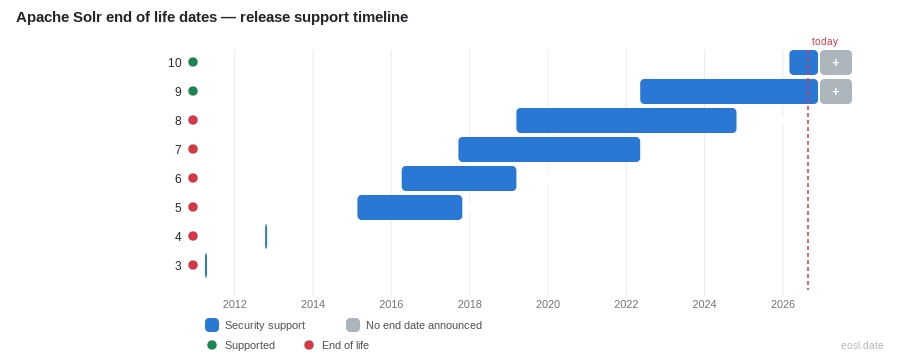
Currently Supported Apache Solr Releases - Active EOS/EOSL Support (2)
Apache Solr End of Life (EOL) Releases - No Longer Supported (7)
| Release | Released | Security Support | Latest |
|---|---|---|---|
| 8 | (7 years and 8 months ago) | (2 years ago) | 8.11.4 (2 years and 1 month ago) |
| 7 | (9 years and 2 months ago) | (4 years and 6 months ago) | 7.7.3 (6 years and 6 months ago) |
| 6 | (10 years and 7 months ago) | (7 years and 8 months ago) | 6.6.6 (7 years and 7 months ago) |
| 5 | (11 years and 9 months ago) | (9 years ago) | 5.5.5 (9 years ago) |
| 4 | (14 years and 1 month ago) | — | 4.10.4 (11 years and 8 months ago) |
| 3 | (15 years and 7 months ago) | — | 3.6.2 (13 years and 10 months ago) |
| 1 | (19 years and 11 months ago) | — | 1.4.1 (16 years and 4 months ago) |
Running search on an old release? Here is where Apache Solr End of Life stands today: Solr 10 is the current line, 9.11 is the last 9.x release, and everything older is EOL. This open-source search engine, built in Java on Lucene, is under active development, so each release line has a short window before it stops receiving fixes.
Apache Solr End of Life: Which Versions Are Supported
The project follows a simple rule. Solr releases arrive as frequent feature releases on the current major version, the previous major version gets occasional critical security fixes, and anything older will not be further updated. Per the downloads page, Solr 10.0.0 (3 March 2026) is the latest version and Solr 9.11.0 (4 October 2026) is the last release in the 9.x series. Treat the official documentation as the source of truth, because the Solr product is run on a voluntary basis by developers and nothing is guaranteed in advance.
Solr EOL Dates by Release Line
The table below combines the project's announcements with the endoflife.date and Versio.io trackers. The release dates show when each line first shipped; the patch version is its final build.
| Release line | First release date | Last patch version | Support status |
|---|---|---|---|
| Solr 10 | 3 March 2026 | 10.0.0 | Supported (stable) |
| Solr 9 | 11 May 2022 | 9.11.0 | Critical fixes only |
| Solr 8 | 13 March 2019 | 8.11.4 | Ended 25 October 2024 |
| Solr 7 | 18 September 2017 | 7.7.3 | Ended 11 May 2022 |
| Solr 6 | 7 April 2016 | 6.6.6 | Ended 13 March 2019 |
| Solr 5 | 19 February 2015 | 5.5.5 | Ended 24 October 2017 |
Trackers disagree slightly on Solr 9. endoflife.date lists it as still receiving security fixes, while Versio.io counts only Solr 10 as supported. Treat 9.11 as a bridge, not a destination.
Current Major Version and Previous Solr Releases
The downloads page labels 10.x as stable, 9.11.x as the previous line that may sometimes receive a bugfix release, and the next major (11) as unstable and unreleased. Anything below 9.11 is end of life.
Solr 8 End-of-Life Date and What Changed on 25 October 2024
The project announced that Solr 8 reaches end-of-life on 25 October 2024, a month after 8.11.4 shipped on 24 September 2024. From that day, upgrading was the only route to new bug fixes. Earlier, in October 2022, the Solr 8 Docker image moved to the Eclipse Temurin JDK, and Solr 9 raised its baseline to Java 11 and Jetty 10.x because Jetty 9.x was itself out of support.
How the Release Strategy Shapes Solr Support
Apache Solr is an open source project built by volunteers, so no release is scheduled in advance. That release strategy keeps the lifecycle short: large or compatibility-breaking changes only land in the next major version, and older lines stop getting attention once a newer one settles. It also means community support for retired versions is hard to find.
Feature Releases and Active Development
Between majors, the current line gets regular updates. Solr 9.11.0, for example, added numeric range field types, hybrid search through reciprocal rank fusion, and nested vector search. It also tightened the query layer, with new parent and child query parsers for nested documents, and widened faceting and highlighting behavior in places. Your Solr version only benefits from this work while it stays inside the supported window, and every new maintenance build is cut from there.
Why There Is No Long-Term Support (LTS) Release
Versio.io confirms that the project does not designate long-term support (LTS) releases; every release follows the standard maintenance period. If you need extended coverage for a retired line, it has to come from a commercial vendor rather than the Apache project, and the Apache License gives no support guarantee on the software itself.
Solr Versions Still Receiving Security Fixes
Only the current line and, in practice, the last 9.x builds get security fixes. The advisories show why this matters: CVE-2026-22022 affects deployments of 5.3.0 through 9.10.0 that use the Rule Based Authorization Plugin, and CVE-2025-66516, an XXE flaw in the extraction module, lists 6.2.0 through 9.10.0. Fixes for such vulnerabilities and critical security bugs arrive on supported lines only. Even a supported line can ship a surprising default: the JWT blockUnknown setting now defaults to true in 9.11.0, so pass-through authentication must be configured explicitly. Read the changelog before applying any patch, since its JSON-formatted API output and admin behavior can change between builds.
Risks of Running a Solr Release Past Its Lifecycle
A version that will no longer receive fixes leaves you vulnerable in three ways:
- Unpatched flaws. New CVE reports name the affected range, and retired lines never get the correction.
- Stale dependencies. Old builds pin old Java and Jetty versions; compatibility with current JDKs, including Java 17, can break.
- Thin help. Questions about retired versions get few answers, and the database or app teams depending on the index inherit that risk.
Solr Upgrade Planning and Migration After End-of-Life
Start with the upgrade notes in the Solr Reference Guide, which list removals, deprecations, and changed defaults for each version, then move one major at a time: 8 to 9, then 9 to 10. SolrCloud clusters need their ZooKeeper and Kubernetes manifests reviewed, and every configset, schema, and backup should be tested before cutover.
After upgrading, check relevance. A practical method compares top results side by side, looking at candidate overlap, rank changes, and score drift. If your indexing format is old, the UPGRADECOREINDEX admin action in 9.11 can rewrite it without reindexing, and the Reference Guide documentation covers the rest.
Check Your Install Against Solr EOL Dates
Run the version command, bin/solr version, to see the build, then match it against the table above. Anything below 9.11 is end of life. You can also follow the project's ATOM feed or an iCalendar feed from endoflife.date, so a calendar reminder warns you before the next cutoff.
Download Solr Releases and Archives
Current builds and Docker images, including the slim variants, are on the official downloads page, with PGP and SHA512 checks for verification. Older packages live in the Apache archives, and anything before 9.0 sits in the Lucene archive. Use them for reference only; do not deploy from them.