Apache Groovy End of Life (EOL) Dates and End of Support (EOS) Dates
Apache Groovy end of life (EOL) and end of support (EOS) dates: 2 Apache Groovy versions have reached EOL, including Apache Groovy 2.5 (EOL date: Apr 30, 2026) — no longer receiving security updates or patches. Apache Groovy 6.0.0 is the current supported release — 5 versions in active support. Also see Apache ActiveMQ Classic end of support life for related end-of-life information.
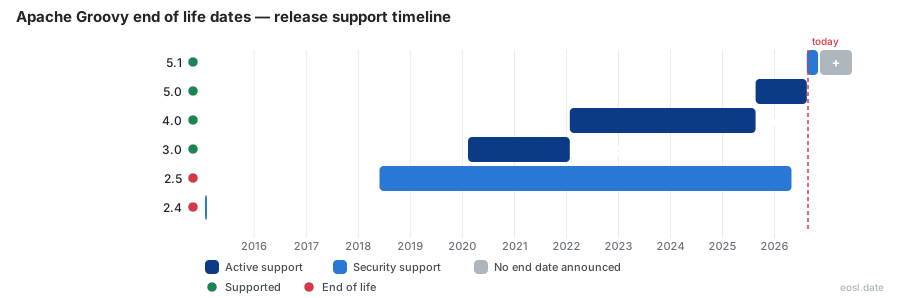
Currently Supported Apache Groovy Releases - Active EOS/EOSL Support (5)
| Release | Released | Bug and Security Fixes | Active Support | Latest |
|---|---|---|---|---|
| 6.0 | (2 months ago) | Active | Active | 6.0.0 (2 months ago) |
| 5.1 | (3 months ago) | Active | (2 months ago) | 5.1.3 (2 months ago) |
| 5.0 | (1 year and 3 months ago) | Active | (3 months ago) | 5.0.8 (3 months ago) |
| 4.0 | (4 years and 9 months ago) | Active | (1 year and 3 months ago) | 4.0.33 (3 months ago) |
| 3.0 | (6 years and 9 months ago) | Active | (4 years and 9 months ago) | 3.0.25 (1 year and 5 months ago) |
Apache Groovy End of Life (EOL) Releases - No Longer Supported (2)
If you run builds, scripts or services on the JVM, Apache Groovy end of life decides how long your current version keeps getting fixes. Groovy is an optionally typed, dynamic language with static compilation for the Java platform, so developers use it as both a programming language and a scripting language alongside Java. This guide shows which release lines are still supported, which have ended, and which version to run today.
Apache Groovy End of Life Status by Version
Groovy has no single shutdown date. Each release line moves from active support to security-only maintenance and then stops getting fixes. The table below shows where all the Groovy releases stand, and it combines data as of 2026-09-23 from endoflife.date (last updated that day) with Versio.io and Wikipedia, with all dates in ISO format. Think of it as a visualisation of the lifecycle: the current line is at the top and the older, superseded lines follow.
| Release line | Released | Active support ended | Bug and security fixes | Latest version |
|---|---|---|---|---|
| 6.0 | 2026-09-19 | Current | Yes | 6.0.0 |
| 5.1 | 2026-08-15 | 2026-09-19 | Yes | 5.1.3 |
| 5.0 | 2025-08-21 | 2026-08-15 | Yes | 5.0.8 |
| 4.0 | 2022-01-25 | 2025-08-21 | Yes | 4.0.33 |
| 3.0 | 2020-02-07 | 2022-01-25 | Yes | 3.0.25 |
| 2.5 | 2018-05-30 | Before 3.0 | Ended 2026-04-30 | 2.5.23 |
| 2.4 | 2015-01-21 | Before 2.5 | No | 2.4.21 |
The vendor is the Apache Software Foundation, and the licence is the Apache License 2.0.
Latest Version and Release Date
The newest line is Groovy 6.0, released on 2026-09-19; that release date also marks the end of active support for 5.1, which was released on 2026-08-15. The latest patch version of each older line is 5.1.3 (2026-09-19), 5.0.8 and 4.0.33 (both 2026-07-29), and 3.0.25 (2025-05-24). Versio.io counts 274 versions across six major lines, including 81 unstable versions, and 98 versions affected by a CVE, which is a good reason not to stay on an old patch.
To match a Groovy install against scanners and package databases, use the product identifiers pkg:maven/org.apache.groovy/groovy (purl), cpe:2.3:a:apache:groovy (CPE) and the Repology entry groovy.
Active Support and Bug and Security Fixes
Active support means a line still receives new work, while its bug and security fixes continue separately in maintenance. That is why 5.1 shows an ended active-support date yet still gets patches. Always read the fixes column first when you decide whether a version is acceptable for production.
Groovy EOL Dates for Each Release Line
Groovy EOL dates are not announced in advance. Versio.io describes a "latest version" model in which only the newest major line counts as current, and earlier lines stay usable but are superseded. Once a new major version ships, the previous line is discontinued for new features, so your upgrade planning starts on the day a release lands, not on a published deadline. Compatibility notes in each release announcement tell you what breaks.
Groovy 4 and Groovy 3 Maintenance
Groovy 4.0 shipped on 2022-01-25 and lost active support on 2025-08-21, yet 4.0.33 appeared on 2026-07-29, so security releases continue. Groovy 3.0 is older still, but its widespread use keeps it supported: the last 3.0 patch is 3.0.25 from May 2025. Each new major version moves the previous one to maintenance, and Gradle and Grails projects often sit on these lines for years because moving a whole framework is slow. Grails, the Groovy web framework, inherits the support status of whichever Groovy line it bundles, so read the Grails release notes before you assume a Grails upgrade also upgrades Groovy.
Groovy 2.5 and Groovy 2.4 Legacy Lines
Groovy 2.5 stopped receiving security fixes on 2026-04-30, so any 2.5 install is now unsupported software. Groovy 2.4 ended earlier: it was the last major release under Pivotal's sponsorship, which finished in March 2015, and its final release was 2.4.21 on 2020-11-30. If a Jenkins pipeline or another framework you ship still pins a 2.x runtime, treat it as an upgrade task, not a background risk. An older Grails application is the classic case, and Grails teams should plan that move first.
How the Groovy Release Cycle and Support Policy Work
Apache Groovy does not follow a fixed release policy. Its support policy says each new major version sends the previous one into maintenance, where it gets one or two bugfix releases and is then dropped, unless users who cannot upgrade ask strongly for a fix. You can track those changes from the endoflife.date JSON API, its RSS feed or its iCalendar feed, which suit a database of tracked products or a calendar reminder.
Long-Term Support and LTS Status
No Groovy line carries a long-term support label, and Versio.io lists LTS as "No" for every release. Support length therefore depends on how many people still use a line, not on a promised window.
Version History Under Apache
James Strachan began Groovy in 2003, Groovy 1.0 arrived on 2007-01-02 and Groovy 2.0 in July 2012. After Pivotal stopped sponsoring the project, it moved to a Project Management Committee at the Apache Software Foundation and became a top-level project in November 2015. Through every release the core stays the same: closures, functional programming, meta-programming and domain-specific language authoring on top of the Java library.
What End-of-Life Means for Your Groovy Software
Once a line is past its last fix, a newly found vulnerability will not be patched there. Your existing bytecode still runs, but the security exposure grows with every new advisory, and a newer Java runtime may break it. Software that cannot move should be isolated until it can.
JVM Requirements by Major Version
Each major line sets a minimum JVM (Java virtual machine) version, and the newest line raises it, so check this before you upgrade a scripting host:
- Groovy 6.0: Java 17+ with indy
- Groovy 5.0: Java 11+
- Groovy 4.0: Java 8+
- Groovy 3.0: Java 8+ with or without indy
- Groovy 2.5: Java 7+
- Groovy 2.4: Java 6+, or Java 7+ with indy
Maven Coordinates and Group ID Change
Groovy 4.0 changed its Maven coordinates: the groupId moved from org.codehaus.groovy to org.apache.groovy. A build that still names the old group will never resolve a newer release, so update it as part of the move.
Life Cycle Planning: Upgrading Your Groovy Version
A sound life cycle plan is short: find your version, compare it with the table, and move to a line that still gets fixes before your own deadline forces the choice. Prefer the newest line your JVM allows.
Checking Your Supported Release
Run groovy --version in a terminal; this version command prints the installed release. If it is 2.5 or older, or a line whose fixes ended, upgrade first to the nearest supported release and then step forward, testing at each major version.