Apache Celeborn End of Life (EOL) Dates and End of Support (EOS) Dates
Apache Celeborn end of life (EOL) and end of support (EOS) dates: 3 Apache Celeborn versions have reached EOL, including Apache Celeborn 0.6 (EOL date: Aug 16, 2026) — no longer receiving security updates or patches. Apache Celeborn 0.7.0 is the current supported release. Also see Apache ActiveMQ Artemis EOSL dates for related end-of-life information.
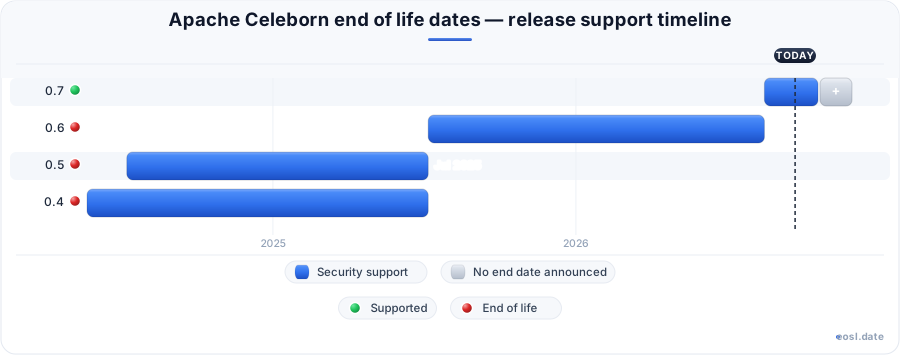
Currently Supported Apache Celeborn Releases - Active EOS/EOSL Support (1)
| Release | Released | Security Support | Latest |
|---|---|---|---|
| 0.7 | (3 months ago) | Active | 0.7.0 (3 months ago) |
Apache Celeborn End of Life (EOL) Releases - No Longer Supported (3)
Planning around Apache Celeborn end of life is unusual, because the project publishes no schedule: only the newest minor line keeps receiving fixes. This guide shows which releases still receive fixes, when older branches stopped, and how to move your shuffle data layer, the intermediate data and spilled data that Apache Spark, Apache Flink and Hadoop MapReduce jobs produce, onto a current version before an outage forces the issue. If you run Celeborn for distributed computing workloads, start with the table below.
Apache Celeborn End of Life Status by Release
According to the endoflife.date tracker, last updated 24 August 2026, only the 0.7 line has security support right now. Release 0.6 ended on 16 August 2026, the day 0.7 shipped, while 0.5 and 0.4 ended on 7 July 2025. Because dates come from the project's GitHub releases, Apache Celeborn end of life for any branch simply begins when a newer release lands.
| Release | Released | Patched | Latest patch |
|---|---|---|---|
| 0.7 | 16 Aug 2026 | Yes | 0.7.0 (17 Aug 2026) |
| 0.6 | 7 Jul 2025 | Ended 16 Aug 2026 | 0.6.3 (23 Apr 2026) |
| 0.5 | 9 Jul 2024 | Ended 7 Jul 2025 | 0.5.4 (13 Mar 2025) |
| 0.4 | 22 May 2024 | Ended 7 Jul 2025 | 0.4.3 (10 Dec 2024) |
Each branch therefore lives only until its successor arrives: about 13 months for 0.6 and about 12 months for 0.5. Run celeborn-worker --version on a node and compare the result with the 0.7 row; that row is the line you should be running. The support window is short, so check often.
Celeborn EOL Policy for Every Minor Release
The tracker's note is blunt: Apache Celeborn does not publish a formal support or EOL policy. Only the newest minor line is actively maintained, and older branches stop receiving fixes once a newer one is released. Treat every earlier line as unsupported the day its successor appears, and book your maintenance window accordingly. There is no long-term support branch to fall back on.
The stakes are practical. The 0.7.0 notes include a CVE fix set for lz4-java, jersey and jetty, plus RPC authorization checks that stop one application from altering another's metadata. A 0.6 cluster gets none of that, and the community will not backport it. With no long-term support branch, the project's mailing list and GitHub are your only channels for backport questions; the contributing documentation explains how to submit a pull request, and you should keep each dependency in your own build under watch.
Supported Release Compatibility with Engines
Choose a supported release that matches your engine and runtime, because Celeborn clients must match the engine version while the server works with every client. The 0.7 line builds for Spark 3.0 through 4.2, Flink 1.18 through 2.3 and Hadoop MapReduce 3, and the build script produces a tarball with jars for each activated profile. Spark 2.4, Flink 1.16 and 1.17, and Hadoop 2 clients were removed.
Spark Client Builds
A Spark client for Spark 3.3 to 3.5 runs on Java 8, 11 or 17 with Scala 2.12 or 2.13, while Apache Spark 4.0 to 4.2 needs Java 17 and Scala 2.13. On Spark 3.0 or 3.1, only Scala 2.12 with Java 8 or 11 works, so older jobs may need an engine move first.
Flink Client Builds
A Flink client for Flink 1.18 to 1.20 runs on Java 8 or 11 with Scala 2.12, whereas Flink 2.0 to 2.3 needs Java 11 or 17.
| Engine release | Java | Scala |
|---|---|---|
| Spark 3.3 to 3.5 | 8, 11, 17 | 2.12, 2.13 |
| Spark 4.0 to 4.2 | 17 | 2.13 |
| Flink 1.18 to 1.20 | 8, 11 | 2.12 |
| Flink 2.0 to 2.3 | 11, 17 | 2.12, 2.13 |
Reading the Release Notes for Security Support
Before moving to 0.7, skim the 0.7.0 release notes. These highlights affect your move:
- Engine coverage: Spark 4.1 and 4.2 plus Flink 2.1 to 2.3 clients arrive, and old clients leave.
- Hardening: CVE fixes, a Java deserialization filter and HTTP authentication for the command-line tool.
- Remote storage: S3, OSS and HDFS gain client caching, credential providers and replication settings.
- Durability: fsync on commit, automatic RocksDB restoration and Ratis stepdown handling.
- Observability: new metrics for flush latency, eviction counts and read buffers, all reflected in the Grafana dashboards, and none of it is backported to 0.6.
- Packaging: the Helm chart gains volume claim templates and service account annotations.
- Defaults:
celeborn.client.spark.fetch.cleanFailedShufflenow defaults to true, so retest failure handling.
How the Shuffle Lifecycle Works Behind Celeborn EOL
Knowing what you are replacing helps you judge risk. The shuffle service is a push-based layer that separates compute from storage: engines hand shuffle data to dedicated nodes instead of holding it on local disks, which suits a disaggregated architecture. Data for one partition lands in a single file where possible, so a reducer needs just one connection.
Master and Worker Roles
- Master: manages cluster resources, allocates slots, and in HA mode syncs state through Raft for high availability; restart it only when a quorum stays up.
- Worker: receives pushed data, merges it for each reducer, replicates it to a peer worker and flushes it to local disks or HDFS; drain it before a restart.
- LifecycleManager: runs in the Spark driver or Flink job master and tracks the metadata of every shuffle, so it picks up the new client when your application restarts.
- Client: the ShuffleClient in each executor or task manager that writes and reads data.
LifecycleManager and Client Metadata
The LifecycleManager asks the master for slots and reserves them on workers, then tells each worker to commit files once every mapper finishes. It also sends heartbeats to the master and picks replacement workers itself after a failed push. Because the LifecycleManager, master and worker must agree on these messages, keep their versions in step during an upgrade and rehearse every rollout off-peak, since a partition that loses both its primary and replica copies is marked lost.
Rolling Upgrade Steps Before Support Ends
A rolling upgrade replaces nodes while jobs keep running. With 0.6 and older now unsupported, move to 0.7 in this order, drawn from the project's design rather than an official runbook:
- Read the 0.7.0 notes, since 0.6 and older no longer receive fixes, and confirm the client build matches your engine.
- Copy your configuration files, then trial the new tarball on a staging cluster.
- Turn on the drain-and-commit mode, then restart workers one at a time.
- Restart masters one at a time so a Raft quorum survives.
- Ship the new client jars with your applications and watch the metrics.
Graceful Shutdown for Workers
With graceful shutdown on, the master stops allocating slots on the worker, the worker tells clients to split, clients send CommitFiles, and the worker flushes data to persistent storage, saves its state in local leveldb and stops. The project says this typically takes under a minute, which is why this graceful upgrade path suits long-running jobs. The project also documents support for Spark dynamic allocation, so autoscaling jobs keep working.
Operating Celeborn Between Releases Without Support Gaps
Between releases, keep celeborn-defaults.conf in version control so an upgrade is a reviewed diff, and keep master and worker memory settings with it. Workers without local disks can point storage at HDFS, and celeborn.metrics.enabled keeps worker metrics flowing so you notice problems during a rollout. Note which master and worker nodes already run 0.7, which workers still hold shuffle files on HDFS, and which LifecycleManager instances belong to jobs that have not restarted, so a half-finished migration never leaves a master, a worker or a client on an unsupported release. Check that each worker can still reach HDFS after a restart, and compare the LifecycleManager logs of old and new jobs.
Finally, recheck the tracker whenever the next minor release ships, because that is the moment 0.7 loses its fixes. A calendar reminder tied to the project's release announcements costs nothing and keeps you inside the one line that still receives patches and support.