Apache Cassandra End of Life (EOL) Dates and End of Support (EOS) Dates
Apache Cassandra end of life (EOL) and end of support (EOS) dates: 2 Apache Cassandra versions have reached EOL, including Apache Cassandra 3.11 (EOL date: Sep 05, 2024) — no longer receiving security updates or patches. Apache Cassandra 5.0.9 is the current supported release — 3 versions in active support. Also see Apache Airflow lifecycle dates for related end-of-life information.
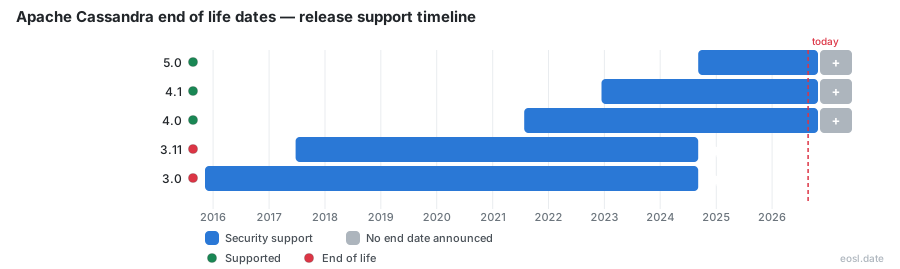
Currently Supported Apache Cassandra Releases - Active EOS/EOSL Support (3)
Apache Cassandra End of Life (EOL) Releases - No Longer Supported (2)
Apache Cassandra end of life arrived for the 3.0 and 3.11 branches when 5.0 became generally available in September 2024, so this open-source distributed database no longer gets routine fixes on those lines. Below you will find each EOL date, what unmaintained means for you, which versions the project still supports, and how to plan an online upgrade. If you still run 3.x, move to 4.0, 4.1 or 5.0 to stay supported.
Apache Cassandra End of Life Dates by Release
Apache Cassandra is a NoSQL, wide-column store built for high availability across commodity servers, which is why scalability and data management teams keep old deployments running long after a release stops moving. The table shows where every recent release stands, based on the project's announcement and the public lifecycle tracker.
| Version | Released | Status | Last release |
|---|---|---|---|
| 3.0 | 9 Nov 2015 | Ended 5 Sep 2024 | 3.0.32 (7 Feb 2025) |
| 3.11 | 23 Jun 2017 | Ended 5 Sep 2024 | 3.11.19 (7 Feb 2025) |
| 4.0 | 26 Jul 2021 | Supported | 4.0.21 (7 Aug 2026) |
| 4.1 | 13 Dec 2022 | Supported | 4.1.12 (7 Aug 2026) |
| 5.0 | 5 Sep 2024 | Supported | 5.0.9 (7 Aug 2026) |
The 3.0 and 3.11 timeline
The Apache Cassandra project team announced on May 15, 2023 that the end-of-life notice for Cassandra 3.0 and Cassandra 3.11 would follow once 5.0 went GA. That happened on 5 September 2024, and the branch has been closed since the final latest release in February 2025.
Where 4.0 and 4.1 stand today
Both remain on the supported list. The download page says Apache Cassandra 4.1 is maintained until the 7.0 release and Apache Cassandra 4.0 until 6.0, so neither is a near-term concern.
Cassandra 3.x End-of-Life: What Changed for 3.0 and 3.11
The committers no longer maintain the Java code on these branches, and the notice points readers to the documentation and community forums for help. A maintenance window that lasted over half a decade has closed, and it stresses that the project must focus its effort on newer lines.
Security patches and CVE fixes after EOL
The project says CVE fixes may still be applied to an unmaintained branch, but only case by case, and contributors who want to extend the EOL can step forward. Treat security patches for 3.x as a courtesy rather than a plan: new vulnerabilities and bug fixes will mostly land in current versions, which makes security the strongest reason to leave.
What unmaintained means for your clusters
An unmaintained cluster keeps running, yet no patches are guaranteed and no one on the community side owes you technical support for 3.x. Any deprecated behavior stays as it is, and every future driver or tool change assumes a newer server.
Lifecycle Support and Release Cadence for Current Versions
The tracker states that the latest three releases are supported at any given time, so a branch drops off when two newer ones exist. That rule is why 3.x ended the day 5.0 arrived, and it is the quickest way to judge your own supported release status.
Cassandra follows SemVer. Patch releases carry fixes only, minor versions add features, and each major version may deprecate APIs that disappear a version later. The project targets a yearly major release, so expect a new line about every twelve months. That cadence keeps compatibility predictable for drivers and tooling, and it brings new features and configuration improvements to each line.
How long a major version stays supported
Support follows the three-release rule rather than a calendar date: 5.0 is maintained until 8.0, 4.1 until 7.0 and 4.0 until 6.0, so plan your next hop before the oldest line you run falls off the list.
Legacy Support and EOL Timelines on Managed Platforms
Vendors can set their own dates. NetApp Instaclustr extended its extended support for 3.x by twelve months after 5.0 launched, with legacy support starting August 31, 2025 and its own end on November 30, 2025. In legacy mode production SLAs still apply, but there are no new deployments of 3.x. After the final date, production SLAs and technical help stop, although the vendor will help move the cluster to a supported offering.
Managed service customers
If you run on the managed platform, you can upgrade directly from 3.11.19 to 4.0.17 or newer, or to 4.1.8 or newer.
Enterprise support customers
Under enterprise support, the vendor recommends moving every one of your clusters to 4.x, and warns that missing the window may mean losing support unless agreed otherwise, so schedule any downtime early.
Upgrade Path Off Unmaintained 3.0 and 3.11 Clusters
Every route leaves 3.x through 4.x. Treat the upgrading effort as a transition with a rehearsal, a rollback plan and a clear owner, because a rushed move costs more than the delay.
Online upgrade to Cassandra 4.0 or 4.1
The project designed and tested the move from 3.x to any 4.x as an online upgrade. Expect faster streaming, incremental repair improvements and audit logging in 4.0, plus easier configuration in 4.1, with better performance and stability as a result.
Why upgrades cannot skip a release line
Upgrades without downtime are supported from one major version to the next, and skipping one is not supported. That is why 3.x must land on 4.x before 5.0.
Cipher suite changes in 4.x
Leaving the unmaintained 3.x line for 4.x also changes TLS requirements: on the managed platform, clusters with client encryption must use a short list of modern TLS options such as TLS_AES_256_GCM_SHA384. Check your network clients and authentication settings, and plan storage headroom before the first node moves.
Moving on to Cassandra 5.0
Once on 4.x you can adopt 5.0, which adds vector search, storage attached indexes, a unified compaction strategy, dynamic data masking and trie memtables. Landing there keeps you inside the supported window until the 8.0 release.