Apache Pulsar End of Life (EOL) Dates and End of Support (EOS) Dates
Apache Pulsar end of life (EOL) and end of support (EOS) dates: 14 Apache Pulsar versions have reached EOL, including Apache Pulsar 4.2 (EOL date: Sep 24, 2026) — no longer receiving security updates or patches. Apache Pulsar 5.0.1 LTS is the current supported release, with support through Oct 05, 2028. Also see Apache ActiveMQ Classic end of support dates for related end-of-life information.
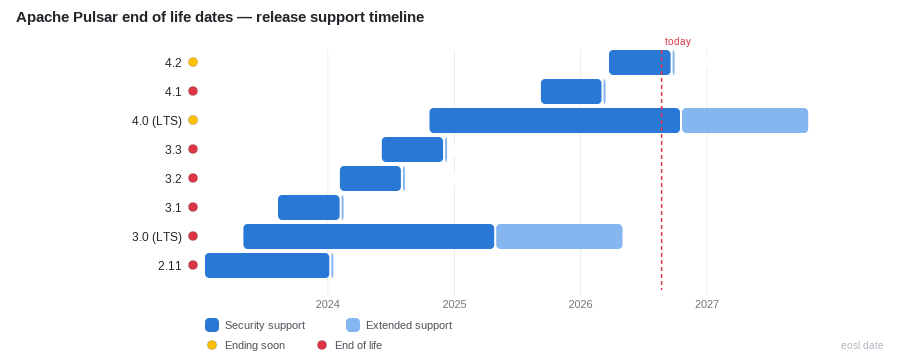
Currently Supported Apache Pulsar Releases - Active EOS/EOSL Support (1)
| Release | Released | Active Support | Security Support | Latest | LTS |
|---|---|---|---|---|---|
| 5.0 (LTS) | (1 month and 2 weeks ago) | (in 1 year and 10 months) | (in 2 years and 10 months) | 5.0.1 (3 weeks and 6 days ago) | LTS |
Apache Pulsar End of Life (EOL) Releases - No Longer Supported (14)
| Release | Released | Active Support | Security Support | Latest | LTS |
|---|---|---|---|---|---|
| 4.2 | (7 months ago) | (1 month and 4 weeks ago) | (1 month and 4 weeks ago) | 4.2.5 (1 month and 2 weeks ago) | - |
| 4.1 | (1 year and 2 months ago) | (8 months ago) | (8 months ago) | 4.1.3 (9 months ago) | - |
| 4.0 (LTS) | (2 years and 1 month ago) | (1 month and 1 day ago) | (in 10 months) | 4.0.14 (1 month and 2 weeks ago) | LTS |
| 3.3 | (2 years and 5 months ago) | (1 year and 11 months ago) | (1 year and 11 months ago) | 3.3.9 (1 year and 1 month ago) | - |
| 3.2 | (2 years and 9 months ago) | (2 years and 3 months ago) | (2 years and 3 months ago) | 3.2.4 (2 years and 3 months ago) | - |
| 3.1 | (3 years and 3 months ago) | (2 years and 9 months ago) | (2 years and 9 months ago) | 3.1.3 (2 years and 8 months ago) | - |
| 3.0 (LTS) | (3 years and 6 months ago) | (1 year and 6 months ago) | (6 months ago) | 3.0.17 (6 months ago) | LTS |
| 2.11 | (3 years and 10 months ago) | (2 years and 10 months ago) | (2 years and 10 months ago) | 2.11.4 (2 years and 8 months ago) | - |
| 2.10 | (4 years and 7 months ago) | (3 years and 7 months ago) | (3 years and 7 months ago) | 2.10.6 (2 years and 8 months ago) | - |
| 2.9 | (4 years and 11 months ago) | (3 years and 11 months ago) | (3 years and 11 months ago) | 2.9.5 (3 years and 7 months ago) | - |
| 2.8 | (5 years and 5 months ago) | (4 years and 5 months ago) | (4 years and 5 months ago) | 2.8.4 (4 years and 1 month ago) | - |
| 2.7 | (5 years and 11 months ago) | (4 years and 11 months ago) | (4 years and 11 months ago) | 2.7.5 (4 years and 2 months ago) | - |
| 2.6 | (6 years and 5 months ago) | (5 years and 5 months ago) | (5 years and 5 months ago) | 2.6.4 (5 years and 5 months ago) | - |
| 2.5 | (6 years and 10 months ago) | (5 years and 10 months ago) | (5 years and 10 months ago) | 2.5.2 (6 years and 6 months ago) | - |
Tracking Apache Pulsar end of life dates starts with one fact: the Apache project makes no separate end-of-life announcement, so its support table is your only notice. As of 26 October 2026, 5.0 is the one line with full active support. Use this guide to check your supported versions and decide when to move this open-source Apache messaging platform forward.
Apache Pulsar End of Life Dates for Supported Versions
The Apache Pulsar project publishes a single table of dates, mirrored below. Each LTS line gets 24 months of active support and 36 months of security support, while each feature release gets six months of both. Once support ended for a line, Apache stops answering issue reports against it, and Apache releases for it become rare.
| Line | Type | Active support ends | Security support ends |
|---|---|---|---|
| 5.0 | LTS | 5 Oct 2028 | 5 Oct 2029 |
| 4.2 | Feature | 24 Sep 2026 | 24 Sep 2026 |
| 4.1 | Feature | 8 Mar 2026 | 8 Mar 2026 |
| 4.0 | LTS | 21 Oct 2026 | 21 Oct 2027 |
| 3.3 | Feature | 5 Dec 2024 | 5 Dec 2024 |
| 3.2 | Feature | 5 Aug 2024 | 5 Aug 2024 |
| 3.1 | Feature | 10 Feb 2024 | 10 Feb 2024 |
| 3.0 | LTS | 2 May 2025 | 2 May 2026 |
| 2.11 | Feature | 11 Jan 2024 | 11 Jan 2024 |
The 4.0 LTS release is the one to watch. Its active support ended on 21 October 2026, but security fixes continue until 21 October 2027. The latest release is 5.0.1, dated 26 October 2026 in the release notes. You can follow every Apache Pulsar version through GitHub, an RSS feed or an iCalendar feed.
Pulsar Release Policy and Support Windows
The release policy sets three windows, and the release cycle for each type decides how long you can stay put:
- LTS release: a new long-term support line every 18 months, with 24 months of active support.
- Feature release: one every 3 months, supported for 6 months.
- Patch release: shipped when it is ready, with no fixed date; the Apache releases page lists them all.
Active Support vs Security Support
During active support, a line receives bug fixes and security fixes. In the later security support window, it receives only security patches for a CVE or other vulnerabilities. After both windows close, the project may cut ad hoc releases on a best-effort basis, depending on how severe an issue is.
How an LTS Release Differs from a Feature Release
Pulsar uses a variant of semantic versioning: LTS.feature.patch. A bump to 5.0.0 signals a new LTS release with no special compatibility break, 4.2.0 is a feature release, and 4.2.5 is a patch. Apache Pulsar numbers its releases this way so new releases stay predictable. Before an LTS, the project ships milestone releases such as 5.0.0-M1, then release candidates. Each release candidate goes to a vote on the mailing list, led by a volunteer committer acting as release manager, and a PIP describes each major change.
Planning Upgrades Before End-of-Support
An upgrade is safest when you move one step at a time. Before 3.0, you had to upgrade linearly through each feature version, so 2.8 went to 2.9 before 2.10. Apache designs these releases so a cluster can roll back afterwards. From 3.0, a live upgrade and downgrade between one LTS and the next works, which makes a rolling upgrade across your brokers realistic. Moving from 3.2 straight to 5.0 is not supported.
Apache Pulsar is open-source with no guarantee. Test every cluster change in staging before production, and remember each team runs its own deployment. Your clients, broker and BookKeeper settings should all be part of that testing. Watch metrics through monitoring while the migration runs.
Moving to 5.0 raises the server requirement to Java 21. Oxia is now the recommended metadata store for new clusters, but a 4.x cluster can upgrade while keeping ZooKeeper, and Scalable Topics, the new elastic kind of topics for distributed streaming, can wait until you are ready. On the cloud or on-premises, plan the jump from 3.0 to 4.0 first, then follow the Apache path to 5.0.
Extended Support Providers After End-of-Life
If a version reaches its end of support before you can leave it, commercial vendors sell support contracts for older releases. Your support providers differ mainly in whether they publish patched builds.
StreamNative and IBM Elite Support
StreamNative runs Pulsar as a cloud service or on your own Kubernetes, but it publishes no support policy for community versions. IBM now sells Elite Support, formerly DataStax Luna Streaming, built around its own Pulsar 3.1 distribution, a line Apache stopped supporting in February 2024.
Perforce OpenLogic and OSSeva
OpenLogic offers Pulsar support at three tiers but no patched builds for retired lines. OSSeva publishes patched builds with backported CVE fixes for 2.10 through 4.0, covering the broker, BookKeeper and ZooKeeper. Whichever vendor you pick, ask which Apache releases it patches.