Apache Hadoop End of Life (EOL) Dates and End of Support (EOS) Dates
Apache Hadoop end of life (EOL) and end of support (EOS) dates: 14 Apache Hadoop versions have reached EOL, including Apache Hadoop 3.2 (EOL date: Dec 21, 2023) — no longer receiving security updates or patches. Apache Hadoop 3.5.0 is the current supported release — 4 versions in active support. Also see Apache Airflow end of support life for related end-of-life information.
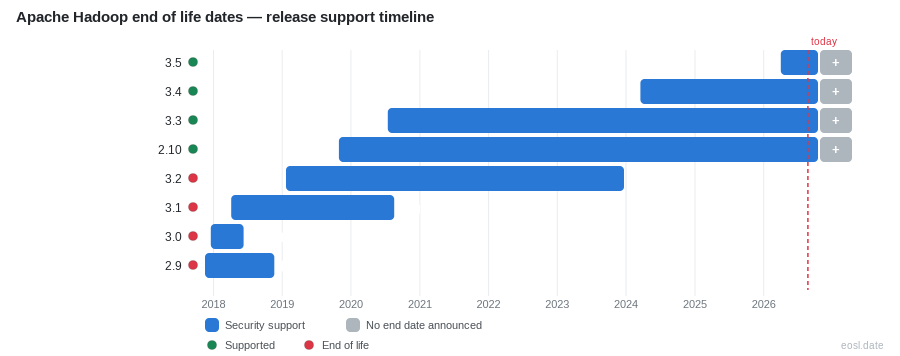
Currently Supported Apache Hadoop Releases - Active EOS/EOSL Support (4)
Apache Hadoop End of Life (EOL) Releases - No Longer Supported (14)
| Release | Released | Support | Latest |
|---|---|---|---|
| 3.2 | (7 years and 10 months ago) | (2 years and 11 months ago) | 3.2.4 (4 years and 3 months ago) |
| 3.1 | (8 years and 7 months ago) | (6 years and 3 months ago) | 3.1.4 (6 years and 3 months ago) |
| 3.0 | (8 years and 11 months ago) | (8 years and 5 months ago) | 3.0.3 (8 years and 5 months ago) |
| 2.9 | (9 years ago) | (8 years ago) | 2.9.2 (8 years ago) |
| 2.8 | (9 years and 7 months ago) | (8 years and 2 months ago) | 2.8.5 (8 years and 2 months ago) |
| 2.7 | (11 years and 4 months ago) | (8 years and 4 months ago) | 2.7.7 (8 years and 4 months ago) |
| 2.6 | (11 years and 11 months ago) | (10 years and 1 month ago) | 2.6.5 (10 years and 1 month ago) |
| 2.5 | (12 years and 2 months ago) | (11 years ago) | 2.5.2 (12 years ago) |
| 2.4 | (12 years and 7 months ago) | (12 years and 4 months ago) | 2.4.1 (12 years and 4 months ago) |
| 2.3 | (12 years and 8 months ago) | (12 years and 8 months ago) | 2.3.0 (12 years and 8 months ago) |
| 2.2 | (13 years and 1 month ago) | (13 years and 1 month ago) | 2.2.0 (13 years and 1 month ago) |
| 1.2 | (13 years and 6 months ago) | (13 years and 3 months ago) | 1.2.1 (13 years and 3 months ago) |
| 1.1 | (14 years and 1 month ago) | (13 years and 8 months ago) | 1.1.2 (13 years and 8 months ago) |
| 1.0 | (14 years and 10 months ago) | (14 years and 1 month ago) | 1.0.4 (14 years and 1 month ago) |
Planning around Apache Hadoop end of life starts with one fact: the project publishes no fixed end-of-life calendar. This open-source software framework handles distributed processing of large data sets across clusters of computers, and each of its lines simply stops receiving new builds when the community moves on. Below, you'll see which lines are current, which have ended, and what to do next with your big data stack.
Apache Hadoop End of Life: What the Project Policy Says
Unlike a commercial vendor, the project has no support policy and no fixed release schedule. Only the newest line is considered current, and older lines stay usable but are superseded. The recommended version is always the newest stable release, and Apache's own announcements tell users of earlier builds to move up.
Latest Version and Release Date
The newest stable release is Hadoop 3.5, with 3.5.0 published in April 2026 and 485 bug fixes since Hadoop 3.4, which stays the previous stable line. That release date is your reference point: any line older than 3.5 is a candidate for retirement. To see what you run today, type hadoop version on a cluster node. That one command prints the exact build, so you can match it against the table below and your supported release status.
Hadoop End-of-Life Dates by Release Line
Each Hadoop release is a numbered line with patch builds under it. The table lists the Apache Hadoop releases that matter most, using dates tracked by endoflife.date and Versio.io. Five end-of-life release lines sit in it; the rest of the 1.x, 0.x and 2.x history ended long ago.
| Release line | Latest version | Status |
|---|---|---|
| 3.5 | 3.5.0 (April 2026) | Current |
| 3.4 | 3.4.3 (February 2026) | Supported |
| 3.3 | 3.3.6 (June 2023) | Supported |
| 2.10 | 2.10.2 (May 2022) | Listed as supported, no new patch since 2022 |
| 3.2 | 3.2.4 (July 2022) | Ended December 2023 |
| 3.1 | 3.1.4 (August 2020) | Ended August 2020 |
| 2.7 | 2.7.7 (July 2018) | Ended July 2018 |
| 2.6 | 2.6.5 (October 2016) | Ended October 2016 |
Versio.io flags no line as LTS, and none carries a long-term support promise. It counts 285 versions in total, 202 of them unstable versions and 78 touched by a CVE, so every patch version you pick matters.
Security Fixes and Supported Release Status
"Supported" means the community may still ship security fixes, nothing more. Hadoop 3.3.3 was billed as primarily a security update, and 3.3.4 limited changes to critical security and integrity patches. Treat the Hadoop 2.10 label as a listing rather than a guarantee, because its last maintenance build is years old, and note that Hadoop 3.2 already ended. Without active support, you carry the risk yourself.
Upgrade Path for Hadoop 2.x Clusters
Apache tells users of Hadoop 2.x and Hadoop 3.2 to upgrade to the 3.3 line, and the notes for each build tell you to upgrade to this release when you run something earlier. Back up the HDFS namespace first, then migrate one cluster stage at a time and test jobs before you cut over production.
What Is Hadoop? HDFS, YARN and MapReduce in Hadoop Releases
Hadoop spreads work across commodity servers, so its nodes each process a slice of the data and the results merge into one answer for your data team. It is a scalable Java framework, and every release ships the same core modules:
- Hadoop Common: the shared utilities for every other module.
- HDFS: a distributed file system for high-throughput storage.
- YARN: job scheduling and cluster resource management.
- MapReduce: the batch engine for parallel work on large clusters.
Around that core sits an ecosystem of Apache projects, including:
- Hive and HBase for SQL queries and tables
- ZooKeeper and Ambari for coordination and cluster management
- Tez and Apache Spark for faster analytics and machine learning
Is Hadoop Still Used? Demand Across the Product Lifecycle
Search interest peaked between 2014 and 2017, yet is Hadoop dead? Not quite. One market report puts the Hadoop market near USD 6.5 billion in 2024, with about 220,000 enterprises running it, mostly large enterprises in banking, government and retail. Its file system and YARN stay popular for data lakes, while the batch engine lost ground to Spark. Is Hadoop still relevant? Mostly as a hybrid or legacy layer that connects to cloud storage through connectors such as S3A and ABFS, which depend on the AWS SDK bundle. A vendor distribution may extend support beyond the project's own.
Why Replace Hadoop? Cloud-Native Pressure on Each Hadoop Version
Once your line stops receiving patches, the main reason to replace Hadoop is that a cloud-native stack removes work: no maintenance windows, no cluster tuning, and a batch-oriented design no longer fits real-time analytics. Older systems start to look obsolete next to modern solutions. The architecture is heavier than most teams need.
Cloud Computing and Scaling Costs
Cloud providers sell the same data processing and data storage as pay-as-you-go services, so you no longer size a cluster for peak load. Many firms kept 10 TB clusters running without needing that capacity, and scaling Hadoop means buying hardware. Running a line that has stopped receiving patches adds unpatched-risk cost on top of the hardware bill, and that gap grows each year.
Real-Time Constraints and Declining Adoption
Streaming data workloads expose Hadoop's real-time constraints. Add a lack of support from smaller vendors, a poor fit for small datasets, and falling adoption, and the case to move on strengthens. Fewer maintained lines also means slower patching, which raises the risk of staying on an ended line.
What Is Better Than Hadoop? Replacing Aging Release Lines
Most teams pair object storage with Apache Spark, Presto or managed data platforms. If you retire a 2.x or 3.2 line, ask what is better than Hadoop for your workload: a managed warehouse for SQL, Spark for pipelines. Data engineering teams usually move on from Hadoop in phases, keeping the ecosystem tools that still earn their place.
Version History Lessons and Hadoop Migration Costs
The version history shows a steady pattern: lines last a few years, then lapse. Line 2.7 stopped in July 2018 and 3.2 in December 2023, so a cluster pinned to either has been unpatched for years. Set the migration budget before the line you run stops, count licence and hardware savings against engineering time, and expect the cost of replacing clusters to repay itself only once the old estate is switched off.
Hadoop Release Archive, Release Notes and SBOM
Before you move builds, read the release notes and changelog for your target build; the changelog also shows which data-handling fixes landed. Since 3.3.6, Apache publishes an SBOM, a software bill of materials, which helps you track each CVE. That build alone carried 117 bug fixes, 3.4.0 carried 2,888 bug fixes, and the 3.5 line's bug fixes run to 485. Hadoop 3.5 builds, plus Maven and Docker packages, are listed in the release archive. The endoflife.date page also offers a JSON API, an RSS feed, an iCalendar feed and a CPE identifier for tracking.