Apache CouchDB End of Life (EOL) Dates and End of Support (EOS) Dates
Apache CouchDB end of life (EOL) and end of support (EOS) dates: 2 Apache CouchDB versions have reached EOL, including Apache CouchDB 3.3 (EOL date: May 05, 2025) — no longer receiving security updates or patches. Apache CouchDB 3.5.3 is the current supported release — 2 versions in active support. Also see Apache Ant end of support life for related end-of-life information.
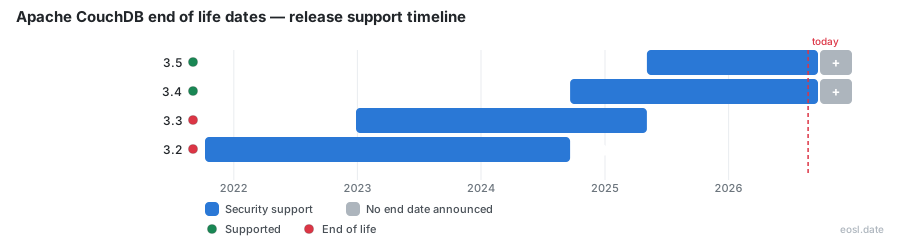
Currently Supported Apache CouchDB Releases - Active EOS/EOSL Support (2)
Apache CouchDB End of Life (EOL) Releases - No Longer Supported (2)
Knowing the Apache CouchDB end of life date for your release is what separates a planned migration from an emergency one. As of October 2026, only the CouchDB 3.5 and 3.4 lines get fixes, while 3.3 and 3.2 have no upstream support, so any server still running them is on its own. Below you will find the dates, the rule behind them and a practical plan for your CouchDB database.
Apache CouchDB End of Life: Supported Releases Table
The table lists every recent CouchDB feature line, when it shipped and whether it still receives patches. The newest stable release is 3.5.3, published in October 2026, and the CouchDB project announces each new build on GitHub and to its community.
| Feature line | Released | Patched? | Latest patch |
|---|---|---|---|
| 3.5 | 5 May 2025 | Yes, current line | 3.5.3 |
| 3.4 | 20 Sep 2024 | Yes, previous line | 3.4.3 (17 Mar 2025) |
| 3.3 | 28 Dec 2022 | Ended 5 May 2025 | 3.3.3 (4 Dec 2023) |
| 3.2 | 8 Oct 2021 | Ended 20 Sep 2024 | 3.2.3 (24 Apr 2023) |
Lines do not last long once a successor appears: 3.3 shipped in December 2022 and lost its fixes 29 months later, and 3.2 lasted 35 months. Check your own line against the table today rather than at the next audit.
Security Support Policy for CouchDB
Only the two most recent releases are maintained for CVEs. A CouchDB maintainer put it plainly in a GitHub issue: the rule covers the current and the last feature line, so when a new line arrives, the oldest of the pair reaches end of life. The rule applies to the CouchDB code itself, not to the operating system or Erlang runtime beneath it, so review those separately on every production host.
Backports for Older CouchDB Lines
Older lines are not covered, yet the team may publish backports at its discretion. Treat one as a courtesy, never a promise. Read each announcement for breaking changes before you apply a patch, and ask your developers to confirm that nothing in the notes touches the features you rely on.
How CouchDB Release Policy Sets the EOL Date
The pattern is regular: when a new feature line ships, the line two steps back drops out. Version 3.5 arrived on 5 May 2025 and retired 3.3 that day, and 3.4 arrived on 20 September 2024 and retired 3.2. By that logic the next feature line will retire 3.4, but no date has been published, so treat it as a forecast. The Apache Software Foundation governs the project through volunteers, which is why timing follows releases rather than a fixed calendar.
To find your line, run curl -s http://localhost:5984/ | jq -r '.version' and compare that number with the table. If you use the official Docker image, pin the tag to a supported line instead of floating on latest, and download the newest patch for that line before you change anything else.
Teams often leave a CouchDB database alone because it works: the data is safe, the server is quiet and nobody owns the software. That habit is how a CouchDB node ends up past end of life unnoticed. Give every CouchDB database an owner and record its line and review date.
Upgrade Planning Before End of Life
Schedule the upgrade while your CouchDB line still gets patches. Moving a database after a line has gone end of life is harder, because fewer fixed builds are left to land on.
- Read the documentation's changelog for every CouchDB line you cross.
- Back up each CouchDB database and its data before touching a node.
- Rehearse on a copy of your data, using the same software stack.
- Move nodes one at a time, checking health between steps.
Subscribe to the announcement mailing list so the next end of life never surprises you.
What CouchDB Is and Why Its Lifecycle Matters
CouchDB is an open source, document-oriented NoSQL database written in Erlang. CouchDB stores data as JSON documents, serves them over an HTTP API, so any HTTP client can talk to CouchDB and runs queries with MapReduce views or the Mango query language. Damien Katz started it in April 2005; it entered the Apache Incubator in February 2008 under the Apache License and graduated to a top-level project soon after. Each document gets ACID behaviour through multiversion concurrency control (MVCC), and multi-node setups settle on eventual consistency.
Because a database holds your state, an unpatched one is a bigger risk than an outdated web page: stale software sits next to everything your applications store, which is why the lifecycle matters. Fauxton, the built-in web interface, makes CouchDB administration easy, and it ships alongside the CouchDB server.
Replication and Offline First Sync
The signature feature is multi-master replication. It lets phones, browsers running PouchDB and servers exchange changes, which is the basis of Offline First apps on mobile devices with flaky connections. Data sync resumes when the link returns, and when two copies change the same document, your application resolves the conflict. Keep every replicating node and PouchDB client on a patched line, since one outdated peer weakens the whole group.
Single-Node and Cluster Setups
Most teams start with a single-node instance, from a Raspberry Pi to a cloud server, and scale out later. A CouchDB database on one node and a CouchDB cluster follow the same release lines and the same end of life dates. Native clustering came from the BigCouch code merged into the project in 2013 and arrived in 2.0, and an append-only storage format gives each node its reliability.
Is CouchDB Still Maintained? Myths and Forks
A common claim is that nobody uses it anymore. The evidence points the other way: 3.5.3 landed in October 2026, the Apache governance model is intact and the community on Slack is active. Peers such as ThruDB and Terrastore faded within a few years, while this open source project kept going. It simply has less marketing than MongoDB, because volunteer time goes into the code.
Couchbase and Cloudant Forks
Couchbase is a separate product that appeared in 2010 from people who also worked on CouchDB, and Cloudant is a hosted service built on CouchDB with proprietary add-ons. Their maintenance schedules are separate from CouchDB's own end of life dates, and neither controls the open-source project, so a licence change at either will not touch the Apache code.
Where to Check CouchDB Versions and Announcements
Keep three sources open: the download pages at couchdb.apache.org, the GitHub repository for issues and tags, and the end-of-life tracker at endoflife.date, which mirrors the table above. Open Fauxton, the built-in web interface, for a quick look at a node, then ask the root endpoint, which answers in JSON, for its exact build. Add each CouchDB node to your software inventory so every line has an owner and a review date.