Amazon Glue End of Life (EOL) Dates and End of Support (EOS) Dates
Amazon Glue end of life (EOL) and end of support (EOS) dates: 5 Amazon Glue versions have reached EOL, including Amazon Glue 2.0 (EOL date: Apr 01, 2026) — no longer receiving security updates or patches. Amazon Glue 6.0 is the current supported release — 5 versions in active support. Also see Amazon Corretto EOSL information for related end-of-life information.
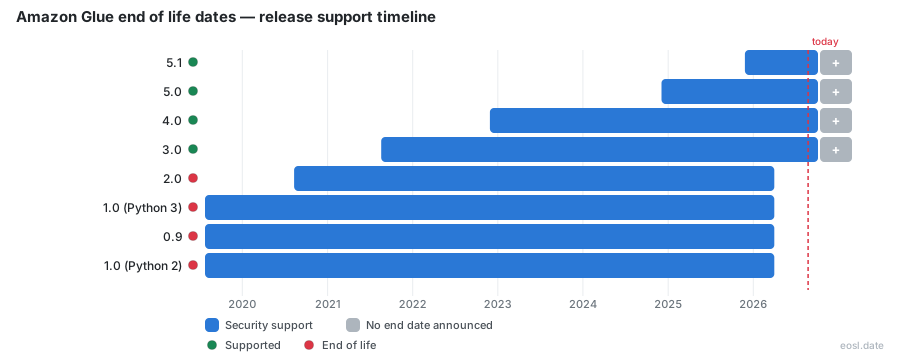
Currently Supported Amazon Glue Releases - Active EOS/EOSL Support (5)
| Release | Java Version | Python Version | Spark Version | Released | Security Support |
|---|---|---|---|---|---|
| 6.0 | 17 | 3.13 | 4.1.1 | (3 months ago) | Active |
| 5.1 | 17 | 3.11 | 3.5.6 | (11 months ago) | Active |
| 5.0 | 17 | 3.11 | 3.5.4 | (1 year and 11 months ago) | Active |
| 4.0 | 8 | 3.10 | 3.3.0 | (3 years and 11 months ago) | Active |
| 3.0 | 8 | 3.7 | 3.1.1 | (5 years and 3 months ago) | Active |
Amazon Glue End of Life (EOL) Releases - No Longer Supported (5)
| Release | Java Version | Python Version | Spark Version | Released | Security Support |
|---|---|---|---|---|---|
| 2.0 | N/A | 3.7 | 2.4.3 | (6 years and 3 months ago) | (7 months ago) |
| 1.0 (Python 3) | N/A | 3.6 | 2.4.3 | (7 years and 3 months ago) | (7 months ago) |
| 0.9 | N/A | 2.7 | 2.2.1 | (7 years and 3 months ago) | (7 months ago) |
| 1.0 (Python 2) | N/A | 2.7 | 2.4 | (7 years and 3 months ago) | (7 months ago) |
| 1.0 (Python 3) | - | 3.6 | 2.4 | (7 years and 3 months ago) | (4 years and 1 month ago) |
Searching for Amazon Glue End of Life dates usually means one thing: you need to know whether a job on AWS Glue, the serverless data integration service behind many analytics and machine learning pipelines in the cloud, is about to stop running. AWS Glue itself is not being retired, but the three oldest AWS Glue runtimes were switched off on April 1, 2026. This guide lists every date, explains what each stage does to your AWS Glue jobs, and shows how to move forward.
Amazon Glue End of Life: Which Versions Have Already Retired
Every AWS Glue job is pinned to a Glue version that fixes its Apache Spark and Python runtime. Retiring a version therefore retires every AWS Glue job pinned to it. Counting from the April 1 cutoff to today, October 27, 2026, the end of life date passed 209 days ago, so any AWS Glue job that was still on those versions has already been stopped.
| Type | Version | Runtime | End of support | End of life | Days between |
|---|---|---|---|---|---|
| Spark | 0.9 | Spark 2.2, Scala 2 | 2022-06-01 | 2026-04-01 | 1,400 |
| Spark | 1.0 | Spark 2.4, Python 2 | 2022-06-01 | 2026-04-01 | 1,400 |
| Spark | 1.0 | Spark 2.4, Scala 2, Python 3 | 2022-09-30 | 2026-04-01 | 1,279 |
| Spark | 2.0 | Spark 2.4, Python 3 | 2024-01-31 | 2026-04-01 | 791 |
| Shell | 1.0 | Older interpreter | 2022-06-01 | 2026-04-01 | 1,400 |
| Shell | 1.0 | PythonShell 3.6 | 2026-03-31 | 2026-06-01 | 62 |
| Development endpoint | Zeppelin | Notebook | 2022-09-30 | Not applicable | None |
The last column is my own arithmetic on the dates in the AWS Glue Developer Guide, and it shows the pattern: the oldest AWS Glue runtimes got about 3.8 years between the two stages, version 2.0 got 2.2 years, and PythonShell 3.6 got only 62 days. Do not assume a long runway for the next retirement. Third-party trackers such as endoflife.date mirror these dates, but the AWS Glue documentation remains the source of record.
Glue Version 0.9 and Glue Version 1.0 Retirements
Version 0.9 and the first-generation flavor of version 1.0 lost support on June 1, 2022, while the second flavor of 1.0 followed on September 30, 2022. All of them then waited until the same final date, so some AWS Glue jobs ran for almost four years on an unpatched runtime.
Glue Version 2.0 and the April 1, 2026 Cutoff
Version 2.0 lost support on January 31, 2024 and joined the others at the cutoff. Its Spark 2.4 base was the reason: once a major component leaves community support, AWS Glue retires the version that carries it.
End of Support vs EOL Under the AWS Glue Version Support Policy
The AWS Glue version support policy, documented in the Developer Guide, ends support for a version when any major component, such as the operating system, language or a bundled library, reaches the end of community long-term support and its fixes stop. AWS Glue builds every version from that mix of components, so one aging piece is enough to retire the whole version. The policy defines two separate stages, and mixing them up leads to wrong decisions.
What Changes at End of Support
Under end of support (EOS), your jobs keep running, but the safety net disappears:
- AWS Glue no longer applies security patches or other updates to the version.
- AWS Glue jobs on it are not eligible for technical support.
- AWS Glue may not honor SLAs for runs on EOS versions.
Quiet risk builds up here. Nothing fails, so nobody notices until the next stage.
Job Runs and Interactive Sessions After Retirement
At retirement, the failures become loud and every change starts at midnight Pacific time on the listed date. You can no longer create AWS Glue jobs or interactive sessions on the version, you can no longer start job runs, AWS Glue stops existing runs and sessions, and the version is removed from the SDKs and APIs. The policy page writes dates in month/day/year order, so read 4/1/2026 as April 1, not January 4.
Supported AWS Glue Versions and Their Spark and Python Runtimes
Five releases are currently supported, and the policy table lists no cutoff date for any of them. AWS Glue version 5.1 is the default version for jobs created without a specified one, though the default has moved over time: when the version property arrived in 2019 alongside worker types, unversioned jobs were treated as 0.9.
| Version | Released | Spark | Python | Java |
|---|---|---|---|---|
| 3.0 | 2021-08-19 | 3.1.1 | 3.7 | 8 |
| 4.0 | 2022-11-28 | 3.3.0 | 3.10 | 8 |
| 5.0 | 2024-12-03 | 3.5.4 | 3.11 | 17 |
| 5.1 | 2025-11-26 | 3.5.6 | 3.11 | 17 |
| 6.0 | 2026-08-21 | 4.1.1 | 3.13 | 17 |
Release gaps run 466, 736, 358 and 268 days, so a new Apache Spark line arrives roughly yearly in AWS Glue, and the newest is only 67 days old. If you want a fresh runtime without chasing the newest, 5.1 is the safer target, while 6.0 is the one to plan for.
Reading the Compatibility Matrix
Third-party trackers publish a compatibility matrix pairing each release with its language and engine versions, as the table above does. Use it before upgrading AWS Glue jobs: a major Apache Spark jump changes behavior, and every package your scripts import must support the new language version. List your dependencies first and confirm each one before touching the job.
Glue Version 6.0 and Glue Version 5.1 Highlights
AWS Glue version 6.0 moves to Apache Spark 4.1.1 with Scala 2.13.17 and brings Iceberg 1.11.0, Hudi 1.1.1 and Delta Lake 4.2.0 in its open table formats, plus real-time mode for stateless streaming. It removes EMRFS, so Amazon S3 access goes through the S3A connector, and it supports only AWS SDK for Java v2. Version 5.1 sits on Apache Spark 3.5.6, adds Iceberg 1.10.0 and Spark-native fine-grained access control, and logs audit context to CloudTrail.
Glue Version 5.0 Limits and the Glue 4.0 Gap
When you move off a retired version, these limits decide whether 5.0 or 4.0 is a safe target. Version 5.0 does not support the GlueContext table-level access control based on Lake Formation permissions that earlier AWS Glue releases allowed, so use fine-grained access control instead. Going the other way, Glue 4.0 launched without the machine learning and PII transforms, and Glue 3.0 predates the native Iceberg, Hudi and Delta Lake support that 4.0 introduced, which is another reason to skip both when starting new work. Glue 4.0 did add a new Amazon Redshift connector and optimizations developed on Amazon EMR, but those gains are available in every later AWS Glue release. The documentation for each release lists these limits, so read it before choosing a target.
Python Shell, Zeppelin Notebook and Other Deprecated Versions
Smaller job types follow the same rules. The Python shell flavor on version 1.0 lost support on March 31, 2026, and the policy page adds a restriction the general definition does not carry: new PythonShell 3.6 jobs cannot be created after that date, although you can still update and run existing ones until the June 1, 2026 retirement. The older interpreter's shell jobs retired earlier, on April 1.
The Zeppelin notebook for development endpoint use lost support on September 30, 2022, with no final date given. AWS Glue jobs running on deprecated versions get no patches, no technical support and no SLA, so treat any such notebook as an unmanaged environment. The GlueVersion setting does not change how a Python shell job behaves, which means bumping it alone gains nothing: you must make the script itself work on the newer language version. Check the console and your infrastructure templates for any leftover references.
AWS Glue for Ray Sunset: Closed to New Customers, Not Shut Down
The AWS Glue for Ray notice uses the phrase end of support, but it means something different from a version retirement. AWS closed the feature to new customers from April 30, 2026. Existing customers can continue as normal, and AWS keeps shipping security and availability improvements without adding new features. Read it as a maintenance-style sunset, not a shutdown date, and judge your own timeline by that.
Migration to Amazon Elastic Kubernetes Service
This move is optional, because AWS Glue for Ray is closed to fresh sign-ups but not retired. If you choose to leave, AWS recommends moving Ray workloads to Amazon Elastic Kubernetes Service (EKS) with the open-source KubeRay operator. You need the aws, kubectl, eksctl and helm command line tools plus Python version 3.9 or newer. The path has five steps:
- Choose a Docker image: the official
rayproject/ray:2.4.0-py39(amd64 only) or your own ARM64 build to match Graviton nodes. - Map job arguments to RayCluster fields, for instance
--min-workersbecomesworkerGroupSpecs[].minReplicas, and convert object store memory from percent to bytes. - Create the cluster, add a node group, and set up a namespace and IAM role for service accounts so pods can reach Amazon S3.
- Install KubeRay and deploy the Ray cluster.
- Submit the job and watch it on the Ray dashboard.
Preparing Before the Next End-of-Life Date
Rather than reacting to a notice, schedule a quarterly review of the version table in the Developer Guide against the versions your AWS Glue jobs use. The steps below cover the common cases.
Find Jobs Still Running on Old Versions
List every AWS Glue job pinned to a given version, then repeat for each old number:
aws glue get-jobs --query "Jobs[?GlueVersion=='2.0'].Name" --output textJobs that were created before the property existed may show no version at all, so check those by hand too.
Upgrade Spark Jobs with Generative AI Upgrades
The generative AI upgrades feature for Apache Spark analyzes existing scripts and configurations and drafts a migration plan, and it covers AWS Glue jobs from 2.0 upward. Review what it proposes before accepting: with 6.0, check custom libraries that assumed EMRFS or the older SDK, and rerun your Spark jobs on a sample dataset first. A short checklist keeps the upgrade honest:
- Pin the target AWS Glue version in a test copy of the job.
- Compare row counts between old and new output.
- Confirm every connector and driver is supported on the new version.
Move Python Shell Jobs to Python 3
In the console, select the newest Glue version for the job type. Through CreateJob or UpdateJob, set GlueVersion to 6.0 and PythonVersion to 3 under the Command parameter, then fix any script syntax that still depends on the old language.
EOL Impact on the Data Catalog, Crawlers and Integrations
A version retirement only touches the AWS Glue job runtime. The Data Catalog keeps working, because it is a shared metastore that Amazon Athena and Amazon EMR have read since general availability, and Amazon Redshift reads it too. AWS Glue crawlers, table definitions and Lake Formation permissions are unaffected, and so are Iceberg materialized views and federation with outside catalogs. The Data Catalog keeps widening its reach, and zero-ETL integration sources grew on the AWS Glue side in December 2024 and July 2025.
The retirement consequence is narrow: only job runtimes carry deadlines. Engines outside AWS Glue lean on the same catalog: Amazon Athena queries tables defined there, Amazon EMR clusters running Apache Spark use it as their Hive metastore, Amazon Redshift reads its external tables through it, and every one of them reaches data in Amazon S3. Apache Iceberg tables registered in the Data Catalog stay readable from all of those engines whichever runtime version wrote them. In practice your ETL code is the only part that carries a deadline. A data lakehouse built around the Data Catalog can therefore stay put while only the ETL jobs move versions, and the same holds for streaming ETL jobs that write into it. The zero-ETL track also moves on its own pace: its sources grew on the AWS Glue side rather than in the destination services.
The one adjacent item to watch is AWS Glue DataBrew: AWS documents a path to import recipes into Glue Studio, with UNION and JOIN recipes unsupported, but no official announcement places DataBrew in maintenance, so it is not a retirement to plan around today.
AWS Glue Timeline: Three Tracks, One Service
The service was announced on December 1, 2016 and reached general availability on August 14, 2017. Its timeline follows three tracks at different speeds: the job engine, which receives a new release about once a year, the Data Catalog, and zero-ETL integration with other services. Only the first track carries version end dates, which is why the Data Catalog and ETL features can look healthy while an old AWS Glue runtime is already past its deadline.