Amazon Aurora PostgreSQL End of Life (EOL) Dates and End of Support (EOS) Dates
Amazon Aurora PostgreSQL end of life (EOL) and end of support (EOS) dates: 3 Amazon Aurora PostgreSQL versions have reached EOL, including Amazon Aurora PostgreSQL 13 (EOL date: Feb 28, 2026) — no longer receiving security updates or patches. Amazon Aurora PostgreSQL 14 reaches its End of Support date on Feb 28, 2027 — plan your upgrade path now. Amazon Aurora PostgreSQL 18.6 is the current supported release, with support through Feb 28, 2031 — 4 versions in active support. Also see Amazon Corretto lifecycle dates for related end-of-life information.
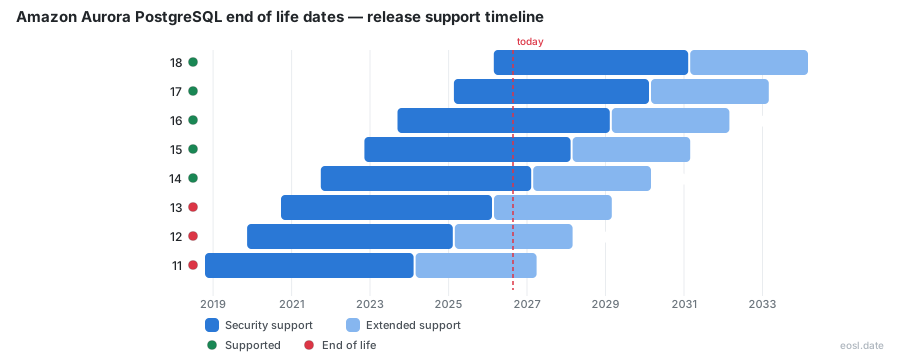
Currently Supported Amazon Aurora PostgreSQL Releases - Active EOS/EOSL Support (4)
| Release | Released | Security Support | Extended Support | Latest |
|---|---|---|---|---|
| 18 | (8 months ago) | (in 4 years and 3 months) | (in 7 years and 3 months) | 18.6 (1 month and 3 weeks ago) |
| 17 | (1 year and 9 months ago) | (in 3 years and 3 months) | (in 6 years and 3 months) | 17.11 (1 month and 3 weeks ago) |
| 16 | (3 years and 2 months ago) | (in 2 years and 3 months) | (in 5 years and 3 months) | 16.15 (1 month and 3 weeks ago) |
| 15 | (4 years ago) | (in 1 year and 3 months) | (in 4 years and 3 months) | 15.19 (1 month and 3 weeks ago) |
Amazon Aurora PostgreSQL Releases Nearing End of Life - Support Ending Soon (1)
| Release | Released | Security Support | Extended Support | Latest |
|---|---|---|---|---|
| 14 | (5 years and 1 month ago) | (in 3 months) | (in 3 years and 3 months) | 14.24 (1 month and 3 weeks ago) |
Amazon Aurora PostgreSQL End of Life (EOL) Releases - No Longer Supported (3)
| Release | Released | Security Support | Extended Support | Latest |
|---|---|---|---|---|
| 13 | (6 years and 1 month ago) | (8 months ago) | (in 2 years and 3 months) | 13.23 (11 months ago) |
| 12 | (7 years ago) | (1 year and 8 months ago) | (in 1 year and 3 months) | 12.22 (1 year and 11 months ago) |
| 11 | (8 years and 1 month ago) | (2 years and 8 months ago) | (in 4 months) | 11.21 (3 years and 2 months ago) |
Planning around Amazon Aurora PostgreSQL end of life starts with knowing which versions of your AWS database are about to lose standard support. Aurora is a serverless-capable, managed PostgreSQL service, a PaaS that AWS patches and retires on a published calendar, so every release has a date after which your options change.
Amazon Aurora PostgreSQL End of Life Dates for Each Major Version
Each of the major versions below stays under support at least until the PostgreSQL community retires it, and the Amazon RDS release notes for Aurora publish AWS's own cutoff. Aurora ships a new major version within eight months of the community's first minor release, so the next release date is never far behind PostgreSQL itself.
| PostgreSQL major version | Community end of life | Aurora end of standard support | RDS Extended Support ends |
|---|---|---|---|
| PostgreSQL 11 | November 2023 | 29 February 2024 | 31 March 2027 |
| PostgreSQL 12 | November 2024 | 28 February 2025 | 29 February 2028 |
| PostgreSQL 13 | November 2025 | 28 February 2026 | 28 February 2029 |
| PostgreSQL 14 | November 2026 | 28 February 2027 | 28 February 2030 |
| PostgreSQL 15 | November 2027 | 29 February 2028 | 28 February 2031 |
| PostgreSQL 16 | 9 November 2028 | 28 February 2029 | 28 February 2032 |
| PostgreSQL 17 | November 2029 | 28 February 2030 | 28 February 2033 |
| PostgreSQL 18 | November 2030 | 28 February 2031 | 28 February 2034 |
As of October 2026, versions 11, 12 and 13 are already past their cutoff, and PostgreSQL 14 follows on 28 February 2027. Clusters on 15 and later have at least a year of runway.
End of Standard Support for Minor Versions and Aurora LTS
Minor releases retire far sooner than majors. Aurora publishes a new one quarterly, within three months of the community build, and each carries its own retirement date, so a cluster pinned to an old minor can hit a deadline long before its major does. To see which engine version a cluster runs, check the console or run aws rds describe-db-engine-versions --engine aurora-postgresql.
| PostgreSQL minor version | Aurora release date | Aurora end of standard support |
|---|---|---|
| 18.6 | 29 September 2026 | 28 February 2028 |
| 17.11 | 29 September 2026 | 28 February 2028 |
| 16.15 | 29 September 2026 | 28 February 2028 |
| 15.19 | 29 September 2026 | 28 February 2028 |
| 14.24 | 29 September 2026 | 28 February 2027 |
| 17.7 (LTS) | 18 December 2025 | 28 February 2030 |
| 16.8 (LTS) | 8 April 2025 | 28 February 2029 |
| 15.10 (LTS) | 13 December 2024 | 29 February 2028 |
| 14.6 (LTS) | 23 January 2023 | 28 February 2027 |
The long-term support releases are the exception: they stay available much longer, which suits workloads that cannot take frequent changes.
Aurora Deprecation Policy, Version Currency Timelines and Upgrade Windows
The published deprecation policy rests on a fixed release cadence:
- A new major release arrives within eight months of the community's first minor for that release.
- Each minor arrives within three months of the community build.
- The LTS build for a major arrives within twelve months of that major's Aurora launch.
Upgrades run in your scheduled maintenance windows, which AWS sets at first and you can change in the AWS console. Depending on the version type, an update can be manual, automatic, or forced, and a security problem can pull a version out of service early. A retired minor generally needs an upgrade within about three months, and a major within six. Check the Amazon Aurora FAQs for the current wording before you commit to a date.
Deprecated Versions and RDS Extended Support Pricing
On the cutoff date, Aurora automatically enrolls every cluster still running a deprecated major version in RDS Extended Support, a paid offering that lasts up to 3 years. Year 1 pricing begins the day after standard support ends (1 March 2026 for version 13) and the higher year 3 pricing begins two years later (1 March 2028). Only certain builds qualify: 13.9 and 13.23 for version 13, 12.9 and 12.22 for version 12.
Treat the extra charge as a bridge, not a plan. If you run PostgreSQL 14, schedule the major upgrade before 28 February 2027, test it on a cloned cluster first, and keep the extended window only as a fallback.