Alibaba Dragonwell End of Life (EOL) Dates and End of Support (EOS) Dates
Alibaba Dragonwell end of life (EOL) and end of support (EOS) dates: 8 (LTS) has reached EOL — EOL date: Jun 30, 2026. This version no longer receives security updates, patches, or support. Alibaba Dragonwell 25.0.5.1.6+2 LTS is the current supported release, with support through Sep 30, 2029 — 4 versions in active support. Also see PHP EOSL information for related end-of-life information.
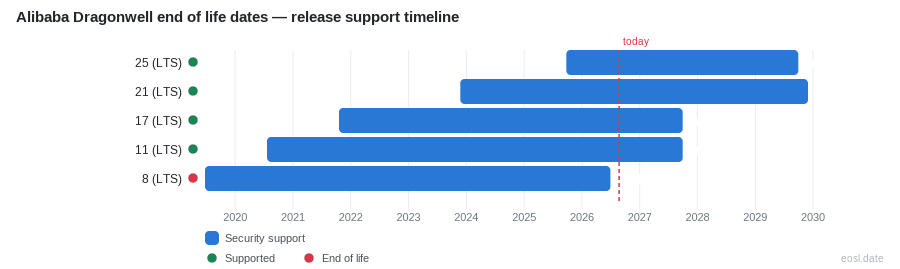
Currently Supported Alibaba Dragonwell Releases - Active EOS/EOSL Support (4)
| Release | Released | Security Support | Latest | LTS |
|---|---|---|---|---|
| 25 (LTS) | (1 year and 1 month ago) | (in 2 years and 10 months) | 25.0.5.1.6+2 (3 days ago) | LTS |
| 21 (LTS) | (2 years and 11 months ago) | (in 3 years) | 21.0.13.1.14+2 (3 days ago) | LTS |
| 17 (LTS) | (5 years and 1 month ago) | (in 10 months) | 17.0.21.1.22+2 (3 days ago) | LTS |
| 11 (LTS) | (6 years and 4 months ago) | (in 10 months) | 11.0.32.28 (2 months ago) | LTS |
Alibaba Dragonwell End of Life (EOL) Releases - No Longer Supported (1)
| Release | Released | Security Support | Latest | LTS |
|---|---|---|---|---|
| 8 (LTS) | (7 years and 4 months ago) | (4 months ago) | 8.30.29 (2 months ago) | LTS |
If you run Java on Alibaba's own OpenJDK build, Alibaba Dragonwell end of life is a date worth putting on the calendar early. Dragonwell began as a JDK for Alibaba's e-commerce workloads, and no release line has been discontinued: each long-term line carries a published floor for maintenance, and Java 8 stays covered until at least December 2030. Below are the dates, the two editions and a migration plan.
Alibaba Dragonwell End of Life Dates by Version
No formal EOL has been announced for any Dragonwell line, so the lifecycle dates below are minimums. Instead, the project's maintenance page, last edited on April 1, 2026, gives a minimum date for each LTS line. Check the schedule below, then weigh the impacts of each date on your own fleet.
| Version | Editions | Maintained until at least |
|---|---|---|
| Dragonwell 8 | Extended, Standard | December 2030 |
| Dragonwell 11 | Extended, Standard | December 2027 |
| Dragonwell 17 | Standard | December 2027 |
| Dragonwell 21 | Extended, Standard | December 2029 |
| Dragonwell 25 | Standard | September 2031 |
The 11 and 17 lines come first: December 2027 is about 14 months after this article's date of October 2026. Treat every date as a floor, not an exact shutdown.
Dragonwell 8 and 11 long-term support windows
Dragonwell is a downstream distribution of OpenJDK that stays completely open source, and Alibaba describes it as a free release with performance enhancements and long-term maintenance. Java 8 is still common in older financial systems, so its 2030 floor matters most. Teams on Java 8 can raise problems on the dragonwell8 repository, where the community follows up, and Alibaba points to its technical support channels through that same page. Because the line is built for stability, stay on the latest version of your line.
Quarterly updates and security fixes
These quarterly updates are what the maintained-until dates promise, so a line past its floor stops receiving them. Dragonwell follows OpenJDK's rhythm, shipping one update every quarter around January, April, July and October. Each update brings the upstream security fixes into Alibaba's tree, and Dragonwell8 packages follow the same cadence. The releases page for Dragonwell 25 lists 25.0.4 as its newest tag, with a Standard and an Extended binary beside it. Download only from the project's own releases list and rebuild any custom image from that package.
Dragonwell JDK Editions: Standard and Extended
Every Dragonwell JDK ships as Standard, which tracks OpenJDK closely, and several lines also ship as Extended, which adds Alibaba-built features. Only Standard exists for 17 and 25. Alibaba's engineers call their custom Java Development Kit AJDK, and the Dragonwell JVM inside it runs on Alibaba Cloud and across thousands of Alibaba servers for applications such as the Double 11 shopping festival. The Dragonwell 11 Extended notes also mention an AI extension aimed at Spark workloads, a reminder that these customizations target large cloud platform deployments and a performance gain only where your code uses them.
Wisp, ElasticHeap and ZGC in Extended builds
Alibaba's write-ups describe Wisp, which turns blocking thread calls into lightweight coroutines and cut CPU use by about 7% near peak load on Double 11 servers. ElasticHeap hands unused heap memory back to the host, lowering memory use between garbage collection cycles, while ZGC is the low-pause collector. Check each Extended release note to see which feature set your version ships, because applications that depend on those coroutines cannot simply run on another distribution. Because these features exist only in Extended builds, they decide how hard a move off Dragonwell will be when a line's maintenance ends.
Planning a Dragonwell JVM Migration Before Support Ends
Because nothing has ended, this is preparation rather than an emergency. Inventory the hosts that run Dragonwell, the applications on them, the tools that attach to them, such as JDK Flight Recorder and Mission Control, and the resources a restart will need, then migrate the least critical server and its application first. The 11 and 17 lines, with their December 2027 floors, are the first to plan for.
Check your Java version on Linux
- Run
java -version; a Dragonwell runtime names itself in the output. - Run
update-alternatives --display javato see which install path wins on that host. - Note the path, for example /usr/local/dragonwell8, and the CPU type, since ARM hosts need their own package; AdoptOpenJDK ran a jdk8u-linux-aarch64-dragonwell build job in February 2021.
Drop-in replacement OpenJDK builds
The AdoptOpenJDK announcement of 2020 called Dragonwell a TCK-certified implementation of Java SE and a drop-in replacement for any other variant, compatible with the same tools. The reverse also holds: a standard OpenJDK should run code that avoids Alibaba-only APIs. Java code that imports classes such as com.alibaba.tenant is the exception to test first. Verify that a candidate's current vendor status before you commit.
Switch the default JAVA_HOME safely
Install the new JDK beside the old one, never over it. Then run sudo update-alternatives --config java to choose the new default, and point JAVA_HOME at it in /etc/environment. Keep the old directory until a full test cycle passes, so rollback is one command.
Alibaba Cloud EOL Notice: Not a Dragonwell Announcement
Searching for Dragonwell lifecycle news surfaces Alibaba Cloud's EOL notice of July 26, 2024, which concerns the classic network, not the JDK. It set end of sale for subscription resources on August 27, 2024 and for all new classic-network resources on September 24, 2024. Configuration changes closed on October 30, 2024, and forced release followed on February 28, 2025. Affected services must move to a VPC, so check your infrastructure inventory against that Alibaba Cloud list. Likewise, a 2021 Temurin issue about a failed job was a one-off build break that closed on February 18, 2021, not a lifecycle signal. The table above remains the reference for Dragonwell dates.