PHP End of Life (EOL) Dates and End of Support (EOS) Dates
PHP end of life (EOL) and end of support (EOS) dates: 19 PHP versions have reached EOL, including PHP 8.1 (EOL date: Dec 31, 2025) — no longer receiving security updates or patches. PHP 8.2 reaches its End of Support date on Dec 31, 2026 — plan your upgrade path now. PHP 8.6.0 is the current supported release, with support through Dec 31, 2030 — 4 versions in active support. Also see Alibaba Dragonwell end of support life for related end-of-life information.
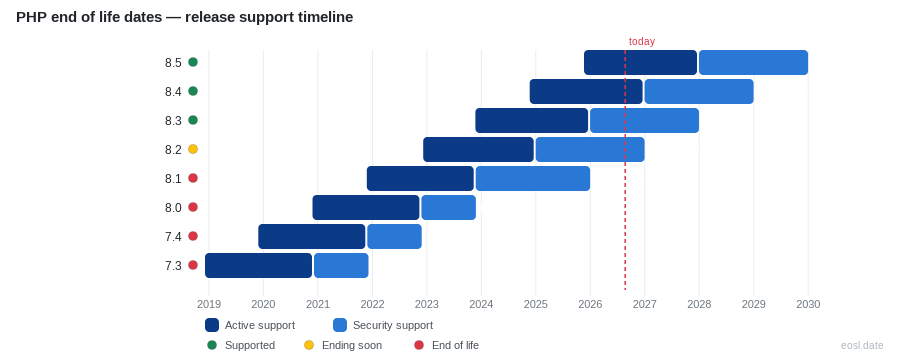
Currently Supported PHP Releases - Active EOS/EOSL Support (4)
| Release | Released | Security Support | Active Support | Latest |
|---|---|---|---|---|
| 8.6 | (2 days ago) | (in 4 years and 1 month) | (in 2 years and 1 month) | 8.6.0 (2 days ago) |
| 8.5 | (1 year ago) | (in 3 years and 1 month) | (in 1 year and 1 month) | 8.5.12 (1 month ago) |
| 8.4 | (2 years ago) | (in 2 years and 1 month) | (in 1 month and 1 week) | 8.4.27 (1 month ago) |
| 8.3 | (2 years and 11 months ago) | (in 1 year and 1 month) | (10 months ago) | 8.3.36 (1 month ago) |
PHP Releases Nearing End of Life - Support Ending Soon (1)
| Release | Released | Security Support | Active Support | Latest |
|---|---|---|---|---|
| 8.2 | (3 years and 11 months ago) | (in 1 month and 1 week) | (1 year and 10 months ago) | 8.2.35 (1 month ago) |
PHP End of Life (EOL) Releases - No Longer Supported (19)
| Release | Released | Security Support | Active Support | Latest |
|---|---|---|---|---|
| 8.1 | (4 years and 11 months ago) | (10 months ago) | (2 years and 11 months ago) | 8.1.34 (11 months ago) |
| 8.0 | (5 years and 11 months ago) | (2 years and 11 months ago) | (3 years and 11 months ago) | 8.0.30 (3 years and 3 months ago) |
| 7.4 | (6 years and 11 months ago) | (3 years and 11 months ago) | (4 years and 11 months ago) | 7.4.33 (4 years ago) |
| 7.3 | (7 years and 11 months ago) | (4 years and 11 months ago) | (5 years and 11 months ago) | 7.3.33 (5 years ago) |
| 7.2 | (8 years and 11 months ago) | (5 years and 11 months ago) | (6 years and 11 months ago) | 7.2.34 (6 years and 1 month ago) |
| 7.1 | (9 years and 11 months ago) | (6 years and 11 months ago) | (7 years and 11 months ago) | 7.1.33 (7 years ago) |
| 7.0 | (10 years and 11 months ago) | (7 years and 10 months ago) | (8 years and 10 months ago) | 7.0.33 (7 years and 10 months ago) |
| 5.6 | (12 years and 2 months ago) | (7 years and 10 months ago) | (9 years and 10 months ago) | 5.6.40 (7 years and 10 months ago) |
| 5.5 | (13 years and 5 months ago) | (10 years and 4 months ago) | (11 years and 4 months ago) | 5.5.38 (10 years and 4 months ago) |
| 5.4 | (14 years and 8 months ago) | (11 years and 2 months ago) | (12 years and 2 months ago) | 5.4.45 (11 years and 2 months ago) |
| 5.3 | (17 years and 4 months ago) | (12 years and 3 months ago) | (15 years and 4 months ago) | 5.3.29 (12 years and 3 months ago) |
| 5.2 | (20 years ago) | (15 years and 10 months ago) | (18 years ago) | 5.2.17 (15 years and 10 months ago) |
| 5.1 | (20 years and 11 months ago) | (20 years and 2 months ago) | (20 years and 2 months ago) | 5.1.6 (20 years and 2 months ago) |
| 4.4 | (21 years and 4 months ago) | (18 years and 3 months ago) | (18 years and 10 months ago) | 4.4.9 (18 years and 3 months ago) |
| 5.0 | (22 years and 4 months ago) | (21 years and 2 months ago) | (21 years and 2 months ago) | 5.0.5 (21 years and 2 months ago) |
| 4.3 | (23 years and 10 months ago) | (21 years and 7 months ago) | (21 years and 7 months ago) | 4.3.11 (21 years and 7 months ago) |
| 4.2 | (24 years and 6 months ago) | (24 years and 2 months ago) | (24 years and 2 months ago) | 4.2.3 (24 years and 2 months ago) |
| 4.1 | (24 years and 11 months ago) | (24 years and 8 months ago) | (24 years and 8 months ago) | 4.1.2 (24 years and 8 months ago) |
| 4.0 | (26 years and 5 months ago) | (25 years and 4 months ago) | (25 years and 4 months ago) | 4.0.6 (25 years and 4 months ago) |
Looking for the PHP end of life dates before your site runs out of fixes? Every release branch gets two years of regular updates plus two more of security patches, then reaches end of life and receives nothing. This guide lists each branch's cutoff, shows what EOL costs you in security and compliance, and explains how to leave unsupported PHP versions behind.
PHP End of Life: Dates for Every Release
The table lists when each branch stopped, or will stop, receiving fixes. Only four supported versions remain: 8.2, 8.3, 8.4 and 8.5. The php 8.1 end of life landed on 31 Dec 2025, and 8.1.34 was its last release, so 8.1 and anything older gets no further patches. PHP 8.4 and PHP 8.5 are the safest picks for production, while 8.6 is still in its release candidate phase.
| Branch | Initial release | Active support ends | Security cutoff | Status |
|---|---|---|---|---|
| 8.5 | 20 Nov 2025 | 31 Dec 2027 | 31 Dec 2029 | Active |
| 8.4 | 21 Nov 2024 | 31 Dec 2026 | 31 Dec 2028 | Active |
| 8.3 | 23 Nov 2023 | 31 Dec 2025 | 31 Dec 2027 | Security only |
| 8.2 | 8 Dec 2022 | 31 Dec 2024 | 31 Dec 2026 | Security only |
| 8.1 | 25 Nov 2021 | 25 Nov 2023 | 31 Dec 2025 | Ended |
| 8.0 | 26 Nov 2020 | 26 Nov 2022 | 26 Nov 2023 | Ended |
| 7.4 | 28 Nov 2019 | 28 Nov 2021 | 28 Nov 2022 | Ended |
| 7.3 | 6 Dec 2018 | 6 Dec 2020 | 6 Dec 2021 | Ended |
| 7.2 | 30 Nov 2017 | 30 Nov 2019 | 30 Nov 2020 | Ended |
Each support timeline above is a fixed date, not an estimate, and the project has never extended a branch once it closed. Even the end-of-life branches keep running in production, but only because nobody has forced the move yet.
PHP 8.2 End of Life: December 31, 2026
PHP 8.2 is the next branch to fall off the calendar. Its bug fixes ended in 2024, so it now receives only critical security patches. After December 31, 2026, a newly disclosed flaw stays open, so plan the php 8.2 end of life now rather than in December.
PHP 8.3: Security Support Through 2027
This branch entered security support when active support closed on 31 Dec 2025, and it runs until December 31, 2027. That is a comfortable runway, but a team already on it should schedule the next hop before the last year.
PHP 7.4 End of Life and Older Branches
PHP 7.4 End of Life arrived on 28 Nov 2022, yet it stays one of the most deployed legacy releases because 8.0 introduced breaking changes. Branches 8.0, 7.3 and 7.2 sit in the same position, and every CVE disclosed since their cutoffs is open there.
How the PHP Lifecycle and Support Policy Work
The php lifecycle is predictable: each release branch ships in November and is supported for four years. The php release cycle gives it two years of bug fixes and regular point releases, then two years of security fixes only. The support policy used to be shorter, with a single year of security cover, until the project lengthened it in 2024.
Active Support and the Support Window
Every supported version sits in one of two phases. During active support, reported bugs are fixed; afterwards only critical flaws get a patch, on an as-needed basis. The support window for 8.4 closes on December 31, 2028, because the project aligns every cutoff to the end of a calendar year.
EOL PHP Risk: Critical Vulnerabilities and CVE Exposure
Running EOL PHP gives attackers a standing advantage. Once a branch is dropped, the project ships no security patches, so each new disclosure of critical vulnerabilities stays open for good. The October 2026 releases 8.5.12, 8.4.27, 8.3.36 and 8.2.35 fixed two flaws with remote code execution potential, while 8.1 and older received only minimal source backports. That is the real risk of EOL PHP: the fix exists, just not for your branch.
CVE-2026-109618 and CVE-2026-109619 Mitigation
The CERT-EU security advisory rates both flaws CVSS 9.2. One corrupts memory when a request exceeds memory_limit; the other reuses stale global state between requests. Any setup that serves web requests is exposed, php-fpm and mod_php included, so treat them as security vulnerabilities you cannot defer. The advice is immediate patching, using distribution packages or your vendor's backports. Temporary mitigation, such as disabling session upload progress, narrows exposure but does not make a host safe. Earlier, unpatched 7.x hosts were exploited in the wild through CVE-2024-4577, which shows how quickly EOL turns into an incident.
Compliance Audit and Hosting Fallout of EOL PHP
Auditors flag EOL PHP and other outdated runtimes. PCI DSS, HIPAA, SOC 2, GDPR and FedRAMP expect current software, and the EU Cyber Resilience Act points the same way. Vulnerability scanners report old PHP automatically, so the finding arrives before the auditor does. A hosting provider may also retire the old runtime at the next platform move, and dependencies drop old branches too, turning a one-step upgrade into a multi-step one.
PHP Versions Reaching EOL Next: WordPress and Frameworks
WordPress runs on PHP and powers roughly 43% of websites according to W3Techs, so each cutoff reaches millions of sites. Many plugins and themes were slow to declare 8.x compatibility, which is why older PHP versions such as 7.4 linger on shared hosting. Drupal 11 needs PHP 8.3 and Laravel 11 needs 8.2 or higher, so a framework or CMS upgrade often has to come first. Symfony, Magento, Joomla and CodeIgniter apps have the same coupling. Check which PHP version your CMS demands before touching the runtime, because WordPress and its extensions set the real floor.
Check Your PHP Version for EOL Status
Before planning anything, confirm which PHP version each machine really runs. WordPress and Drupal admin dashboards show it, and a typical stack mixes Linux or Windows, Apache or nginx and MySQL, and the command-line build can differ from the one your web server loads, so one check is never enough.
Command Line and phpinfo Checks
Run php -v in a shell for the CLI build, then create a temporary file calling phpinfo(); to see what the stack uses. Delete it right after, because it exposes configuration, then compare the result with the end of life dates above.
Composer, Containers and Control Panel Settings
Run composer check-platform-reqs to see whether the environment meets package requirements. In a container, read the Docker image tag, Kubernetes manifests and CI/CD pipeline files, since an old base image carries a dead runtime. In cPanel or Plesk, the PHP selector shows the version per site. Compare the version you find with the EOL dates in the table above.
Upgrade Options for Unsupported PHP
You have three realistic routes off EOL PHP: upgrade in place, modernize, or buy support. Developers can often handle a small website with a current CMS alone; web applications, ecommerce stores and enterprise software with custom code warrant specialist help.
Choosing an Upgrade Path In Place
An in-place move works when dependencies already support the target branch. Jumping from 7.4 to 8.4 crosses stricter typing, deprecated dynamic properties and other breaking changes, so allow time for testing. Skipping several PHP versions at once raises the cost. Rector can automate many code rewrites.
Migration Guide and Re-platforming
Follow the official migration guide for each branch you cross. When an EOL branch depends on abandoned libraries, a migration to a newer framework, or a full re-platform to Python or Go, can cost less than patching. It is also the slowest route.
Long-Term Support for EOL Workloads
Not every team can upgrade before the deadline. Long-term support from a PHP LTS vendor delivers patched runtimes for branches the project has dropped, which buys time and keeps EOL PHP covered while you migrate.
Commercial Extended Support
Vendors sell updated runtimes as packages for Linux and Windows, and some call it Never-Ending Support. Treat it as a bridge, not a destination: it closes the vulnerability gap but leaves the compatibility problems of an old branch in place.
Planning Ahead for PHP EOL Events
Good PHP end of life website maintenance starts before the deadline. Put every PHP EOL date in a calendar and work backward from it.
- Build an inventory of every application, owner, PHP version and hosting platform.
- Prioritize public-facing, revenue-generating and regulated applications first.
- Budget for dependency upgrades, test creation and any specialist help before the cutoff arrives.
Done early, the next EOL becomes a routine upgrade instead of an emergency.