Weakforced End of Life (EOL) Dates and End of Support (EOS) Dates
Weakforced end of life (EOL) and end of support (EOS) dates: 8 Weakforced versions have reached EOL, including Weakforced 3.0 (EOL date: Aug 20, 2026) — no longer receiving security updates or patches. Weakforced 3.2.0 is the current supported release. Also see Caddy EOSL information for related end-of-life information.
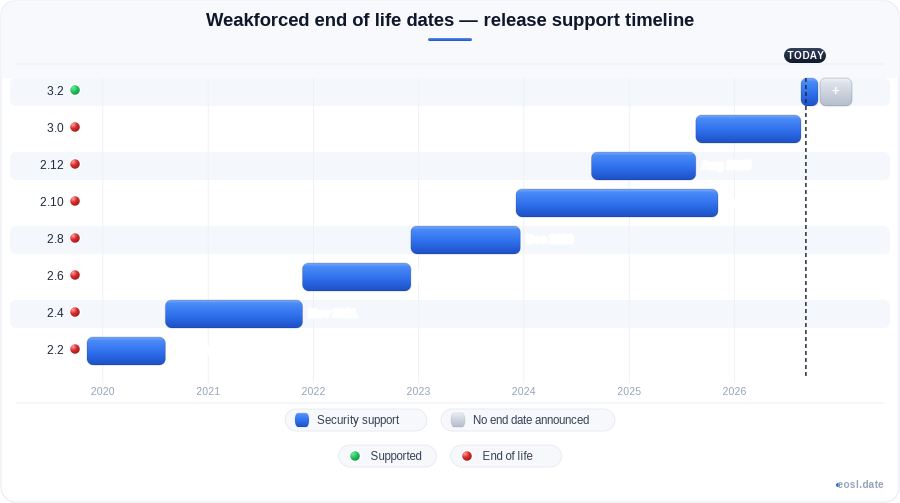
Currently Supported Weakforced Releases - Active EOS/EOSL Support (1)
| Release | Released | Security Support | Latest |
|---|---|---|---|
| 3.2 | (2 months ago) | Active | 3.2.0 (2 months ago) |
Weakforced End of Life (EOL) Releases - No Longer Supported (8)
| Release | Released | Security Support | Latest |
|---|---|---|---|
| 3.0 | (1 year and 2 months ago) | (2 months ago) | 3.0.1 (6 months ago) |
| 2.12 | (2 years and 2 months ago) | (1 year and 2 months ago) | 2.12.1 (1 year and 9 months ago) |
| 2.10 | (2 years and 11 months ago) | (1 year ago) | 2.10.3 (1 year ago) |
| 2.8 | (3 years and 11 months ago) | (2 years and 10 months ago) | 2.8.0 (3 years and 11 months ago) |
| 2.6 | (4 years and 11 months ago) | (3 years and 11 months ago) | 2.6.2 (4 years and 5 months ago) |
| 2.4 | (6 years and 3 months ago) | (4 years and 11 months ago) | 2.4.1 (5 years and 4 months ago) |
| 2.2 | (7 years ago) | (6 years and 3 months ago) | 2.2.2 (6 years and 8 months ago) |
| 2.0 | (7 years and 11 months ago) | (6 years and 11 months ago) | 2.0.1 (7 years and 6 months ago) |
Planning an upgrade? Here is where weakforced end of life dates stand today. Wforce is an open-source anti-abuse engine that acts as a policy decision point for your logins, and only the newest release line still gets security fixes, so check your version before the next maintenance window.
Weakforced End of Life Status for Each Release
The table below lists every line published so far and when its security support stopped. Only 3.2 is covered at the moment, and the 3.0 line lost cover on 20 August 2026, the same day 3.2.0 shipped. If you handle email, web portals or any login path, treat an expired row as a finding to fix, not a note to file.
| Release | Released | Security support ended | Last version |
|---|---|---|---|
| 3.2 | 20 Aug 2026 | Still supported | 3.2.0 |
| 3.0 | 20 Aug 2025 | 20 Aug 2026 | 3.0.1 |
| 2.12 | 23 Aug 2024 | 20 Aug 2025 | 2.12.1 |
| 2.10 | 5 Dec 2023 | 5 Nov 2025 | 2.10.3 |
| 2.8 | 5 Dec 2022 | 20 Dec 2023 | 2.8.0 |
| 2.6 | 24 Nov 2021 | 5 Dec 2022 | 2.6.2 |
| 2.4 | 5 Aug 2020 | 24 Nov 2021 | 2.4.1 |
| 2.2 | 7 Nov 2019 | 5 Aug 2020 | 2.2.2 |
| 2.0 | 11 Dec 2018 | 25 Nov 2019 | 2.0.1 |
Anything older than 3.2 should be called retired. Pick the latest release for any new deployment.
Weakforced Release Policy and Release Cycle
The project publishes no formal release policy, so the pattern has to be read from history. Looking at past versions, a new minor version has appeared roughly once a year, and every new release cycle closes the previous one. Public stable cycles carry an even minor number, which is why you see 2.8, 2.10, 2.12 and 3.2 in the table.
Major release and minor release patterns
The jump from 2.x to 3.0 was the only major release in recent years. Each minor release adds features, and the older line stops getting attention once its successor is out.
Patch versions between cycles
Inside the current cycle, patch versions such as 3.0.1 appear as needed. A pre-release candidate, such as the 3.2.0 RC1 build, precedes each stable tag, so keep candidates out of production.
Wforce Security Support and Supported Release Lines
A supported release is one that still receives security updates. Once a line is retired, a flaw found in it is fixed only in the newer lines, so an old install keeps its known weaknesses. Running unpatched security software in front of your login systems defeats the purpose of installing it.
Some projects keep a narrower tier of critical updates before full retirement; wforce does not publish one, so assume nothing beyond the newest line. If you rely on a commercial agreement or a paid support agreement with the vendors, ask them directly what coverage you hold for an old line, because the public dates do not describe private arrangements.
Upgrade Steps Before a Wforce Release Is Retired
An upgrade is mostly a matter of knowing what you run and where it came from, then rebuilding from the current sources on GitHub.
Check your current wforce version
Open the runtime console and ask the daemon directly:
wforce -c
> showVersion()
Compare the answer with the table above.
Packages, Docker and operating system targets
The builder produces packages for Debian bookworm and trixie and for Ubuntu jammy and noble, and a Docker image is published on Docker Hub. The 3.2.0 notes add Ubuntu resolute as a target, so an Ubuntu or Debian host rarely blocks an upgrade. Since 2.12 the packages bundle a LuaJIT fork that fixes problems under heavy load. The repository on GitHub also holds the build scripts, so a source rebuild is possible when packages do not fit.
Weakforced Releases: Improvements, New Features and Bug Fixes
The newest weakforced releases show what a move off an old line gets you. The 3.2.0 build adds the replfwd daemon for forwarding events between clusters, TLS for the Redis connection, and a call that reloads GeoIP databases without a restart, so GeoIP lookups stay current. A retired line lacks replfwd, which cuts cross-cluster replication traffic, so that is one more reason to move off it. It also adds IPv4 and IPv6 prefix lengths for list entries, and fixes a bug where JA3 entries were not reloaded on startup.
The 3.0.1 patch repaired persistent lists that stopped loading at 1000 entries, and it trimmed noisy logging. Smaller improvements cover new build targets and command completion. Whichever line you land on, read the notes before you roll out.
Release notes and changelog
Each tag on GitHub carries release notes grouped by type, and the repository keeps a changelog file. Skim them for removed settings before you touch a config.
Wforce Anti-Abuse and Brute Force Protection
Because the engine sits in front of every login, running a retired line leaves your brute-force defences unpatched. It is an anti-abuse layer for authentication. Services report successful and failed logins through a JSON interface and ask whether the next one should proceed, be delayed or be ignored. That lets you catch brute force activity spread across many servers, plus slow brute forcing by a botnet that tries a few passwords per account.
Feeds from IMAP, POP3, SMTP, FTP and webmail all count login attempts, and a Lua policy turns the counts into allow, delay or block decisions. An unpatched decision engine is one you cannot trust to make them.
Wforce Features to Review Before the Release Life Cycle Ends
When a line approaches the end of its release life cycle, audit the features you actually use, because behavior can differ in the new line.
- A built-in statistics DB with sliding windows, which feeds your policy.
- Blacklists and whitelists held in Redis, which are persistent across restarts.
- Replication of the stats and lists between instances; check it still works after the upgrade.
- Webhooks for core events and a REST API, plus custom API endpoints written in Lua. Any script that calls the API should be retested.
- Prometheus metrics, and trackalert for scheduled Lua jobs.
The code lives in the PowerDNS organization on GitHub, and the engine is a joint effort of PowerDNS, Dovecot and Open-Xchange, so PowerDNS documentation is the primary reference for every API call.
Wforce Versus PowerDNS Authoritative Server Support Statements
Do not confuse these two. The PowerDNS Authoritative DNS server has its own life cycle page, and its dates do not apply here. Its page shows how a mature project handles a legacy line: the 3.x series receives no updates, not even for security, and the 2.x series is exposed to a denial of service advisory. A minor release train there gets critical-only updates for a time before retirement. Wforce publishes no equivalent tier, so the table above is your only schedule.
Where to Track Wforce Release Information
The most reliable release information is the dated table on endoflife.date, the GitHub tags, and the documentation site. Check it each time you plan a window, and note the next retirement date for your authentication stack in your calendar.