VMware Site Recovery Manager End of Life (EOL) Dates and End of Support (EOS) Dates
VMware Site Recovery Manager end of life (EOL) and end of support (EOS) dates: 13 VMware Site Recovery Manager versions have reached EOL, including VMware Site Recovery Manager 8.8 (EOL date: Oct 11, 2025) — no longer receiving security updates or patches. VMware Site Recovery Manager 9.1.0.0 is the current supported release, with support through Aug 12, 2028 — 2 versions in active support. Also see VMware Cloud Foundation end of support dates for related end-of-life information.
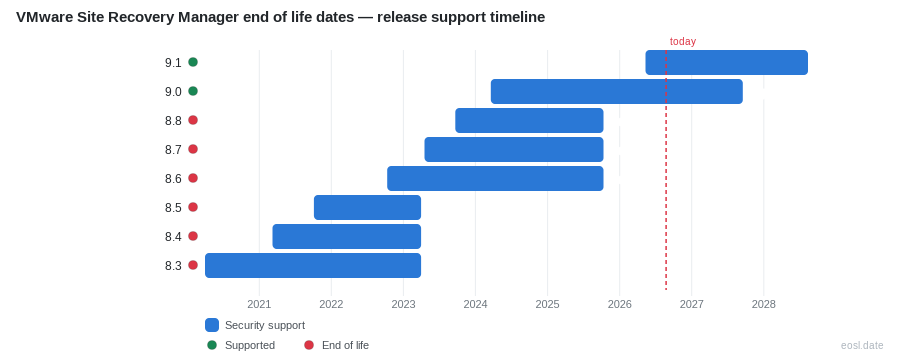
Currently Supported VMware Site Recovery Manager Releases - Active EOS/EOSL Support (2)
VMware Site Recovery Manager End of Life (EOL) Releases - No Longer Supported (13)
| Release | Technical Guidance | Released | General Support | Latest |
|---|---|---|---|---|
| 8.8 | 2026-10-11 | (3 years and 2 months ago) | (1 year and 1 month ago) | 8.8.0.3 (2 years and 9 months ago) |
| 8.7 | 2026-10-11 | (3 years and 7 months ago) | (1 year and 1 month ago) | 8.7.0.4 (2 years and 9 months ago) |
| 8.6 | 2026-10-11 | (4 years and 1 month ago) | (1 year and 1 month ago) | 8.6.0.2 (3 years and 4 months ago) |
| 8.5 | 2024-04-01 | (5 years and 1 month ago) | (3 years and 7 months ago) | 8.5.0.8 (3 years and 1 month ago) |
| 8.4 | 2024-04-01 | (5 years and 8 months ago) | (3 years and 7 months ago) | 8.4.0.5 (4 years and 7 months ago) |
| 8.3 | 2024-04-01 | (6 years and 7 months ago) | (3 years and 7 months ago) | 8.3.1.6 (4 years and 4 months ago) |
| 8.2 | 2023-11-15 | (7 years and 6 months ago) | (5 years ago) | 8.2.1.2 (5 years and 5 months ago) |
| 8.1 | 2023-11-15 | (8 years and 7 months ago) | (5 years ago) | 8.1.2.4 (5 years and 5 months ago) |
| 6.5 | 2023-11-15 | (10 years ago) | (5 years ago) | 6.5.1.3 (7 years and 4 months ago) |
| 6.0 | 2022-03-12 | (11 years and 8 months ago) | (6 years and 8 months ago) | 6.0.0.1 (11 years and 6 months ago) |
| 6.1 | 2022-03-12 | (11 years and 8 months ago) | (6 years and 8 months ago) | 6.1.2.2 (8 years and 3 months ago) |
| 5.5 | 2020-09-19 | (13 years and 2 months ago) | (8 years and 2 months ago) | 5.5.1.7 (10 years and 2 months ago) |
| 5.8 | 2020-09-19 | (13 years and 2 months ago) | (8 years and 2 months ago) | 5.8.1.1 (10 years and 3 months ago) |
Planning around VMware Site Recovery Manager end of life is now urgent: every 8.x release has left general support, and the 8.6, 8.7 and 8.8 releases lost technical guidance on 11 October 2026. Use this guide to check each VMware release date and decide what to do next.
VMware Site Recovery Manager End of Life Dates by Version
Broadcom does not list the product on its own. It follows the same EOS timelines as VMware Live Recovery, so the table below shows each release's current support status. End of general support for 8.6 through 8.8 came on 11 October 2025.
| Release | General support ended or ends | Technical guidance ends |
|---|---|---|
| SRM 8.8 | 11 October 2025 | 11 October 2026 |
| SRM 8.7 | 11 October 2025 | 11 October 2026 |
| SRM 8.6 | 11 October 2025 | 11 October 2026 |
| 9.0 | 17 September 2027 | 17 September 2028 |
| 9.1 | 12 August 2028 | 12 February 2029 |
SRM 8.5 and Older Releases
Releases 8.5, 8.4 and 8.3 left general support on 1 April 2023 and technical guidance on 1 April 2024. Anything older ended even earlier.
End of General Support vs Technical Guidance Phases
Each phase ends on its own date, so the two columns above are not interchangeable.
What General Support Covers
While a release is in general support, you get bug fixes, security patches and security updates, plus technical assistance under your subscription terms.
What Technical Guidance Covers
During technical guidance you only get workarounds for low-severity issues on supported configurations. There is no new hardware support, no guest OS updates and no new fixes.
VMware Live Recovery Support Status and the Four-Year Policy
Since 8.3, the product follows the Application Platform Lifecycle policy: four years in total, with three of general support and one of technical guidance. Broadcom now sells it inside VMware Live Recovery, and its end of support life notices name the SRM component VMware Live Site Recovery. Check the Broadcom product lifecycle matrix for the latest dates.
A maintenance release only carries fixes, while a major release changes the digit before the first decimal point. To keep full subscription services, run a supported version. Under technical guidance you cannot raise a Severity-1 ticket, only lower-severity cases.
Upgrading Site Recovery Manager Before End of Support
Moving to 9.x is the cleanest answer. Confirm that your vSphere release, the Windows Server host and the SRM database are all compatible with the target version first.
Upgrade Order and Compatibility Checks
Upgrade the protected site, then the recovery site, and re-pair them afterwards. Confirm vSphere Replication still talks to both vCenter instances before you declare the upgrade finished.
Disaster Recovery Migration Plans After SRM EOL
Treat the VMware Site Recovery Manager lifecycle as a project deadline. A migration should keep failover and failback orchestration intact, so downtime stays minimal if a real disaster strikes while you switch. Rebuild your recovery plans in the new release rather than assuming they carry over untouched.
Non-Disruptive Testing Before Cutover
Run a test recovery in an isolated network before any cutover. It proves the new disaster recovery runbooks work without touching production.