VMware Cloud Foundation End of Life (EOL) Dates and End of Support (EOS) Dates
VMware Cloud Foundation end of life (EOL) and end of support (EOS) dates: 11 VMware Cloud Foundation versions have reached EOL, including VMware Cloud Foundation 4.5 (EOL date: May 31, 2025) — no longer receiving security updates or patches. VMware Cloud Foundation 9.1.1.0 is the current supported release, with support through Aug 12, 2028 — 5 versions in active support. Also see VMware ESXi lifecycle dates for related end-of-life information.
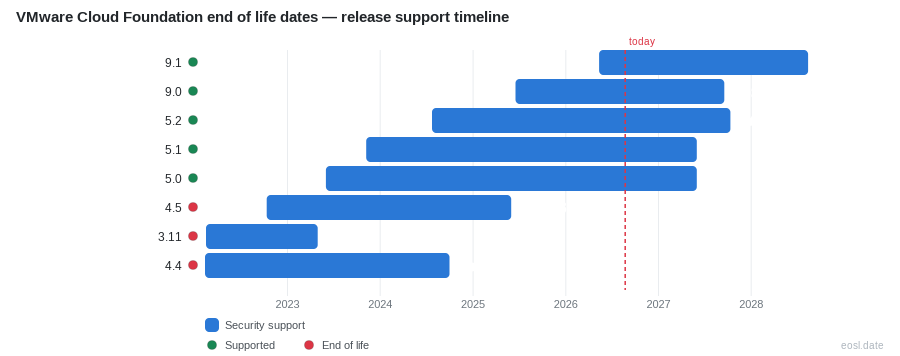
Currently Supported VMware Cloud Foundation Releases - Active EOS/EOSL Support (5)
| Release | Released | General Support | Latest |
|---|---|---|---|
| 9.1 | (6 months ago) | (in 1 year and 8 months) | 9.1.1.0 (2 months ago) |
| 9.0 | (1 year and 5 months ago) | (in 9 months) | 9.0.2.0 (10 months ago) |
| 5.2 | (2 years and 3 months ago) | (in 10 months) | 5.2.3 (8 months ago) |
| 5.1 | (3 years ago) | (in 6 months) | 5.1.1 (2 years and 7 months ago) |
| 5.0 | (3 years and 5 months ago) | (in 6 months) | 5.0.0.1 (3 years and 1 month ago) |
VMware Cloud Foundation End of Life (EOL) Releases - No Longer Supported (11)
| Release | Released | General Support | Latest |
|---|---|---|---|
| 4.5 | (4 years and 1 month ago) | (1 year and 5 months ago) | 4.5.2 (3 years and 3 months ago) |
| 3.11 | (4 years and 9 months ago) | (3 years and 6 months ago) | 3.11.0.1 (4 years and 7 months ago) |
| 4.4 | (4 years and 9 months ago) | (2 years and 1 month ago) | 4.4.1 (4 years and 6 months ago) |
| 4.3 | (5 years and 2 months ago) | (3 years ago) | 4.3.1 (5 years and 2 months ago) |
| 4.2 | (5 years and 9 months ago) | (5 years and 5 months ago) | 4.2.1 (5 years and 5 months ago) |
| 4.1 | (6 years and 1 month ago) | (4 years and 9 months ago) | 4.1.0 (6 years and 1 month ago) |
| 3.10 | (6 years and 5 months ago) | (4 years and 2 months ago) | 3.10.2 (5 years and 7 months ago) |
| 4.0 | (6 years and 7 months ago) | (5 years and 2 months ago) | 4.0.1 (6 years and 4 months ago) |
| 3.9 | (7 years ago) | (6 years ago) | 3.9.1 (6 years and 10 months ago) |
| 3.8 | (7 years and 4 months ago) | (6 years and 4 months ago) | 3.8.1 (7 years and 2 months ago) |
| 2.3 | (8 years and 3 months ago) | (6 years ago) | 2.3.2 (8 years and 6 months ago) |
The VMware Cloud Foundation end of life calendar tells you how long Broadcom keeps fixing each release, and several dates fall within a year. This guide lists the end of support dates by version, explains what you lose when support lapses, and shows how the vSphere 8 deadline affects your hardware and budget, so you can plan before your VMware infrastructure runs out of cover.
VMware Cloud Foundation End of Life Dates by Release
Every release has a release date and a date when general support stops. Broadcom publishes each supported release in the VCF release notes, and the table below summarizes the current picture as tracked on endoflife.date in September 2026.
| Release | Release date | General support ends | Latest build |
|---|---|---|---|
| VCF 9.1 | 12 May 2026 | 12 Aug 2028 | 9.1.1.0 |
| VCF 9.0 | 17 Jun 2025 | 17 Sep 2027 | 9.0.2.0 |
| VCF 5.2 | 23 Jul 2024 | 11 Oct 2027 | 5.2.4 |
| VCF 5.1 | 7 Nov 2023 | 1 Jun 2027 | 5.1.1 |
| VCF 5.0 | 1 Jun 2023 | 1 Jun 2027 | 5.0.0.1 |
| VCF 4.5 | 11 Oct 2022 | Ended 31 May 2025 | 4.5.2 |
VCF 9 is the current code line, and 9.1 outlasts 9.0 by about eleven months. A supported release is the only safe target for new VMware deployments. Anything on 4.x or older already sits outside support, and vSphere 7 reached its own end of general support on 2 October 2025.
Older VCF 4.x and 3.x Component Versions
Each build bundles a bill of materials: SDDC Manager, Cloud Builder, vCenter, ESXi, NSX, vSAN, a witness appliance and Aria Suite Lifecycle at pinned versions. Since VCF 4.4 the vRealize components are upgraded separately, so the older mapping tables stop listing them. Every 4.x and 3.x build in those tables is already past its support dates.
What Technical Guidance Means After Support Ends
General support is the last date you can request regular maintenance: security patches, bug fixes and fixes under the support terms. Technical guidance comes next, and it covers only low-severity issues on supported configurations. During that phase there is no new hardware support, no new security fixes and no bug fixes unless stated otherwise.
The length of each phase depends on the policy. VCF 3 and 4 followed the N-2 lifecycle policy, which supports the three latest releases for at least 12 months. VCF 5 and above follow the Enterprise HCI policy: four years of general support plus one year of guidance. For 5.0 and 5.1, guidance runs until 1 June 2028.
End of Service Under the VCF 9 Support Model and Release Cadence
Earlier major versions used a 5+2 model, five years of support plus up to two years of extended support, with a new major release every two years. From VCF 9.0, Broadcom switched to 6+1: six years from each major release and an optional extra year. The release cadence also stretches to three years between each major release, with a minor release roughly every nine months.
Early minor releases get 27 months of coverage, while the last minor release gets 45 months, so customers can pick an upgrade path. Broadcom estimates end of service for the 9.x line at 17 June 2031.
vSphere 8 End of Support and VCF Compliance Exposure
General support for vSphere 8 ends on 11 October 2027, the date VMware Cloud Foundation becomes the default stack, and technical guidance runs to 11 October 2029. That looks like a two-year reprieve, but guidance brings no new patches, so your environment counts as unsupported software from the first date. That is a compliance problem, not just a patching one:
- Compliance attestation: SOC, PCI and HIPAA frameworks expect supported software in production.
- Cyber insurance: many policies require supported software, so a breach on an unsupported host can leave a claim disputed.
- Client contracts: promises to maintain SOC or PCI status can be breached in your next audit.
The security risk and the audit risk land on different teams, so put both dates on one shared register.
Planning Around the VMware Cloud Foundation Deadline
Moving from vSphere 7 to 8 was an in-place upgrade. Reaching VCF is a re-architecture that needs extra hardware just for the management plane, so the usual upgrade cycle does not apply. The platform is a unified stack for a private cloud or hybrid cloud, bundling compute, storage and network virtualization into one software-defined data center.
Amplix, an IT services firm, estimates two to three months to migrate, about six months of hardware lead time and a couple of months of scoping. That is nearly eleven months of timeline before your operations team touches production, and the cost lands in a single budget cycle. Count backwards from October 2027 before agreeing to any date.
Run a Health Check Before You Buy Hardware
A health check shows whether your servers support VCF and for how long. That answer decides whether you plan one migration or two, so do it before migration planning or any hardware order, and well ahead of the VCF support dates in the table above.
Your VCF Options Before End of General Support
When your VCF release reaches its support date, such as 1 June 2027 for 5.0 and 5.1, you have three realistic paths. The supported route is moving to VCF 9 under Broadcom's subscription licensing. Independent vendors such as Rimini Street sell third-party support for perpetual VMware licenses, which extends vSphere 8 beyond the vendor's date but is not Broadcom support. Some enterprise buyers also evaluate alternatives such as Nutanix; Amplix cites roughly 35 percent doing so. Every path needs the same planning window before your VCF support ends.
Migration Versus Extended Support
Under the 6+1 model you can buy up to one year of extended support. Treat it as a bridge for hardware delivery on your VMware estate, not a destination: migration is the only lasting fix once support ends.