Telegraf End of Life (EOL) Dates and End of Support (EOS) Dates
Telegraf end of life (EOL) and end of support (EOS) dates: 39 Telegraf versions have reached EOL, including Telegraf 1.38 (EOL date: Sep 07, 2026) — no longer receiving security updates or patches. Telegraf 1.40.3 is the current supported release — 2 versions in active support. Also see Adobe ColdFusion end of support dates for related end-of-life information.
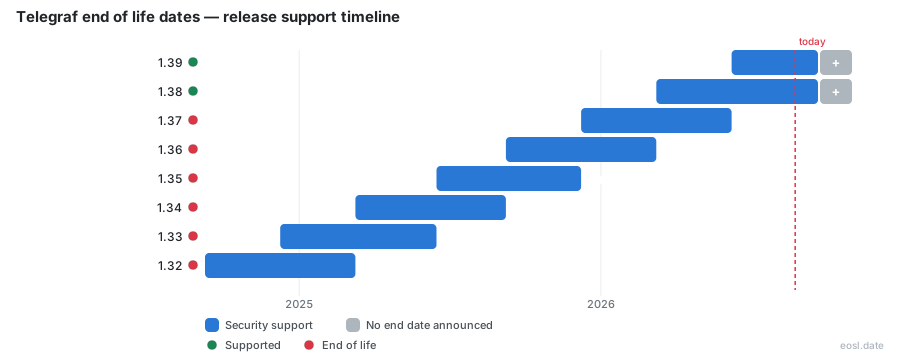
Currently Supported Telegraf Releases - Active EOS/EOSL Support (2)
Telegraf End of Life (EOL) Releases - No Longer Supported (39)
| Release | Released | Security Support | Latest |
|---|---|---|---|
| 1.38 | (8 months ago) | (2 months ago) | 1.38.4 (6 months ago) |
| 1.37 | (11 months ago) | (5 months ago) | 1.37.3 (8 months ago) |
| 1.36 | (1 year and 2 months ago) | (8 months ago) | 1.36.4 (1 year ago) |
| 1.35 | (1 year and 5 months ago) | (11 months ago) | 1.35.4 (1 year and 3 months ago) |
| 1.34 | (1 year and 8 months ago) | (1 year and 2 months ago) | 1.34.4 (1 year and 6 months ago) |
| 1.33 | (1 year and 11 months ago) | (1 year and 5 months ago) | 1.33.3 (1 year and 8 months ago) |
| 1.32 | (2 years and 2 months ago) | (1 year and 8 months ago) | 1.32.3 (2 years ago) |
| 1.31 | (2 years and 5 months ago) | (1 year and 11 months ago) | 1.31.3 (2 years and 3 months ago) |
| 1.30 | (2 years and 8 months ago) | (2 years and 2 months ago) | 1.30.3 (2 years and 6 months ago) |
| 1.29 | (2 years and 11 months ago) | (2 years and 5 months ago) | 1.29.5 (2 years and 9 months ago) |
| 1.28 | (3 years and 2 months ago) | (2 years and 8 months ago) | 1.28.5 (3 years ago) |
| 1.27 | (3 years and 5 months ago) | (2 years and 11 months ago) | 1.27.4 (3 years and 3 months ago) |
| 1.26 | (3 years and 8 months ago) | (3 years and 2 months ago) | 1.26.3 (3 years and 6 months ago) |
| 1.25 | (3 years and 11 months ago) | (3 years and 5 months ago) | 1.25.3 (3 years and 8 months ago) |
| 1.24 | (4 years and 2 months ago) | (3 years and 8 months ago) | 1.24.4 (3 years and 11 months ago) |
| 1.23 | (4 years and 5 months ago) | (3 years and 11 months ago) | 1.23.4 (4 years and 3 months ago) |
| 1.22 | (4 years and 7 months ago) | (4 years and 2 months ago) | 1.22.4 (4 years and 6 months ago) |
| 1.21 | (4 years and 11 months ago) | (4 years and 5 months ago) | 1.21.4 (4 years and 9 months ago) |
| 1.20 | (5 years and 2 months ago) | (4 years and 7 months ago) | 1.20.4 (5 years ago) |
| 1.19 | (5 years and 5 months ago) | (4 years and 11 months ago) | 1.19.3 (5 years and 3 months ago) |
| 1.18 | (5 years and 8 months ago) | (5 years and 2 months ago) | 1.18.3 (5 years and 6 months ago) |
| 1.17 | (5 years and 11 months ago) | (5 years and 5 months ago) | 1.17.3 (5 years and 9 months ago) |
| 1.16 | (6 years and 1 month ago) | (5 years and 8 months ago) | 1.16.3 (5 years and 11 months ago) |
| 1.15 | (6 years and 4 months ago) | (5 years and 11 months ago) | 1.15.4 (6 years and 1 month ago) |
| 1.14 | (6 years and 7 months ago) | (6 years and 1 month ago) | 1.14.5 (6 years and 4 months ago) |
| 1.13 | (6 years and 11 months ago) | (6 years and 4 months ago) | 1.13.4 (6 years and 8 months ago) |
| 1.12 | (7 years and 2 months ago) | (6 years and 7 months ago) | 1.12.6 (7 years ago) |
| 1.11 | (7 years and 5 months ago) | (6 years and 11 months ago) | 1.11.5 (7 years and 2 months ago) |
| 1.10 | (7 years and 8 months ago) | (7 years and 2 months ago) | 1.10.4 (7 years and 6 months ago) |
| 1.9 | (8 years ago) | (7 years and 5 months ago) | 1.9.5 (7 years and 8 months ago) |
| 1.8 | (8 years and 2 months ago) | (7 years and 8 months ago) | 1.8.3 (8 years ago) |
| 1.7 | (8 years and 5 months ago) | (8 years ago) | 1.7.4 (8 years and 2 months ago) |
| 1.6 | (8 years and 7 months ago) | (8 years and 2 months ago) | 1.6.4 (8 years and 5 months ago) |
| 1.5 | (8 years and 11 months ago) | (8 years and 5 months ago) | 1.5.3 (8 years and 8 months ago) |
| 1.4 | (9 years and 2 months ago) | (8 years and 7 months ago) | 1.4.5 (8 years and 11 months ago) |
| 1.3 | (9 years and 6 months ago) | (8 years and 11 months ago) | 1.3.5 (9 years and 3 months ago) |
| 1.2 | (9 years and 9 months ago) | (9 years and 2 months ago) | 1.2.1 (9 years and 9 months ago) |
| 1.1 | (10 years ago) | (9 years and 6 months ago) | 1.1.2 (9 years and 11 months ago) |
| 1.0 | (10 years and 2 months ago) | (9 years and 9 months ago) | 1.0.1 (10 years and 1 month ago) |
If an agent on one of your servers is still reporting an old build, you need to know whether it is safe to leave it there. This guide covers Telegraf end of life: which minor lines still receive fixes, when each older line stopped, and what to do about it. The short answer is that only the two newest minor lines are supported, and everything older has reached EOL.
Telegraf End of Life: What It Means for Your Agents
Telegraf is InfluxData's open source server agent for collecting, processing, aggregating and writing metrics, logs and other data from infrastructure, applications and devices into time series storage. Because it is a plugin-driven, single standalone binary that you simply download and run, it often sits quietly on hosts for years, and that is exactly how an unsupported copy ends up in production. The product has no formal contract tying a vendor to a date: end of support is a consequence of the release rhythm, not a calendar entry. The agent is MIT licensed, the community contributes many of its plugins, and Telegraf Enterprise exists for teams running it at scale, but none of that changes how long a given line is maintained.
A Latest-Version Policy, Not a Fixed Schedule
Versio.io states that the project does not publish a fixed end-of-life schedule and instead follows a "latest version" approach. In practice that means the vendor patches the newest lines and expects you to move forward, so the useful question is never "when does my version expire?" but "how many minor releases behind am I?" The tracker at endoflife.date turns that policy into dates you can plan around, and the tables in this guide use them. The same lifecycle logic applies whether you run one agent or a thousand, and each patch version adds to the version history that the tables summarise.
Where the Telegraf Agent Runs
The agent targets IoT and edge devices, container platforms such as Kubernetes and Docker, and ordinary system and network monitoring. With more than 400 plugins, it can read metrics from sources like Prometheus endpoints and write them to InfluxDB, which is why it tends to be installed once and forgotten. Telemetry pipelines built on the TIG stack are a common example, and the data they gather feeds observability dashboards. The configuration file is the only thing most teams ever touch, so a cloud instance, a Docker container or a device on the edge can keep its original agent for years. Anything that runs unattended is a candidate for drifting out of support, and the InfluxData documentation is the place to confirm the details for your own plugins.
Telegraf Version Numbers and the Support Window
Every telegraf version follows the pattern major.minor.patch, so 1.40.2 is the second patch of the 1.40 line. The line, not the patch, is what gets supported or retired.
Semantic Versioning and Four Minor Releases a Year
The official documentation says Telegraf uses semantic versioning and ships four minor releases a year, in March, June, September and December. The release date for each one is listed in the release calendar and the GitHub milestones. Between those dates, bug-fix releases arrive roughly every three weeks, while new features wait for the next minor release.
Only Two Streams Get Security Support
The endoflife.date table shows a clear pattern: a line is supported until two newer minor lines exist. When 1.40 shipped on 07 Sep 2026, security support for 1.38 ended the same day, leaving 1.40 and 1.39 as the only supported streams. There is no long-term support track, and Versio.io marks every release as not LTS. Active support, in other words, follows the newest two streams and nothing else, so every older release stream loses security maintenance.
Telegraf Releases Still Receiving Security Support
As of mid-October 2026, two lines are inside the window. Both can still receive fixes, so running either of these is fine, though you should track the newest patch of whichever line you choose.
Latest Version, Latest Patch and Release Dates
| Release | Release date | Security support | Latest patch |
|---|---|---|---|
| 1.40 | 07 Sep 2026 | Supported | 1.40.2 (12 Oct 2026) |
| 1.39 | 08 Jun 2026 | Supported | 1.39.3 (10 Aug 2026) |
The newest build is 1.40.2. Versio.io's database records 48 releases and 284 versions in total, none of the unstable ones affected by a known CVE, and the licence is MIT. If the next minor release arrives on the documented December cadence, the same pattern implies support for 1.39 would then end.
End-of-Life Dates for Each Telegraf Stream
These are the lines that have already left the window. The "support ended" column is the day security fixes stopped for that stream.
| Release | Release date | Security support ended | Final patch |
|---|---|---|---|
| 1.38 | 09 Mar 2026 | 07 Sep 2026 | 1.38.4 (11 May 2026) |
| 1.37 | 08 Dec 2025 | 08 Jun 2026 | 1.37.3 (23 Feb 2026) |
| 1.36 | 08 Sep 2025 | 09 Mar 2026 | 1.36.4 (17 Nov 2025) |
| 1.35 | 16 Jun 2025 | 08 Dec 2025 | 1.35.4 (18 Aug 2025) |
| 1.34 | 10 Mar 2025 | 08 Sep 2025 | 1.34.4 (19 May 2025) |
| 1.33 | 09 Dec 2024 | 16 Jun 2025 | 1.33.3 (25 Feb 2025) |
| 1.32 | 09 Sep 2024 | 10 Mar 2025 | 1.32.3 (18 Nov 2024) |
| 1.31 | 10 Jun 2024 | 09 Dec 2024 | 1.31.3 (12 Aug 2024) |
Everything older than 1.31 is also past its end-of-life date. Tools that flag outdated or deprecated software, including trackers, use these same dates, and most teams retire such hosts in a batch.
How to Check Your Telegraf EOL Status
Checking takes a minute per host, and the configuration of the agent does not change the answer. Run the same check across a fleet of Docker containers, cloud machines and edge devices, since each one carries its own binary.
- Run
telegraf --versionon the host to read the installed release. - Take the first two numbers, such as 1.35, and find that line in the tables above.
- If it is not 1.40 or 1.39, treat the host as unsupported and schedule an upgrade.
For example, a host reporting 1.35.2 is on a stream whose support ended on 08 Dec 2025, which is 323 days before 27 Oct 2026, and it is also missing the later patches 1.35.3 and 1.35.4.
What Happens After Support Ended
Nothing breaks the moment support ended. The agent keeps collecting and sending data, which is why the risk is easy to ignore. What stops is the flow of fixes to that stream.
Unpatched Dependencies and Vulnerabilities
Each patch release bundles dependency bumps, and a frozen stream stops receiving them. A vulnerability found in a library the agent links against, or in the agent itself, is fixed only in supported lines. Hosts on old builds quietly accumulate exposure, and any monitoring or telemetry collected from them is only as trustworthy as the system they run on.
Distribution Packages That Fall Behind
Operating system packagers hit this too. A Microsoft Azure Linux issue opened in April 2026 noted its telegraf package sat on 1.31.0, a stream whose security support had ended in December 2024, and proposed moving to 1.37.3 or retiring the package. The platform later confirmed that 1.38 was already available through another repository. If you install through a distribution, check how far its package has fallen behind upstream.
Upgrading Safely: Test, Stage, Roll Out
Upgrade to the newest stable line instead of stepping through each minor one. Test your existing configuration against it on a staging host, confirm that your inputs and outputs still produce the same metrics, then roll out in batches. Read the release notes for removed or renamed plugins first.
Lifecycle of a Telegraf Minor Version
A minor line lives through a predictable lifecycle. It is released, receives a run of patches, and then is superseded by two newer lines. Take 1.38: it appeared on 09 Mar 2026, got four patches through 1.38.4 on 11 May 2026, and its support ended on 07 Sep 2026.
Bugfixes and the Three-Week Patch Cycle
Bug fixes land in the next patch rather than waiting for a minor release. Bug fixes and bugfixes of this kind are usually plugin-specific, such as a Docker input pinning its API version for older daemons or an SNMP input dropping a connection after a failed gather.
Dependency Updates in Every Patch
Most patch notes are dominated by dependency updates and dependency updates alone, long lists of library bumps from cloud SDKs to the Kafka client. They look dull, but they are how security fixes in upstream libraries reach you.
Reading Telegraf Release Notes Before You Upgrade
The release notes on the InfluxData documentation site list one section per version, and the GitHub releases page mirrors them. Scan them in a fixed order and you will rarely be surprised by an upgrade.
Important Changes and Breaking Changes
Start here. Important changes describe behaviour you might depend on, and breaking changes tell you what to rewrite in your configuration before the new binary will run.
New Plugins and Features
New plugins and features, including new inputs, outputs and processors, only ship in minor releases. They are worth reading to see whether a newly added input can replace a custom script, but they never force an upgrade.
Bugfixes and Dependency Updates as Upgrade Signals
If a bugfix names a plugin you run, or a dependency update mentions a security issue in a library you care about, that tells you how urgent your move is. Treat it as a signal, not a checklist.