Statamic End of Life (EOL) Dates and End of Support (EOS) Dates
Statamic end of life (EOL) and end of support (EOS) dates: 3 Statamic versions have reached EOL, including Statamic 4 (EOL date: Sep 30, 2024) — no longer receiving security updates or patches. Statamic 5 reaches its End of Support date on Dec 31, 2026 — plan your upgrade path now. Statamic 6.43.1 is the current supported release, with support through Dec 31, 2027. Also see Akeneo PIM end of life dates for related end-of-life information.
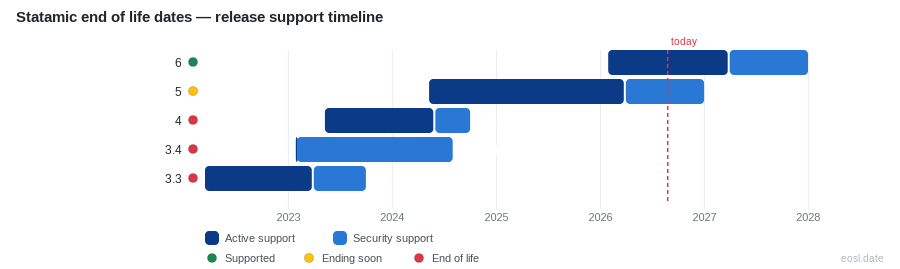
Currently Supported Statamic Releases - Active EOS/EOSL Support (1)
| Release | Supported Laravel Versions | Supported Php Versions | Released | Security Support | Active Support | Latest |
|---|---|---|---|---|---|---|
| 6 | 12-13 | 8.3-8.6 | (9 months ago) | (in 1 year and 1 month) | (in 4 months) | 6.43.1 (3 days ago) |
Statamic Releases Nearing End of Life - Support Ending Soon (1)
| Release | Supported Laravel Versions | Supported Php Versions | Released | Security Support | Active Support | Latest |
|---|---|---|---|---|---|---|
| 5 | 10-12 | 8.2-8.4 | (2 years and 6 months ago) | (in 1 month and 1 week) | (7 months ago) | 5.74.7 (1 month and 2 days ago) |
Statamic End of Life (EOL) Releases - No Longer Supported (3)
| Release | Supported Laravel Versions | Supported Php Versions | Released | Security Support | Active Support | Latest |
|---|---|---|---|---|---|---|
| 4 | 9-10 | 8.0-8.3 | (3 years and 6 months ago) | (2 years and 1 month ago) | (2 years and 5 months ago) | 4.58.3 (2 years and 2 months ago) |
| 3.4 | 8-9 | 7.4-8.1 | (3 years and 9 months ago) | (2 years and 3 months ago) | (3 years and 9 months ago) | 3.4.17 (2 years and 9 months ago) |
| 3.3 | 8-9 | 7.4-8.1 | (4 years and 8 months ago) | (3 years and 1 month ago) | (3 years and 7 months ago) | 3.3.68 (3 years and 9 months ago) |
Knowing the Statamic end of life date for your version tells you how long this flat-file CMS keeps receiving fixes before your site is on its own. Because it is a flat file content management system, the table below is the first thing to check. As of October 2026, Statamic 6 is the latest version, Statamic 5 gets security fixes only until 31 December 2026, and everything older has no future patches. Below you will find every release's support dates, how the release schedule works, and how to upgrade your Laravel and PHP stack in time.
Statamic End of Life Dates by Version
Each release moves through two phases: bug fixes first, then security fixes alone. The table below follows the published lifecycle data from endoflife.date and the Statamic team.
| Release | Released | Active support ends | Security support ends |
|---|---|---|---|
| 6 | 28 Jan 2026 | 31 Mar 2027 | 31 Dec 2027 |
| 5 | 9 May 2024 | 31 Mar 2026 (ended) | 31 Dec 2026 |
| 4 | 9 May 2023 | 31 May 2024 (ended) | 30 Sep 2024 (ended) |
| 3.4 | 27 Jan 2023 | 31 Jan 2023 (ended) | 31 Jul 2024 (ended) |
| 3.3 | 14 Mar 2022 | 31 Mar 2023 (ended) | 30 Sep 2023 (ended) |
In short, only releases 6 and 5 are safe choices today, and Statamic 5 has roughly two months left.
Laravel Versions and PHP Versions Behind Each Release
Because the CMS is a Composer package on top of the Laravel framework, each release also fixes which stack it runs on. When Laravel or PHP stops getting patches, the dependency chain ages with it, and every one of its dependencies counts toward your risk.
| Release | Laravel | PHP |
|---|---|---|
| 6 | 12-13 | 8.3-8.5 |
| 5 | 10-12 | 8.2-8.4 |
| 4 | 9-10 | 8.0-8.3 |
| 3 | 8-9 | 7.4-8.1 |
Statamic 5 Support Dates and What Comes Next
Statamic 5 arrived in May 2024, added Laravel 11 support and dropped support for PHP 8.0 and Laravel 9, with performance gains for large sites. Its active support window closed on 31 March 2026, so only security patches remain until 31 December 2026. Treat that last date as the real deadline, because a mid-year update to the next major release takes longer than most teams expect. Upgrading early also gives you the newest supported release, with a rolling Laravel and PHP floor, instead of a rushed move in December.
Statamic 4 Security Fixes Have Ended
Statamic 4 was released in May 2023 with a redesigned control panel. Its modernization work moved the framework to Laravel 10 and dropped PHP 7 and Laravel 8, which matters if your host is still running an old stack. The final bug fixes shipped in May 2024 and the last security fixes in September 2024. Any vulnerability found since then has been fixed only in newer versions, so packages and addons on a version 4 site quietly accumulate known vulnerabilities. The same applies to 3.3 and 3.4.
Statamic v2 Lifecycle and the Move to v3
Statamic 1, 2 and 3 were full rewrites, which is why each behaved like a separate product with its own migration path. Version 2 reached end of life when Statamic 4 launched, and version 3 moved to critical and security bug fixes only at the same time. Since then the architecture has stayed the same: flat files in Git for content, the Stache for caching, and a Laravel app around it. Because content lives as flat files under version control, a v2 or v3 site is easy to move forward, and neither appears in the supported rows of the table.
Active Support vs Security Support in the Release Schedule
The release schedule is simple. A new major release typically lands about once a year, often shortly after Laravel's own major release, and the project follows semantic versioning, so breaking changes only arrive in a major version. For every release, bug fixes last at least 12 months and security fixes at least 18 months, and the dates above often run longer.
- Active support: bug fixes, new features and fixes for security issues.
- Security support: patches for vulnerabilities only, no new features and no other bug fixes.
- First-party addons: only the latest major release of the first party addons gets bug fixes, so older addon versions stop receiving fixes sooner.
Calendar the security-support end date for each site's version, since that is the real end-of-life date. A developer on a team of developers who handle maintenance for many sites should do this the day a new release ships.
Statamic 3 Gets No Further Updates
Statamic 3.3 and 3.4 both reached end of life by July 2024 and get no further updates of any kind, including patches for newly published vulnerabilities. Sites on them are not broken, but they carry risk that grows every month: version 3 runs on Laravel 8-9 and PHP 7.4-8.1, so the stack underneath has stopped getting patches too, and addons drop compatibility. Content on an unsupported site is not lost, since it lives in plain files, so the way out is always upgrading rather than a rescue. The longer you wait, the more major releases you must cross.
How to Upgrade from Statamic v3: Upgrade Path and Upgrade Guide
The upgrade path from version 3 to 5 is straightforward, because these majors were not rewrites; move one major at a time (3 to 4 to 5). Work through the official upgrade guide for each major release and read its breaking changes before you touch production.
- Back up your content, users and config, then work on a branch.
- Check the Laravel and PHP requirements for the target release.
- Set the
statamic/cmsComposer constraint to the next major, for example^5.0. - Run
composer update, then re-test the control panel and your addons. - Read the changelog and fix anything your templates or custom code relied on.
How to Upgrade Laravel Before Statamic
If your app runs Laravel 9 or older, you must upgrade Laravel first. Follow the Laravel upgrade guide yourself, use Laravel Shift to automate the tedious steps, or start a fresh site and move your content, resources and users across.
Checking Your Latest Version Against endoflife.date
Run php please --version to see what you have installed, then compare it with the endoflife.date page. For an ongoing audit, the Sentinel addon cross-references your installed versions with the OSV database, Packagist and endoflife.date, then flags every dependency that is out of support.