Akeneo PIM End of Life (EOL) Dates and End of Support (EOS) Dates
Akeneo PIM end of life (EOL) and end of support (EOS) dates: 18 Akeneo PIM versions have reached EOL, including Akeneo PIM 2026.4 (EOL date: Oct 30, 2026) — no longer receiving security updates or patches. Akeneo PIM 2026.5 is the current supported release. Also see Laravel EOSL dates for related end-of-life information.
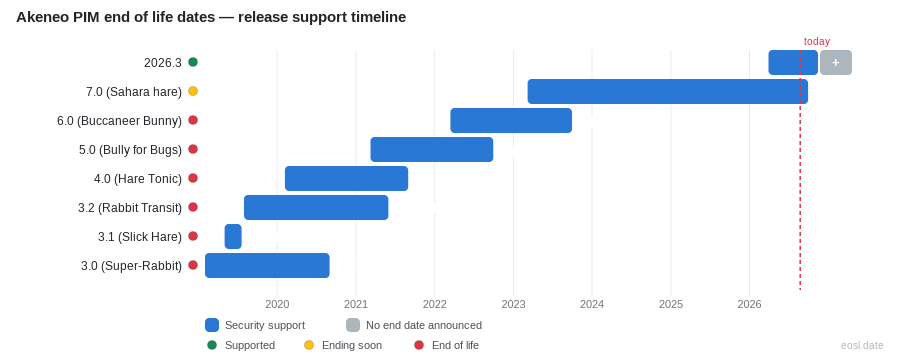
Currently Supported Akeneo PIM Releases - Active EOS/EOSL Support (1)
| Release | Released | Support | Latest |
|---|---|---|---|
| 2026.5 | (3 weeks and 2 days ago) | Active | 2026.5 (3 weeks and 2 days ago) |
Akeneo PIM End of Life (EOL) Releases - No Longer Supported (18)
| Release | Released | Support | Latest |
|---|---|---|---|
| 2026.4 | (2 months ago) | (3 weeks and 2 days ago) | 2026.4 (2 months ago) |
| 2026.3 | (7 months ago) | (2 months ago) | 2026.3 (7 months ago) |
| 7.0 (Sahara hare) | (3 years and 8 months ago) | (1 month and 3 weeks ago) | 7.0.88 (1 month and 3 weeks ago) |
| 6.0 (Buccaneer Bunny) | (4 years and 8 months ago) | (3 years and 1 month ago) | 6.0.113 (2 years and 1 month ago) |
| 5.0 (Bully for Bugs) | (5 years and 8 months ago) | (4 years and 1 month ago) | 5.0.120 (3 years and 9 months ago) |
| 4.0 (Hare Tonic) | (6 years and 9 months ago) | (5 years and 2 months ago) | 4.0.126 (5 years ago) |
| 3.2 (Rabbit Transit) | (7 years and 3 months ago) | (5 years and 5 months ago) | 3.2.84 (5 years and 6 months ago) |
| 3.1 (Slick Hare) | (7 years and 6 months ago) | (7 years and 4 months ago) | 3.1.18 (7 years and 3 months ago) |
| 3.0 (Super-Rabbit) | (7 years and 9 months ago) | (6 years and 2 months ago) | 3.0.84 (6 years and 3 months ago) |
| 2.0 (Rebel Rabbit) | (9 years and 1 month ago) | (7 years and 6 months ago) | 2.0.52 (7 years and 6 months ago) |
| 1.7 (The Old Grey Hare) | (9 years and 8 months ago) | (7 years and 6 months ago) | 1.7.41 (7 years and 7 months ago) |
| 1.6 (Wackiki Wabbit) | (10 years and 2 months ago) | (8 years and 7 months ago) | 1.6.23 (8 years and 7 months ago) |
| 1.5 (Fresh Hare) | (10 years and 8 months ago) | (9 years and 1 month ago) | 1.5.27 (9 years and 2 months ago) |
| 1.4 (Rhapsody Rabbit) | (11 years and 2 months ago) | (9 years and 7 months ago) | 1.4.28 (9 years and 11 months ago) |
| 1.3 (Hare Force) | (11 years and 9 months ago) | (10 years and 1 month ago) | 1.3.41 (10 years and 7 months ago) |
| 1.2 (Acrobatty Bunny) | (12 years and 2 months ago) | (11 years and 3 months ago) | 1.2.37 (11 years and 3 months ago) |
| 1.1 (Rabbit Punch) | (12 years and 7 months ago) | (12 years and 4 months ago) | 1.1.3 (12 years and 4 months ago) |
| 1.0 (Hare We Go) | (12 years and 8 months ago) | (10 years and 7 months ago) | 1.0.3 (12 years and 7 months ago) |
If your catalog runs on Akeneo, the Akeneo PIM End of Life date has already passed, and you need to know what that means for your setup right now. This guide shows which releases still get fixes, what changed for your Community Edition or paid PIM tier, and how to choose your next step.
Akeneo PIM End of Life: What Happens After Version 7
Akeneo is a product information management platform: a single place where your team collects, enriches and distributes the product catalog to every sales channel. Every PIM release has a finite life, and the end-of-life of version 7 is the milestone most teams are now dealing with. Akeneo shipped version 7 in March 2023 and promised support for it until the end of September 2026, so the clock you were watching has now run out.
September 30, 2026: The Cutoff Date
That cutoff closes the paid support window for the hosted and self-run editions of version 7. Customers on the Enterprise Edition who stay on version 7 no longer receive SLA-backed bug patches, so you should treat any 7.0 installation as exposed. Your customer success manager is the right first call if you hold a contract; ask them to confirm your exact position and the migration slot they can offer.
Latest Release and Release Date History
Akeneo moved to year-based numbering for its newest builds, so the newest build now carries a year and a number instead of a classic major version. The most recent tagged build, 2026.4, was published on August 28, 2026, and the previous one, 2026.3, stopped receiving fixes the same day. Only the newest build is maintained, so any build that stops being the newest has reached its end-of-life; keep moving forward rather than parking on one number.
Akeneo PIM Support Dates and Versions
Every Akeneo release has a published start and finish, and the schedule below shows how short the window really is. The official documentation lists each version from 1.0 to the Serenity cloud, with its release notes and user guides, and each page links to API documentation too, so open that documentation for your exact number before you plan anything. Read it for the new features each release added.
Supported Version Status in a Table
This table condenses the most recent versions, using the support dates Akeneo publishes for its paying customers.
| Version | Release date | End of support | Status |
|---|---|---|---|
| 7.0 | March 8, 2023 | September 30, 2026 | Not supported |
| 6.0 | March 15, 2022 | September 30, 2023 | Not supported |
| 5.0 | March 9, 2021 | September 30, 2022 | Not supported |
| 4.0 | February 6, 2020 | August 31, 2021 | Not supported |
| 3.2 | July 31, 2019 | May 31, 2021 | Not supported |
| Serenity | Monthly features | None; always current | Supported |
Only Serenity remains a supported version in the sense that its fixes are applied for you. Treat any other row as history, and read the table as a list of releases you should leave behind.
Not Supported: Versions Already Retired
Anything older than 7.0 is not supported, and many of these builds passed their end of support years ago. Akeneo documents every one of them, from 1.0 in 2014 onward, and each page repeats the same advice: move to a newer release. If you run a retired build, you receive no security patches, no bug fixes and no help from the vendor, so a version in this state should be your first candidate to move.
Calendar Versioning and Release Policy
Since 2026, the open-source line follows calendar versioning and used semver before that. Breaking changes may land in any release, so pin an exact version in your composer.json instead of a range. The release policy decides when each build is retired: the newest build gets support, and older ones are expected to fall off. Plan your release rhythm around that rule, because skipping several updates makes each later step bigger.
Akeneo Community Edition Discontinued: What Changes
The Community Edition is where opinions split. Akeneo's own support page says the community build is continuously supported through its GitHub repository, while integrators report that the vendor stopped shipping new features for the open-source edition after 2023 and has focused on the Growth and Enterprise tiers and its subscription roadmap. Several consultancies describe the Community Edition, which many teams chose for its simplicity, as discontinued, and you should read that as "no new features," not "the software stops running." What you can count on is the latest release only. The core features, such as attributes, families, categories and import and export, still work in the Community Edition, while the Enterprise Edition keeps gaining new features.
Bug Fixes and Safer Releases for Community Users
Community Edition users now rely on fixes that arrive through GitHub, and only for the newest line. Open issues show the pain: trouble moving to a current PHP version, a dashboard bug for categories with uppercase codes, and image upload failures on version 7.0.50. Without official technical support, your developers carry that maintenance load themselves, including dependencies such as Symfony, MySQL and Elasticsearch, so budget real engineering time for it.
Unsupported Extensions and Marketplace Bundles
Akeneo also removed Community Edition bundles from its marketplace, so unsupported extensions are the next risk. Modules that once installed with one click may break against new compatibility requirements, and nobody owns the fix. Third-party vendors such as Webkul sell add-on features and pre-built modules, custom integrations for Magento or Shopify, and long-term support contracts to fill that gap, and they can help you keep ecommerce connectors alive while you decide what to do.
Enterprise Edition, PaaS and On-Premise End-of-Support
For paying customers, the end-of-support story is about hosting model. If you run the Enterprise Edition yourself, you carry the servers; if you use the PaaS flavor, called Flexibility, Akeneo hosts your instance but version 7's cutoff applied to both. After the cutoff, fixes with an SLA only exist on the SaaS side, so both groups face the same choice.
Growth Edition and Serenity SaaS
The Growth Edition and Enterprise customers can move to Serenity, the cloud version where Akeneo handles every move for you. Serenity users get exclusive features each month, delivered straight into the PIM, such as time to market insights, enriched categories, remote storage options for imports and exports, tailored imports with regular expressions, and a yes/no attribute type for assets. The extra features are the point: Serenity is where Akeneo now ships new features first, and the Serenity roadmap moves faster than any self-hosted cycle. Serenity also includes SLA-backed support, so you stop worrying about fixes, and your customer success manager can show a demo of the newest Serenity features.
Hosted and Self-Run Customers
If you host your own on-premise stack, the Serenity offer is available only to Enterprise and Growth clients, and moving to it is planned with your customer success manager. The same applies to hosted customers: their window also ended on the last day of September, so speak to your customer success manager about timing, cost and downtime. Ask for a written plan, because Serenity features differ from the Flexibility setup you know. Compare the features you use today with the Serenity features, and check that your documentation covers each one before you commit.
Your Options Before the Akeneo EOL: Migration Paths
With the Akeneo EOL behind you, four routes exist. None is free of trade-offs, and which fits depends on your team's size, your budget and how much custom work sits on top of the platform.
Upgrade to a Paid Akeneo Plan
You can upgrade to the Growth tier or the Enterprise Edition and keep your PIM data model, workflows and integrations; ask your customer success manager for a quote, and for a Serenity demo. This is the least disruptive path and the one the vendor prefers, but the cost moves from free to an annual contract, and for many mid-market businesses the gap in features versus Community is modest. Use it if you value vendor-backed updates over price.
Switch to Pimcore
Pimcore is another popular option. It offers deep data-management features, but it is built mainly for developers, so the learning curve is steep and the setup is heavy. It suits a business with a dedicated engineering team more than a small ecommerce shop.
Stay on LibrePIM, a Community Fork
LibrePIM is a community fork of the Community Edition that publishes fixes and updates dependencies like PHP and Elasticsearch. It lets you avoid an immediate move, but long-term health depends on volunteers, and you remain on aging architecture with no promised new features.
Migrate to Ergonode or UnoPim
You can migrate to Ergonode, an API-first system with a free tier and managed hosting, or to UnoPim, another open-source alternative. A typical move covers a data audit, extraction and transformation of product data, import with validation, and reconnecting sales channels. Partners quote two to three weeks for an Ergonode migration with no downtime on live shops, and the same steps let you migrate any structured catalog, though your own timeline depends on how many attributes and custom code you carry.
Risks of Waiting Until Support Ends
Staying on Akeneo version 7 after the cutoff means no vendor-backed fixes, and the main risk of delay is an emergency migration after something breaks. Running unpatched software exposes your business to security holes, and aging server components stop matching modern libraries. If you decide to migrate, do it on your terms: a planned project is cheaper and calmer than a rushed one, and any team that can migrate this quarter should, so schedule a data audit for your PIM stack this quarter, listing the features you rely on, and pick a target before the next incident decides for you.