SQLite End of Life (EOL) Dates and End of Support (EOS) Dates
SQLite end of life (EOL) and end of support (EOS) dates: 2 SQLite versions have reached EOL, including SQLite 2 (EOL date: Sep 18, 2004) — no longer receiving security updates or patches. SQLite 3.54.1 is the current supported release. Also see CockroachDB EOSL dates for related end-of-life information.
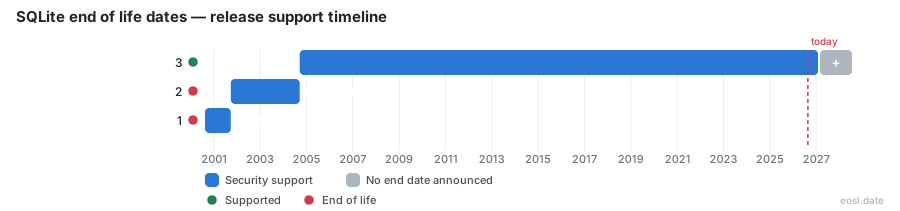
Currently Supported SQLite Releases - Active EOS/EOSL Support (1)
| Release | Released | Support Status | Latest |
|---|---|---|---|
| 3 | (22 years and 2 months ago) | Active | 3.54.1 (1 month and 5 days ago) |
SQLite End of Life (EOL) Releases - No Longer Supported (2)
Planning around SQLite end of life is simpler than for most software: this in-process library is a serverless, zero-configuration, transactional SQL database engine in the public domain, and its developers plan to support it through 2050. It is the most widely deployed database, running inside every application from desktop tools to operating systems and mobile phones, so only its oldest major versions have actually ended.
SQLite End of Life Status by Major Version
Three major generations of the engine exist, and only the newest one still gets fixes. The table below shows where each stands today, with the last version released for each line.
| Major version | First release | Support status | Last version |
|---|---|---|---|
| Version 3 | June 2004 | Supported and active | 3.54.1 (16 October 2026) |
| Version 2 | September 2001 | Ended September 2004 | 2.8.17 (19 December 2005) |
| Version 1 | August 2000 | Ended September 2001 | 1.0.32 (23 July 2001) |
Support Status of SQLite Version 3
Version 3 is the only line in the active stage of its lifecycle. Every 3.x release shares one file format and one C interface, so a new minor release replaces the old one rather than starting a separate branch. The newest release, version 3.54.1, shipped on 16 October 2026, and that is the build to run. Trackers often add a phasing out stage shortly before a retirement date, but the 3 line has no such date, so its support timeframe is open-ended.
Why Version 2 and Version 1 Ended
Version 1 used gdbm for storage, and version 2 swapped that for a custom B-tree with real transaction capability. Version 3 then added internationalization and manifest typing. Once the new file format took over, the earlier lines stopped receiving fixes, and both are now past any phase where an upgrade is optional. Treat any database file still tied to version 1 or version 2 as a migration task.
SQLite Long Term Support and the 2050 Pledge
The project makes an unusual promise: the developers intend to support SQLite through the year 2050. Their own wording is careful. Nobody can guarantee what the world looks like that far out, but they plan as if the commitment holds, and that outlook shapes the way they write code.
What the 2050 Commitment Covers
The pledge covers the library as a whole, not every old release. It does not mean each earlier version stays maintained. It means the project keeps shipping a current version, and a working upgrade path, for decades. Plan for the long term at the project level, but still move to a supported release on your side.
Backwards Compatible File Format and C-Language API
The second half of the pledge is compatibility. The developers promise to keep the C-language API and the on-disk format fully backwards compatible, so an application written today should link against future versions. The file format is documented and stable, and database files are bit-for-bit identical on 32-bit, 64-bit, big-endian and little-endian platforms, which makes cross-platform copying safe. The US Library of Congress lists the format as a recommended option for the long-term preservation of digital content.
Aviation-Grade Testing and Disaster Planning
Long life depends on discipline. Every machine-code branch is tested in both directions, which the team calls aviation-grade testing, and more than a third of the source code is comment, so new programmers can maintain it. For disaster planning, the full source history is cryptographically protected and replicated across servers owned by different companies, and the main developers live in different regions. The extensive documentation is candid and written by and for programmers, and the heavily commented source code doubles as documentation. Together, these habits are what make the 2050 support promise believable.
SQLite Versions and Release Policy
Understanding the release policy tells you what "supported" really means in practice.
Semantic Versioning Since 3.9.0
The project has followed semantic versioning since 3.9.0. A major release or minor release adds features, while a patch is limited to bug fixes and security corrections, so staying within the 3 series is low risk. A patch is the smallest unit you receive.
Only the Latest Version Receives Fixes
Only the latest version is supported at any moment. The project does not backport fixes to older numbers, though a brief overlap sometimes lets users shift to the newest build. If you run something other than the newest build, you are running unsupported code in the strict sense, even when it works fine.
Release Cadence and the Supported Release
The maintainer says he is striving to slow the release cadence to about once every six months, a goal rather than a promise. In practice, the supported release is whatever the download page lists at the top, and a new patch can appear within weeks of any minor release.
Paid Support Options When a Release Reaches EOL
When a version falls behind the newest release, you can still buy help. The developers offer three paid support tiers:
- Annual maintenance subscription: private, expert email advice from the people who write SQLite.
- Technical support: high-priority email and phone support, with a guaranteed response time as an option.
- Consortium membership: premium enterprise coverage with on-site visits plus access to proprietary extensions and the full test suites.
Technical Support and Annual Maintenance Subscription
Technical support reaches back further than the free policy: it covers any version up to a year old, which buys time for teams that cannot upgrade immediately. The annual maintenance subscription suits small teams who only need an expert answer by email.
Consortium Membership for Enterprises
Organizations that embed the engine in products with long service lives usually choose consortium membership, since it adds on-site visits and the proprietary test suites.
Recent SQLite Release History and Patch Releases
The news log shows how the project handles each patch release, maintenance release and major release. The table summarizes the newest ones.
| Date | Version | Release type |
|---|---|---|
| 2026-10-16 | Version 3.54.1 | Patch release |
| 2026-10-09 | Version 3.54.0 | Major release |
| 2026-07-24 | Version 3.53.4 | Maintenance release |
| 2026-06-26 | Version 3.53.3 | Maintenance release |
| 2026-06-03 | Version 3.53.2 | Maintenance release |
| 2026-05-05 | Version 3.53.1 | Maintenance release |
| 2026-04-09 | Version 3.53.0 | Re-release of 3.52.0 |
| 2026-03-13 | Version 3.51.3 | Patch release |
| 2026-03-06 | Version 3.52.0 | Major release (withdrawn) |
| 2026-01-09 | Version 3.51.2 | Patch release |
| 2025-11-28 | Version 3.51.1 | Patch release |
| 2025-11-04 | Version 3.51.0 | Major release |
Version 3.54.1 Patch Release
This patch release fixes a few bug reports against 3.54.0. The notable bug is a security-relevant heap buffer overflow that affected some 32-bit builds but never 64-bit machines, so 32-bit users should treat it as a required upgrade.
Version 3.54.0 Major Release
Version 3.54.0 brought a much improved command-line interface and a better query planner that picks stronger plans for many SQL statements, so performance improved on common queries. It also carries countless fixes for each bug that AI tools discovered, and measurable performance gains for some workloads. Performance work like this is a good reason to move off older builds, and since only the newest build is supported, anyone on 3.53 or earlier should plan the move. It will not compile on Windows versions before Vista, because it switched to Slim Reader/Writer Locks. It is also the last release to ship the sqlite3_analyzer tool; the new .diskused command replaces it.
Version 3.53.4 and Earlier 3.53 Maintenance Releases
The 3.53 line saw four maintenance releases, 3.53.1 to 3.53.4, mostly for AI-discovered bugs. The developers noted that the avalanche of bug reports slowed by July, and each remaining bug grew less important.
Version 3.53.0 Re-Release
Version 3.53.0 re-released 3.52.0 with extra work on the problem of stale expression indexes. It was the first major release to contain the WAL-reset bug fix, so upgrading from earlier lines was recommended; the 3.53.0 change log lists the query planner and other SQL changes that came with it.
Version 3.52.0 Withdrawal and Version 3.51.3
Version 3.52.0 fixed a 15-year-old database corruption bug, then was withdrawn because new features were not fully compatible with earlier builds. Patch release 3.51.3 replaced it and fixed the WAL-reset bug. Interoperability issues affected only an index on expressions that produce floating-point values from text or JSON input, such as a JSON column used in a computed index.
Earlier Version 3.51 Patch Releases
The 3.51 series began with 3.51.0 in November 2025. Patch release 3.51.1 fixed two cases of incorrect answers, and 3.51.2 fixed an unlikely deadlock (see its change log) in the unix interface, with minimal changes from 3.51.0. Check each change log before skipping a patch.
Version 3.41 to 3.50 Release Timeline
Between February 2023 and July 2025, the log lists dozens of entries from version 3.41.0 up to 3.50.4. Each one is a normal patch or minor release, and the same pattern holds throughout: a major release adds features, then two or three patch updates follow. None of these older builds is supported now, because only the newest build receives fixes. Browse the full change log whenever you need the exact fix list.
SQLite Lifecycle History From 1.0 to 3.0
D. Richard Hipp designed the engine in the spring of 2000 while working for General Dynamics on a contract with the US Navy, building software for a damage-control system aboard guided-missile destroyers. It began as a Tcl extension. Version 1.0 appeared in August 2000, version 2.0 in September 2001 and version 3.0 in June 2004, partly funded by America Online. Those dates anchor the status table above: each earlier line lost support soon after its successor arrived. That history explains why the older numbers are retired, while the lifecycle of version 3 is still unfolding.
How SQLite Design Shapes Its Support Status
The database engine's design is a big reason support is easy to promise. It needs no server process, so the library links straight into an application program and database operations avoid inter-process communication. That is why it is called zero-configuration: no service management, startup scripts or GRANT-based access control, and permissions come from the file system. The whole database, with tables, indices and data, lives in a single cross-platform file.
It implements most of the SQL standard, including transactions and ACID guarantees, and generally follows PostgreSQL syntax. It does not enforce type checking by default, and it omits some features such as materialized views. Fewer moving parts means fewer things that can reach end of support, which makes decades of support realistic. Built-in JSON functions are part of the same library, so a JSON feature needs no add-on database component, and the single storage file keeps each database easy to back up. Every SQL query goes through a query planner that picks an index when one helps, and that planner is why performance stays strong on small hardware.
Where SQLite Runs and Why EOL Matters
As a free and open-source embedded database and an open source project in the public domain, it ships inside software you rarely think about, so an outdated copy of the database can hide in places you do not control, which makes security patching a vendor decision.
Operating Systems, Web Browsers and Middleware
Bundled copies follow the vendor's support, so check the vendor's end-of-life notice rather than SQLite's alone. It ships in the top web browsers, in several operating systems, in phones and in many embedded systems, and many programming languages provide bindings for it. Because those components bundle their own copy, updating the vendor product is often the only way to move to a fixed version.
Check Your Version and Plan Upgrades Before Support Ends
Run sqlite3 --version to see what the command-line tool reports, and ask your language runtime for its library version too, since the two often differ. Compare the result with the newest build on the news page, then confirm the database opens cleanly and your SQL still runs. If you are behind, read the change log for every release in between, take a backup of each database file, then test on a copy first.
- Record the current version in each environment.
- Read the patch notes between your version and the latest one.
- Upgrade to the newest 3.x build and rerun your tests.