Memcached End of Life (EOL) Dates and End of Support (EOS) Dates
Memcached end of life (EOL) and end of support (EOS) dates: 2 Memcached versions have reached EOL, including Memcached 1.5 (EOL date: Mar 09, 2020) — no longer receiving security updates or patches. Memcached 1.6.45 is the current supported release. Also see CockroachDB end of life dates for related end-of-life information.
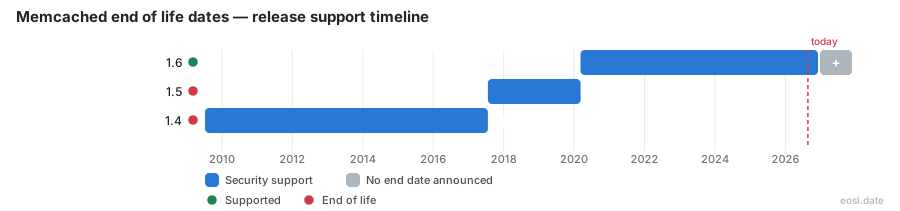
Currently Supported Memcached Releases - Active EOS/EOSL Support (1)
| Release | Released | Security Support | Latest |
|---|---|---|---|
| 1.6 | (6 years and 8 months ago) | Active | 1.6.45 (4 months ago) |
Memcached End of Life (EOL) Releases - No Longer Supported (2)
If you run an open source key-value store for object caching in front of a database, the Memcached end of life picture is unusual: there is no fixed EOL calendar, and only the newest release line still gets fixes. Memcached is a free, high-performance, distributed memory object caching system that speeds up dynamic web applications, so this guide shows which versions are current, which are retired and when to move.
Memcached End of Life: Where Each Release Stands
Memcached is a community project, so its lifecycle works differently from a commercial product. As of 26 October 2026 the 1.6 line is the only one with security fixes. The 1.5 line ended in March 2020 and 1.4 ended in July 2017.
Does Memcached Have a Fixed End-of-Life Schedule?
No. Memcached does not publish a fixed end-of-life date for any release. It is community-supported and has no clearly defined support policy, and judging by its recent releases, only the latest release is supported. Older lines keep running, but they are superseded and never receive another patch version.
What Is the Latest Version of Memcached?
The latest version is 1.6.45, published in July 2026 inside the 1.6 line. Treat that number as a moving target: because older lines are retired rather than maintained in parallel, the safest plan is to track the newest 1.6 patch.
Memcached Releases and Version History
The table below combines the release dates and support status that endoflife.date and Versio.io track for each line.
| Release line | Release date | Latest patch | Security support | LTS |
|---|---|---|---|---|
| 1.6 | 2020-03-09 | 1.6.45 (July 2026) | Yes | No |
| 1.5 | 2017-07-21 | 1.5.22 (February 2020) | Ended March 2020 | No |
| 1.4 | 2009-07-09 | 1.4.39 (July 2017) | Ended July 2017 | No |
Versio.io counts 134 versions across five lines, since 1.3 and 1.2 date back to early 2009. Of those, 14 are unstable versions and 80 are affected by a CVE. The code is released under the BSD 3-Clause license and maintained by Dormando.
Memcached Release Lines Compared: LTS and Security Support
No release line carries long-term support, so there is no extended window to plan around. The gap between lines is the real signal: 1.4 was current for about eight years before 1.5 replaced it, while 1.5 lasted under three years. Only 1.6 offers security support today, which makes any 1.5 or 1.4 server a known risk.
What Memcached EOL Means for a Community Project
Memcached is an in-memory store for small chunks of data from database calls, API calls or page rendering, so most teams treat it as plumbing and forget it. When a line reaches end of life, the practical effect is that bugs and security flaws found afterwards are fixed only in newer releases. Your cache keeps serving, every cache hit still returns quickly, and performance does not change overnight, but a patch you may need will not be backported. The cost grows quietly with every new vulnerability disclosed.
End-of-Life Dates for ElastiCache for Memcached
Managed hosting follows its own calendar. Amazon ElastiCache lists the Memcached engine versions it supports: 1.6.22, 1.6.17, 1.6.12, 1.6.6, 1.5.16, 1.5.10, 1.4.34, 1.4.33, 1.4.24, 1.4.14 and 1.4.5. The extended support schedule on that AWS page gives dates for Redis OSS major versions, not for these. If you self-host, the packages shipped for Ubuntu, Debian and the official Docker image decide which version you actually run, and the project's release notes on GitHub show what each one fixed.
ElastiCache Versions in the 1.6 Line
The 1.6 entries are 1.6.22, 1.6.17, 1.6.12 and 1.6.6. They are the only ElastiCache choices that sit on a release line the project still supports, so a managed cluster pinned to one of them is the easiest to keep current.
Older 1.5 and 1.4 Versions on ElastiCache
1.5.16 and 1.5.10, plus the 1.4 entries from 1.4.34 down to 1.4.5, belong to lines the project retired years ago. Treat them as legacy and plan a move to a 1.6 engine.
Testing Your Cache After an End-of-Life Memcached Upgrade
Leaving an end-of-life line swaps the engine under your cache, so re-check how it evicts items. A full cache must quickly drop something, and Dormando frames that choice as a cost trade-off. Memcached favours LRU behaviour, with a hash table index and a fixed memory limit deciding what goes when space runs out.
After the upgrade, compare your hit ratio and latency with the numbers from before. A drop in hits means more load on the database behind the cache, and a rise in tail latency is felt first by active users.
Upgrading Off an End-of-Life (EOL) Memcached Version
Moving between lines is usually a small change for the application, because the cache protocol is stable, but test it on a copy of your cache first.
- Record the installed version and its release line.
- Pick the newest 1.6 patch your package source offers.
- Restart a staging server and run the real application against it.
- Watch hit ratio, latency and memory use for a day before switching production.
Checking Your Installed Memcached Version
Run memcached -V on the server to print the version, then match it to the table above. If it starts with 1.5 or 1.4, the line has ended and the upgrade is overdue.