Robo End of Life (EOL) Dates and End of Support (EOS) Dates
Robo end of life (EOL) and end of support (EOS) dates: 3 Robo versions have reached EOL, including Robo 3 — no longer receiving security updates or patches. Robo 5.2.4 is the current supported release — 2 versions in active support. Also see Backdrop end of support dates for related end-of-life information.
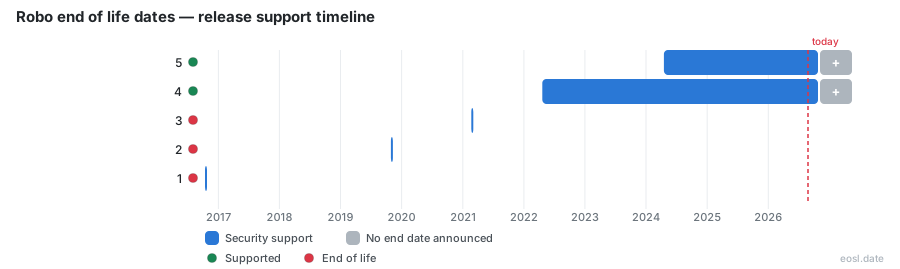
Currently Supported Robo Releases - Active EOS/EOSL Support (2)
| Release | Supported Phpversions | Released | Security Support | Active Support | Latest |
|---|---|---|---|---|---|
| 5 | 8.2 - 8.5 | (2 years and 7 months ago) | Active | Active | 5.2.4 (2 days ago) |
| 4 | 8.0 - 8.3 | (4 years and 7 months ago) | Active | Active | 4.0.6 (3 years and 6 months ago) |
Robo End of Life (EOL) Releases - No Longer Supported (3)
| Release | Supported Phpversions | Released | Security Support | Active Support | Latest |
|---|---|---|---|---|---|
| 3 | 7.1 - 8.1 | (5 years and 9 months ago) | — | — | 3.0.12 (3 years and 6 months ago) |
| 2 | 7.1 - 7.4 | (7 years ago) | — | — | 2.2.2 (5 years and 11 months ago) |
| 1 | 5.5 - 7.4 | (10 years and 1 month ago) | — | — | 1.5.0 (5 years and 1 month ago) |
Searching for Robo end of life details usually means the Robo PHP task runner, a vendor's robot software, or a physical robot. You get the Robo support dates first, then how robot software and hardware reach EOL.
Robo end of life dates and supported releases
Robo is a PHP framework and task runner installed with Composer and developed on GitHub. Only the two newest major version lines receive active support and security support. The project documents its supported releases in its branches list, and each line works with its own PHP versions. Breaking changes between majors are fairly minor. The dates below come from the endoflife.date tracker, last updated 6 July 2026.
| Version | PHP versions | Released | Support | Latest release |
|---|---|---|---|---|
| 5 | 8.2 - 8.3 | 17 Apr 2024 | Active and security | 5.1.1 (14 Nov 2025) |
| 4 | 8.0 - 8.3 | 21 Apr 2022 | Active and security | 4.0.6 (30 Apr 2023) |
| 3 | 7.1 - 8.1 | 21 Feb 2021 | EOL | 3.0.12 (30 Apr 2023) |
| 2 | 7.1 - 7.4 | 29 Oct 2019 | EOL | 2.2.2 (18 Dec 2020) |
| 1 | 5.5 - 7.4 | 13 Oct 2016 | EOL | 1.5.0 (07 Oct 2021) |
Versions 3, 2 and 1 are EOL: no security fixes, so any upgrade plan should target version 5 or 4. Version 5 was released two years and six months before that update, while version 1 dates from 2016.
Which major version is the latest version?
Robo 5.1.1 is the latest version, released 14 Nov 2025. Its compatibility with PHP 8.2 and 8.3 makes it the safest product line for new projects.
Robot versions: end-of-support and your operating system
A Broadcom note on UIM robot versions says older robots carry no specific end-of-life or end-of-support dates. The rule of thumb is that the underlying operating system decides. Microsoft stopped supporting Windows 2003 on July 14, 2015, so no robot version counts as a supported operating system install there.
You may keep running a legacy robot on an unsupported system at your own risk. For troubleshooting, the vendor may ask you to upgrade the software to the current robot version first, because a bug may already be fixed in the current release.
End-of-life versions lists from software vendors
Some vendors publish a plain list of end-of-life versions. Robot Morning lists commercial software such as DemandLine Client 11.1.x (EOL 2025-07-01) and 10.x lines (EOL 2023 and 2024), with 1.x through 9.x at EOL 2022-07-27. An end of life date there marks when that release stops getting fixes.
How to check the version you are running
Sign in to the robot software, click the robot button at the top left and select About. Match the number against the list before your next maintenance window or installation. For Robo itself, run robo --version.
Robot life cycle and replacement planning
A robot life cycle runs 8-10 years in typical planning, yet many FANUC robots give 10+ years of service, and FANUC cites 80,000 to 100,000 hours without failure. Proper setup, such as load inertia values, extends the robot's life.
At replacement time, the cost is mostly stable: a new robot is priced close to the original, plus an end of arm tool at $5,000 to $50,000. Allow one to two days for two installers and one or two programmer days, since reverse compatibility lets old programs run with little change.
Also review the rest of the robot cell. Conveyors and safety equipment may no longer meet current standards such as RIA 15.06-2012, so replace them together with the robot.