Neos End of Life (EOL) Dates and End of Support (EOS) Dates
Neos end of life (EOL) and end of support (EOS) dates: 4 Neos versions have reached EOL, including Neos 8.2 (EOL date: Mar 31, 2025) — no longer receiving security updates or patches. Neos 9.2.0 is the current supported release, with support through Oct 01, 2028 — 5 versions in active support. Also see Backdrop end of support dates for related end-of-life information.
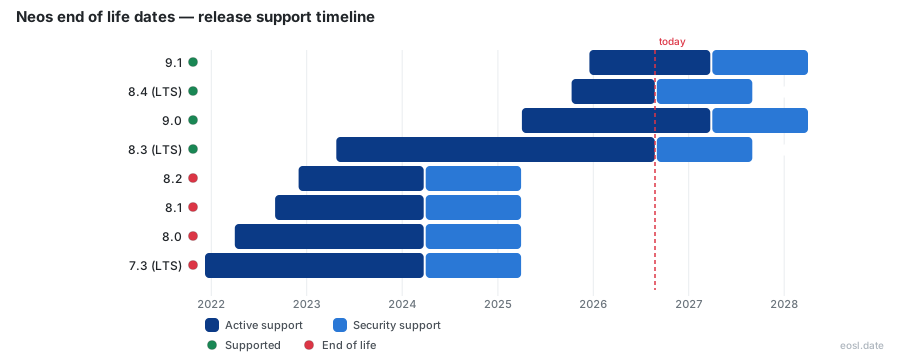
Currently Supported Neos Releases - Active EOS/EOSL Support (5)
| Release | Released | Security Support | Active Support | Latest | LTS |
|---|---|---|---|---|---|
| 9.2 | (1 month and 1 week ago) | (in 1 year and 10 months) | (in 10 months) | 9.2.0 (1 month and 1 week ago) | - |
| 9.1 | (11 months ago) | (in 1 year and 4 months) | (in 4 months) | 9.1.10 (1 month and 2 weeks ago) | - |
| 8.4 (LTS) | (1 year and 1 month ago) | (in 9 months) | (2 months ago) | 8.4.8 (1 month and 2 weeks ago) | LTS |
| 9.0 | (1 year and 7 months ago) | (in 1 year and 4 months) | (in 4 months) | 9.0.17 (1 month and 2 weeks ago) | - |
| 8.3 (LTS) | (3 years and 6 months ago) | (in 9 months) | (2 months ago) | 8.3.36 (1 month and 2 weeks ago) | LTS |
Neos End of Life (EOL) Releases - No Longer Supported (4)
| Release | Released | Security Support | Active Support | Latest | LTS |
|---|---|---|---|---|---|
| 8.2 | (3 years and 11 months ago) | (1 year and 7 months ago) | (2 years and 7 months ago) | 8.2.14 (2 years and 7 months ago) | - |
| 8.1 | (4 years and 2 months ago) | (1 year and 7 months ago) | (2 years and 7 months ago) | 8.1.14 (2 years and 7 months ago) | - |
| 8.0 | (4 years and 7 months ago) | (1 year and 7 months ago) | (2 years and 7 months ago) | 8.0.19 (2 years and 7 months ago) | - |
| 7.3 (LTS) | (4 years and 11 months ago) | (1 year and 7 months ago) | (2 years and 7 months ago) | 7.3.21 (2 years and 7 months ago) | LTS |
Your Neos end of life date is the day a release of this extensible, web-based content management system stops getting fixes, and as of late October 2026 that day has already passed for several 8.x branches. This guide shows which versions are still covered, how the release schedule works, and what to do while your CMS can still be patched, so an upgrade or migration stays a plan instead of an emergency.
Neos End of Life Dates by Version
The table below follows the published support schedule for each release. Active support means bug fixes and new patches, while security support means only security fixes. Today is 27 October 2026, so every version before 9.0 is already past its active window.
| Version | Released | Active support ends | Security support ends |
|---|---|---|---|
| 9.2 | 9 Oct 2026 | 1 Oct 2027 | 1 Oct 2028 |
| 9.1 | 17 Dec 2025 | 1 Apr 2027 | 1 Apr 2028 |
| 9.0 | 3 Apr 2025 | 1 Apr 2027 | 1 Apr 2028 |
| 8.4 (LTS) | 10 Oct 2025 | 1 Sep 2026 | 1 Sep 2027 |
| 8.3 (LTS) | 24 Apr 2023 | 1 Sep 2026 | 1 Sep 2027 |
| 8.0 to 8.2, 7.3 (LTS) | Dec 2021 to Dec 2022 | 31 Mar 2024 | 31 Mar 2025 |
That makes 1 April 2027 the next deadline: 156 days from today, 9.0 and 9.1 lose active fixes and fall back to security-only patches.
Neos 8.3 and Neos 8.4 LTS Versions
Both are long-term support (LTS) releases and share one lifetime: Neos 8.4 was added as a second LTS in the same range, so it inherits the 8.3 dates. The schedule above lists 1 September 2026 for the end of bug fixes, but the 8.4 release announcement says the branch receives patches until the end of 2026, so confirm with the release team before you rely on either date. Security updates for 8.3 and 8.4 run to 1 September 2027, 309 days away.
Maintained Versions on the Neos 9 Branch
Among the maintained versions, Neos 9 is where all new features land, and a 9.3 LTS has been announced for late 2026. The Neos UI repository follows the same versioning, so the editing interface you use matches the core release. The older 7.3 and 8.0 to 8.2 branches only ever received security updates after their active window, and those have stopped as well.
Release Schedule and Active Support Rules
The team aims for a regular release schedule that follows semantic versioning:
- Three minor releases a year, roughly one every four months.
- Yearly major releases, which is when breaking changes are expected.
- Patch level releases whenever they are needed in between.
- Regular releases get bug fixes for at least one year and security fixes for one more year, two in total.
- LTS releases get bug fixes for two years plus one year of security fixes, three in total.
The extended LTS overlap is why 8.3 and 8.4 end together. It also means the gap between the two support windows, 153 days in the 9.0 and 8.4 comparison, is shorter than you would expect from the rules alone.
Release Notes and Change Logs
To track when a branch ends, follow the change logs per branch in the online documentation and the endoflife.date API, RSS feed or calendar feed. Its product identifiers (a package URL and a CPE) help security scanners match your install to the right support window. Each release also ships with release notes and release highlights listing new features, with credit to its contributors.
PHP Support and Security Support Windows
Your PHP version limits the Neos version you can run, so check it before you plan. Neos 9 supports PHP 8.2 to 8.5, while the 8.3 LTS supports PHP 8.0 to 8.3. Neos 8.0 raised the minimum to PHP 8.0, and the 8.4 line supports both doctrine/dbal 2.x and 3.x, which eases the move. The official PHP support table keeps these php versions current.
When a PHP branch loses security support, an old Neos install on it loses it too in practice, so a hosting change can force an upgrade earlier than the CMS schedule suggests. Use Composer to see what you run and what is outdated, and Packagist to check that your add-on packages are compatible with the target release.
What End-of-Life Means for Your Neos Site
After end-of-life, a site keeps running, but nobody fixes a newly found bug or vulnerability, and security problems stay open for as long as you stay on the old release. Sites on 8.0 to 8.2 or 7.3 are already in that position, since no fixes ship for those branches any more. For a production website that handles logins or user data, that exposure is the real cost, not the missing features. Some sites built on the old project setup also stay on deprecated code, which makes the later jump larger.
Keeping Up With Security Updates
Neos fixes ship as small bugfix releases, so a routine update every few weeks keeps you current while your branch is still supported; move off it before its security end date in the table. Watch the GitHub repositories and the announcement channel, then deploy each patch to staging before live. This software habit is cheaper than a rushed jump across several versions.
Planning an Upgrade Before Support Ends
A calm upgrade follows the same order each time: read the upgrade instructions, test on a copy, then update through Composer. The 8.4 release added a migration helper that prepares Fusion code for Neos 9, so many projects need little extra work later. The Flow framework underneath Neos gets its own notes and its own Flow version, and the NodeTypes and CLI commands you rely on are covered there as well.
Upgrade Instructions and Breaking Changes
Each major version lists breaking changes that need manual work, while minor releases stay backwards compatible. The 8.4 update moved FontAwesome from version 5 to 6, which can affect custom icon packages. The Neos 8.0 notes, for instance, removed Fusion namespace support and rewrote the Fusion parser, so only fully qualified prototype names work in Fusion files. Fusion changes dominate most real upgrades, which is why they come first.
Fusion Code and Migration Helper Steps
Run the migration command during the 8.4 upgrade, then review the Fusion diffs it produces. Examples include node.label becoming Neos.Node.label(node). Rewrite any remaining Fusion by hand, keep Fusion prototypes small, and test every Fusion template in a staging copy. As a result the Fusion work for the Neos 9 jump shrinks, and an integrator can review it in one sitting.
Where to Find Upgrade Documentation
Read these before your branch's support window closes. The upgrade guides live in the official documentation, and Karsten Dambekalns' talks at the Neos conference explain why, when and how to update. A roadmap page shows what is coming, and tools like Rector and PHPStan help with the code changes.