Redis End of Life (EOL) Dates and End of Support (EOS) Dates
Redis end of life (EOL) and end of support (EOS) dates: 3 Redis versions have reached EOL, including Redis 7.0 (EOL date: Jul 29, 2024) — no longer receiving security updates or patches. Redis 8.0 reaches its End of Support date on Dec 01, 2026 — plan your upgrade path now. Redis 8.10.3 is the current supported release — 8 versions in active support. Also see ArangoDB EOSL dates for related end-of-life information.
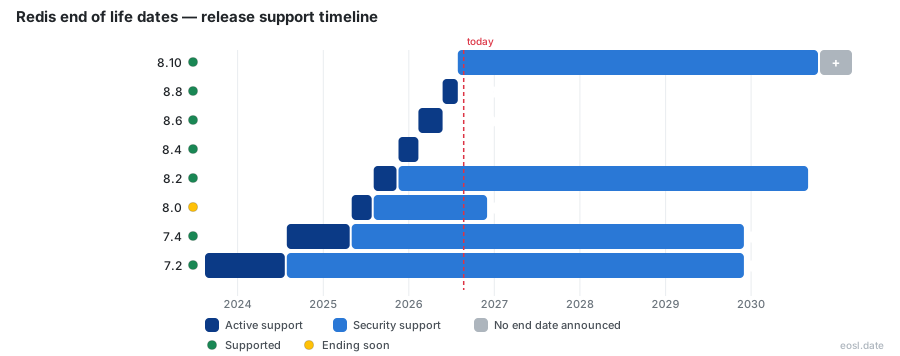
Currently Supported Redis Releases - Active EOS/EOSL Support (8)
| Release | Released | Security Support | Active Support | Latest |
|---|---|---|---|---|
| 8.10 | (3 months ago) | Active | Active | 8.10.3 (3 weeks and 5 days ago) |
| 8.8 | (5 months ago) | Active | (3 months ago) | 8.8.4 (3 weeks and 5 days ago) |
| 8.6 | (9 months ago) | Active | (5 months ago) | 8.6.8 (3 weeks and 5 days ago) |
| 8.4 | (1 year ago) | Active | (9 months ago) | 8.4.8 (3 weeks and 5 days ago) |
| 8.2 | (1 year and 3 months ago) | (in 3 years and 9 months) | (1 year ago) | 8.2.11 (3 weeks and 5 days ago) |
| 7.4 | (2 years and 3 months ago) | (in 3 years) | (1 year and 6 months ago) | 7.4.12 (3 weeks and 5 days ago) |
| 7.2 | (3 years and 3 months ago) | (in 3 years) | (2 years and 3 months ago) | 7.2.17 (3 weeks and 5 days ago) |
| 6.2 | (5 years and 8 months ago) | (in 4 months) | (4 years and 6 months ago) | 6.2.24 (3 months ago) |
Redis Releases Nearing End of Life - Support Ending Soon (1)
| Release | Released | Security Support | Active Support | Latest |
|---|---|---|---|---|
| 8.0 | (1 year and 6 months ago) | (in 1 week and 3 days) | (1 year and 3 months ago) | 8.0.6 (8 months ago) |
Redis End of Life (EOL) Releases - No Longer Supported (3)
| Release | Released | Security Support | Active Support | Latest |
|---|---|---|---|---|
| 7.0 | (4 years and 6 months ago) | (2 years and 3 months ago) | (3 years and 3 months ago) | 7.0.15 (2 years and 10 months ago) |
| 6.0 | (6 years and 6 months ago) | (4 years and 5 months ago) | (5 years and 8 months ago) | 6.0.20 (3 years and 4 months ago) |
| 5.0 | (8 years and 1 month ago) | (4 years and 6 months ago) | (6 years and 6 months ago) | 5.0.14 (5 years and 1 month ago) |
Your Redis end of life date decides when security fixes stop for the in-memory database behind your caching layer, and the risk grows quietly until it does. This guide shows which versions are supported, how the rules work for Redis Enterprise and open-source builds, and what to do while replication and persistence keep running. Use it to find your deadline and pick the safest upgrade route.
Redis End of Life Dates by Version
The Redis end of life schedule depends on how you run Redis. For cluster releases from 6.2 onward, support ends 24 months after the next major version ships, which gives you a long lead time. The latest release date for each line is listed below, and the vendor's subscription agreement overrides any summary here.
Redis Software Cluster Version End-of-Life Schedule
Each cluster version of Redis Software has its own EOL date. If you run version 7.4, your deadline is close, because support for that line ends on November 30, 2026. Anything on the 6.x line or on 7.2 has already passed its Redis EOL date. Redis Enterprise for Kubernetes follows a separate support lifecycle tied to the Kubernetes distribution.
| Version | Release date | End of life |
|---|---|---|
| 8.2 | July 2026 | TBD |
| 8.0 | October 2025 | July 31, 2028 |
| 7.22 | May 2025 | October 30, 2027 |
| 7.8 | November 2024 | May 30, 2027 |
| 7.4 | February 2024 | November 30, 2026 |
| 7.2 | August 2023 | February 28, 2026 |
| 6.4 | February 2023 | August 31, 2025 |
| 6.2 | August 2021 | February 28, 2025 |
Redis Cloud Database Version EOL Dates
On Redis Cloud, each release carries an LTS or STS label and its own date, and the end-of-life dates below come straight from the vendor's version table.
| Version | Support model | EOL date |
|---|---|---|
| Redis 8.6 | STS | TBD |
| Redis 8.4 | STS | January 1, 2027 |
| Redis 8.2 | LTS | September 1, 2030 |
| Redis 8.0 | STS | December 1, 2026 |
| Redis 7.4 | LTS | December 1, 2029 |
| Redis 7.2 | LTS | December 1, 2029 |
| Redis 6.2 | LTS | April 1, 2027 |
Community builds work differently. The open source project tracks active support and security support separately, and for version 8.0 security support ends on December 1, 2026.
Redis Product Lifecycle and Support Models
The lifecycle policy ties every release to a numbering scheme and a support window. Understanding the Redis lifecycle explains why dates differ between products. Each Redis Software release ships with bundled database versions, so the newest cluster release can still host an older line. Builds from 7.4 onward use RSALv2, SSPLv1 or AGPLv3 licenses, so check the license terms of any replacement before your current version's EOL date.
Version Numbers and Major Release Cadence
Redis uses a MAJOR.MINOR.PATCH scheme. A major release may include breaking changes, a minor version adds features, and patch versions carry fixes. For Redis Software, maintenance releases arrive roughly monthly, with monthly maintenance applied to the last minor release of each line.
Long-Term Support and Short-Term Support Versions
- Long-term support (LTS) versions are the second and last minor releases of a major line and get five years of coverage.
- Short-term support (STS) versions are every other minor release and last six months after the following version ships.
This version support split explains the dates in the table above, so plan around the supported versions list rather than the newest tag.
Risks of Unsupported Redis Versions
Running unsupported Redis past a version's EOL date means no further fixes ship, so every newly found vulnerability stays open. An unpatched cluster can expose cached data, and downtime from an incident costs more than a planned upgrade.
Security Patches and Compliance Exposure
Once a Redis version passes its EOL date, security patches and security updates for new CVEs stop, so the in-memory store stays exploitable, and bug fixes stop too. Auditors in finance and healthcare increasingly flag unsupported software, so compliance findings can follow even when nothing breaks.
Hidden Costs and Extended Support Options
The hidden costs of staying past EOL include extra operational overhead, since your engineers backport fixes themselves. Paid extended support can buy time, but it only delays the forced upgrade, so you still have to upgrade or migrate eventually. A late migration also delays gains in latency, new features and performance improvements from newer releases.
Redis Version Management on Redis Cloud
Good version management on the hosted service means knowing what the platform does for you. When a version reaches EOL, the platform applies an automatic upgrade to the next minor release during your maintenance windows if you have not moved first. Essentials plans use auto-upgrades for every version, while Pro plans apply them only from 8.4 and later, with an opt-out.
If you miss a deadline, the provider will force upgrade after sending notifications, and a downgrade is not supported, so read the release notes first. Check your modules too, since they follow their own lifecycle.
Planning an Upgrade Before Redis EOL
Start with an inventory of every Redis instance and its version, so you know which ones are nearing their EOL date, then check your client libraries for compatibility with the target release.
Upgrade Path Rules Between Versions
You cannot always leap straight to the newest release. A cluster on 6.0, for example, must reach 6.2 first, so map each hop in your upgrade path in advance. Each hop must finish before the source version's EOL date, so start with the line that expires first. Sentinel-managed setups should upgrade replicas first, then fail over.
Testing and Rollout Checklist
- Restore an RDB or AOF backup into a staging environment that mirrors production.
- Run regression tests against the target release and compare performance.
- Upgrade production in a low-traffic window, finishing before the version's EOL date.
Treat each deadline as a project date and start well ahead of it.