Red Hat JBoss Enterprise Application Platform End of Life (EOL) Dates and End of Support (EOS) Dates
Red Hat JBoss Enterprise Application Platform end of life (EOL) and end of support (EOS) dates: 5 Red Hat JBoss Enterprise Application Platform versions have reached EOL, including Red Hat JBoss Enterprise Application Platform 7 (EOL date: Jun 30, 2025) — no longer receiving security updates or patches. Red Hat JBoss Enterprise Application Platform 8.1.9 is the current supported release, with support through Feb 05, 2031. Also see Jenkins end of support life for related end-of-life information.
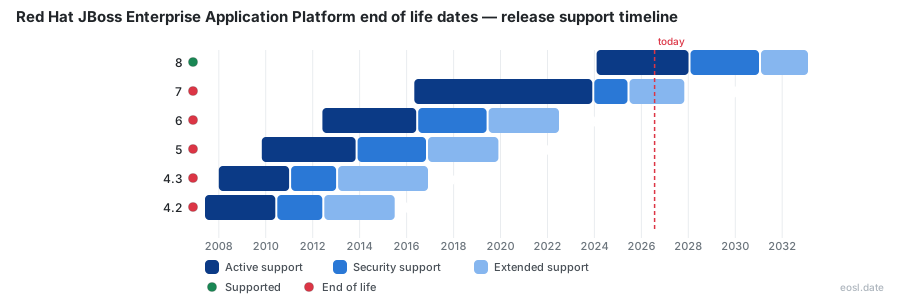
Currently Supported Red Hat JBoss Enterprise Application Platform Releases - Active EOS/EOSL Support (1)
| Release | Released | Maintenance Support | Full Support | Extended Life Support 1 | Latest |
|---|---|---|---|---|---|
| 8 | (2 years and 9 months ago) | (in 4 years and 2 months) | (in 1 year and 2 months) | (in 6 years and 2 months) | 8.1.9 (3 weeks and 4 days ago) |
Red Hat JBoss Enterprise Application Platform End of Life (EOL) Releases - No Longer Supported (5)
| Release | Released | Maintenance Support | Full Support | Extended Life Support 1 | Latest |
|---|---|---|---|---|---|
| 7 | (10 years and 6 months ago) | (1 year and 4 months ago) | (2 years and 10 months ago) | (in 4 years and 1 month) | 7.4.25 (3 months ago) |
| 6 | (14 years and 5 months ago) | (7 years and 4 months ago) | (10 years and 4 months ago) | (4 years and 4 months ago) | 6.4.24 (4 years and 4 months ago) |
| 5 | (17 years ago) | (9 years and 11 months ago) | (12 years and 11 months ago) | (6 years and 11 months ago) | 5.2.0 (13 years and 9 months ago) |
| 4.3 | (18 years and 10 months ago) | (13 years and 9 months ago) | (15 years and 9 months ago) | (9 years and 11 months ago) | 4.3.0 CP10 (13 years and 9 months ago) |
| 4.2 | (19 years and 5 months ago) | (14 years and 4 months ago) | (16 years and 4 months ago) | (11 years and 4 months ago) | 4.2.0.CP09 (16 years and 6 months ago) |
This guide to Red Hat JBoss Enterprise Application Platform End of Life dates tells you when each JBoss EAP release loses support and what you can do about it. EAP 7 left maintenance on June 30, 2025, so any Java EE application server still running it needs a plan. Below you get the version dates, the support phases, the 7.4 update schedule and your choices once a release runs out of road.
Red Hat JBoss Enterprise Application Platform End of Life Dates
Red Hat JBoss Enterprise Application Platform is a subscription-based Java runtime and enterprise application server built on the open source WildFly project. Red Hat treats this middleware as a foundation product and publishes a fixed life cycle calendar for every major release. The table lists the life cycle dates of each release, from general availability to the end of extended life support, so you can see where your own application sits.
| Release | Generally available | Full support ends | End of maintenance | Extended life ends |
|---|---|---|---|---|
| EAP 8 | Feb 5, 2024 | Feb 5, 2028 | Feb 5, 2031 | Feb 5, 2033 |
| EAP 7 | May 2016 | Dec 31, 2023 | Jun 30, 2025 | Dec 31, 2030 |
| EAP 6 | Jun 2012 | Jun 30, 2016 | Jun 30, 2019 | Dec 30, 2028 |
| EAP 5 | Nov 2009 | Nov 30, 2013 | Nov 30, 2016 | Nov 30, 2019 |
Red Hat EAP 8 support dates
EAP 8 arrived on February 5, 2024 and is the current release, with full support running to February 2028 and maintenance to February 2031. Updates keep shipping, and 8.1.8 appeared on September 22, 2026.
Red Hat EAP 7 support dates
EAP 7 reached maintenance support end on June 30, 2025. Its extended life support (ELS) period is listed to run through December 2030, but Red Hat's change log shows it moved the ELS-1 and ELS-2 dates on September 8, 2026 to align with OpenJDK 8. Confirm the final dates on the Red Hat page before you plan around them, because the EOL calendar for the 7.x family has already moved once.
EAP 6 and older versions
EAP 6 lost maintenance on June 30, 2019, and Red Hat later pushed its ELS-2 phase out to December 30, 2028. EAP 5 and 4.3 finished their extended life by 2019 and 2016, so treat them as end-of-life and unsupported.
JBoss EAP Life Cycle Phases Explained
Every major release follows the same product life cycle under the Red Hat support policy. Each of the life cycle phases removes some services, as this comparison shows. Red Hat measures the end of full support and the end of maintenance support as separate milestones, so a release can stop receiving enhancements long before it stops receiving fixes.
| Life cycle phase | Security patches | Bug-fix patches | Minor releases | Software enhancements | New certifications |
|---|---|---|---|---|---|
| Full support | Yes | Yes | Yes | Yes | Yes |
| Maintenance support | Yes | Yes | No | No | Yes |
| ELS-1 | Critical only | Selected | No | No | No |
| ELS-2 | No | No | No | No | No |
Red Hat full support
Under full support you receive every qualified patch, including security fixes rated Critical, Important or Moderate with a CVSS score of 7 or higher, plus bug fixes, enhancements and new certifications for JVMs and databases. This is also the only phase that delivers a minor release.
Red Hat maintenance support
Maintenance starts at least one year after general availability. Red Hat then releases qualified fixes for Critical or Important critical impact vulnerabilities and select mission-critical bug-fix patches, while feature work stops. For a catastrophic problem, Red Hat can issue a hotfix as a temporary measure until the permanent fix is built. Compatibility is kept across the whole life cycle, so each support phase tests patches against the initial major release and documents any break in the release notes.
Phase 3: extended life support
Extended life support begins once maintenance ends. This last support phase of the life cycle is a paid add-on on top of your base subscription, and after it the release is out of support for good.
- ELS-1: Critical security patches and selected urgent fixes, if and when available, generally for three years.
- ELS-2: technical support for existing installations only, with advice and workarounds but no fixes.
Troubleshooting is limited to the latest minor release, and container images are marked Deprecated.
Long-life product life cycle
JBoss EAP follows the seven-year long-life product life cycle: four years of full support and three of maintenance, so each major release reaches its final maintenance date about seven years after general availability, then moves into extended life.
End of Support for EAP 7 and the 7.4 Maintenance Schedule
After the end of maintenance, Red Hat supports only EAP 7.4, and only with an ELS add-on, so the life cycle of the older 7.x minor versions is over. The maintenance schedule below lists recent EAP 7.4 update dates.
| Update | Date | Release notes |
|---|---|---|
| Update 25 (ELS) | Aug 6, 2026 | Release notes |
| Update 24 (ELS) | Mar 18, 2026 | Release notes |
| Update 23 | Jul 14, 2025 | Release notes |
| Update 22 | May 6, 2025 | Release notes |
| Update 21 | Feb 18, 2025 | Release notes |
| Update 20 | Dec 10, 2024 | Release notes |
| Update 19 | Oct 14, 2024 | Release notes |
| Update 18 | Aug 8, 2024 | Release notes |
| Update 17 | Jun 3, 2024 | Release notes |
| Update 16 | Apr 4, 2024 | Release notes |
What changed for JBoss EAP on June 30, 2025
From that date you must migrate to EAP 8 or buy ELS and run 7.4. Buy it before the July 1, 2025 start, otherwise the add-on is back-dated to that day. Charges apply only to the cores running the old version, and each application server in that group must stay on a supported configuration.
Red Hat cumulative patch releases
Red Hat ships fixes as a cumulative patch for your application server, and defect fixes land only in the latest minor, micro or cumulative patches release. For EAP 7.4 the life cycle matters here: since the maintenance end, new cumulative patches reach you only through an ELS subscription, so lapsed subscribers get none.
Extended Life Support or Migration: Your Options
Once a release leaves the JBoss EAP lifecycle, Red Hat gives you two routes: pay to stay put or move on. Both are valid for different customers, and each one affects your application workloads differently.
Option 1: migrate to a supported release
Moving to EAP 8 restores Red Hat full support for six more years. It is the better long-term path when you can afford the effort to move every application.
Option 2: pay for an ELS add-on
The Red Hat ELS subscription buys time while each application moves, covers only the cores on the old version, and renews yearly. It only postpones the cutoff: for EAP 7 it runs to December 2030, and then support ends completely.
Red Hat migration tools
To move off EAP 7 before its dates run out, Red Hat offers a migration guide and a checklist for EAP 7 to 8, the server migration tool for configuration, and the migration toolkit for applications, which flags deprecated APIs.
Build an upgrade strategy
A sound upgrade strategy follows an order:
- Choose the target version: EAP 8 is supported to February 2031.
- Study the differences between releases.
- Set a deadline ahead of your ELS end date, using the chance of modernizing with microservices, containerizing for the cloud, and DevOps delivery.
- Keep ELS only until the last workload moves.
Risks of running unsupported software
You may keep running an unsupported release, but it gets no patches, so every new vulnerability is yours to absorb. Check the installed version with $JBOSS_HOME/bin/standalone.sh --version and treat the risk as real.