JRuby End of Life (EOL) Dates and End of Support (EOS) Dates
JRuby end of life (EOL) and end of support (EOS) dates: 4 JRuby versions have reached EOL, including JRuby 9.3 (EOL date: Jun 26, 2024) — no longer receiving security updates or patches. JRuby 10.1.3.0 is the current supported release — 3 versions in active support. Also see Jenkins EOSL dates for related end-of-life information.
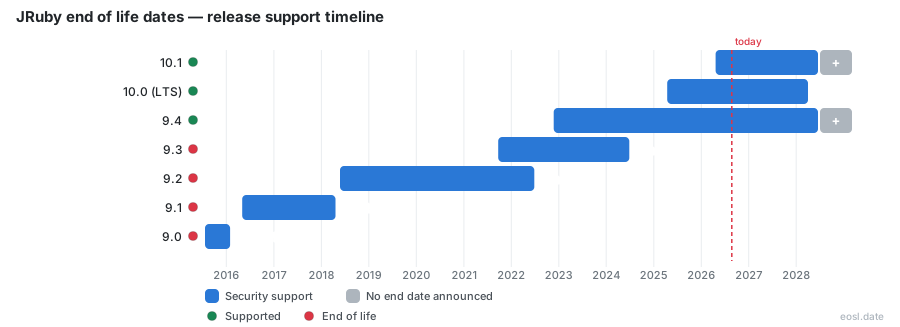
Currently Supported JRuby Releases - Active EOS/EOSL Support (3)
| Release | Min Java Version | Supported Ruby Version | Released | Support | Latest | LTS |
|---|---|---|---|---|---|---|
| 10.1 | 21 | 4.0 | (7 months ago) | Active | 10.1.3.0 (2 weeks and 3 days ago) | - |
| 10.0 (LTS) | 21 | 3.4 | (1 year and 7 months ago) | (in 1 year and 4 months) | 10.0.8.0 (2 weeks and 3 days ago) | LTS |
| 9.4 | 8 | 3.1 | (3 years and 11 months ago) | Active | 9.4.15.0 (5 months ago) | - |
JRuby End of Life (EOL) Releases - No Longer Supported (4)
| Release | Min Java Version | Supported Ruby Version | Released | Support | Latest | LTS |
|---|---|---|---|---|---|---|
| 9.3 | 8 | 2.6 | (5 years and 2 months ago) | (2 years and 4 months ago) | 9.3.15.0 (2 years and 4 months ago) | - |
| 9.2 | 8 | 2.5 | (8 years and 5 months ago) | (4 years and 4 months ago) | 9.2.21.0 (4 years and 4 months ago) | - |
| 9.1 | 7 | 2.3 | (10 years and 6 months ago) | (8 years and 7 months ago) | 9.1.17.0 (8 years and 7 months ago) | - |
| 9.0 | 7 | 2.2 | (11 years and 4 months ago) | (10 years and 9 months ago) | 9.0.5.0 (10 years and 9 months ago) | - |
If you run Ruby on the JVM, the JRuby end of life schedule tells you which release lines still receive fixes and which ones are on their own. JRuby is a threaded Java implementation of the Ruby programming language, so each version has its own support status, EOL timing and maintenance rules, and this guide lays them out line by line.
JRuby End of Life Status for JRuby 10.0 LTS and 10.1
As of October 2026, two release lines are actively maintained: JRuby 10.0, the long-term support line, and JRuby 10.1, the tip line. The table below summarizes every line, with support status taken from endoflife.date and the JRuby team's own announcements on the jruby.org homepage.
| Release line | Ruby compatibility | Required Java version | Released | Support status |
|---|---|---|---|---|
| JRuby 10.1 | Ruby 4.0 | Java 21 | 21 Apr 2026 | Supported (tip release) |
| JRuby 10.0 (LTS) | Ruby 3.4 | Java 21 | 14 Apr 2025 | Supported until 01 Apr 2028 |
| JRuby 9.4 | Ruby 3.1 | Java 8 | 23 Nov 2022 | Soft EOL |
| JRuby 9.3 | Ruby 2.6 | Java 8 | 22 Sep 2021 | Ended 26 Jun 2024 |
| JRuby 9.2 | Ruby 2.5 | Java 8 | 24 May 2018 | Ended 27 Jun 2022 |
JRuby 10.1 Is the Tip Release Line
The JRuby 10.1 line targets Ruby 4.0 and carries the newest performance work, including smaller objects and a cross-platform Prism parser. It is a stable release for trying new features, but it has no long-term guarantee, so treat it as the edge of the release line rather than a place to park production for years.
JRuby 10.0 LTS Release Support Until April 2028
The LTS release is JRuby 10.0. It follows Ruby 3.4 and is the line the team recommends for conservative users, with security fixes and bug fixes planned through the spring of 2028. Support for this line ends in roughly a year and five months.
How JRuby Support and EOL Policy Works
JRuby does not publish a formal end-of-life policy, and endoflife.date says so directly. In practice the team concentrates maintenance on the newest major release and ships occasional patch releases for the previous line while people migrate. Each JRuby release targets one Ruby language level, so a version's support window is also a statement about which Ruby you can run.
Soft EOL for JRuby 9.4 Explained
When JRuby 10.1 arrived, JRuby 9.4 moved into a "soft" EOL. Regular open-source updates stopped after 9.4.15.0 in June 2026, although organizations can sponsor continued work. The final public patch release is the one to pin if you cannot move yet.
Long-Term Support Every Two Years
The team will publish a new long-term support baseline every two years, starting in spring 2027. Alternating years are edge versions with no guarantees, which keeps room for experiments while giving cautious teams a stable target.
JRuby 9.3 and Older Lines Are Past End-of-Life
The 9.3 line is gone. The team was already ramping down maintenance in November 2023, when 9.3.13.0 shipped with a handful of bug fixes, and the last build, 9.3.15.0, appeared in June 2024. Any JRuby 9.3 install is now unpatched, and the same is true of every older line.
End-of-Life Dates for 9.3, 9.2 and 9.1
- JRuby 9.3: support ended 26 Jun 2024 (Ruby 2.6, Java 8)
- JRuby 9.2: support ended 27 Jun 2022
- JRuby 9.1: support ended 20 Apr 2018
Ruby and Java Compatibility Behind Each EOL Date
Every JRuby line pairs a Ruby compatibility level with a Java requirement. The compatibility promise is that JRuby stays in sync with C Ruby (also called Ruby MRI), so when upstream retires a Ruby version, the matching JRuby line usually follows.
Ruby Compatibility by Major Release
The Ruby compatibility mapping is: 10.1 for Ruby 4.0, 10.0 for Ruby 3.4, 9.4 for Ruby 3.1 and 9.3 for Ruby 2.6. Moving up a line means adopting new Ruby semantics, so run your test suite and check that your gems still work.
Required Java Version
The required Java version jumped from Java 8 on the 9.x lines to Java 21 on 10.x. Check your Java version and runtime before an upgrade, since that bump can matter as much as the Ruby change.
Ruby Maintenance Branches and the JRuby EOL Gap
The Ruby core team publishes its own maintenance branches page, and it is a useful clock for JRuby. Ruby 3.2 reached EOL on 2026-04-01, Ruby 3.3 is expected to reach EOL on 2027-03-31, and the 3.4 and 4.0 branches are still in normal maintenance. If you also run Ruby on Rails, check the Rails maintenance policy, because a framework can lose support before your JRuby version does.
Normal Maintenance vs Security Maintenance
In normal maintenance a branch receives general bug fixes and security fixes. In security maintenance only security fixes are backported to that branch. After EOL a branch gets nothing at all, and no further patch release is planned.
EOL Release History and Latest JRuby Versions
Recent JRuby releases arrive every few months. JRuby 10.1.2.0 and 10.0.7.0 were both released on 21 Sep 2026, the 9.4 line ended at 9.4.15.0 on 08 Jun 2026, with no preview release of a newer line announced on the news page.
Latest Release in Each Line
The latest release for each active line is 10.1.2.0 (76 issues resolved) and 10.0.7.0 (53 issues resolved). Read the release notes on the news page to see the fixed issues, contributors and changes to fibers, startup time and the standard library.
Checking Your Installed Version
Run jruby --version and compare the output with the table above. If your status reads EOL, plan your migration now.
Planning a JRuby Release Upgrade Before Support Ends
An upgrade from 9.4 to 10.0 is the most common move, because it lands you on the stable LTS line. List your gems, confirm each dependency supports Ruby 3.4, and test on Java 21 before you change production. The download page offers tar, zip and Windows installers for the current version.
Standard Library and Default Gems
Each release refreshes the standard library, including default gems such as json and psych and bundled gems such as csv and minitest. Review those library changes, since a newer gem can change how a platform integration behaves.
Java Integration and Performance
Java integration and performance improve steadily, from faster subclasses of Java classes to quicker autoloads. Those gains are another reason to move off a line that is out of support.
Choosing Between LTS and Tip Releases for JRuby EOL Risk
Pick LTS if you value stability and a known support date, and the tip line if you want the newest Ruby features and can upgrade often. The JRuby community also offers commercial support for teams that must stay on an older version, and the full versions list is on the homepage.
Commercial Support Options
Software teams stuck on 9.4 can contact the maintainers to sponsor releases for their own needs. That is a business arrangement, not a free EOL extension.