Jenkins End of Life (EOL) Dates and End of Support (EOS) Dates
Jenkins end of life (EOL) and end of support (EOS) dates: 17 Jenkins versions have reached EOL, including Jenkins 2.555 (LTS) (EOL date: Jun 10, 2026) — no longer receiving security updates or patches. Jenkins 2.568.3 LTS is the current supported release — 2 versions in active support. Also see Spring Boot end of support life for related end-of-life information.
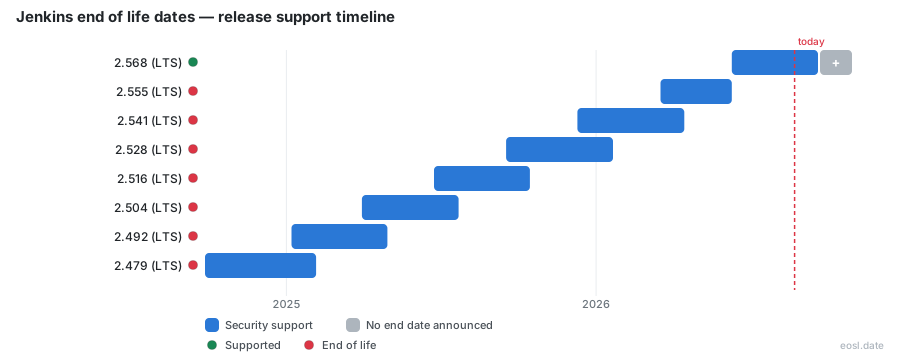
Currently Supported Jenkins Releases - Active EOS/EOSL Support (2)
Jenkins End of Life (EOL) Releases - No Longer Supported (17)
| Release | Released | Support | Latest | LTS |
|---|---|---|---|---|
| 2.555 (LTS) | (8 months ago) | (5 months ago) | 2.555.3 (5 months ago) | LTS |
| 2.541 (LTS) | (11 months ago) | (7 months ago) | 2.541.3 (8 months ago) | LTS |
| 2.528 (LTS) | (1 year and 2 months ago) | (10 months ago) | 2.528.3 (11 months ago) | LTS |
| 2.516 (LTS) | (1 year and 4 months ago) | (1 year and 1 month ago) | 2.516.3 (1 year and 2 months ago) | LTS |
| 2.504 (LTS) | (1 year and 7 months ago) | (1 year and 3 months ago) | 2.504.3 (1 year and 4 months ago) | LTS |
| 2.492 (LTS) | (1 year and 10 months ago) | (1 year and 6 months ago) | 2.492.3 (1 year and 7 months ago) | LTS |
| 2.479 (LTS) | (2 years and 1 month ago) | (1 year and 9 months ago) | 2.479.3 (1 year and 10 months ago) | LTS |
| 2.462 (LTS) | (2 years and 5 months ago) | (2 years and 1 month ago) | 2.462.3 (2 years and 2 months ago) | LTS |
| 2.452 (LTS) | (2 years and 7 months ago) | (2 years and 3 months ago) | 2.452.4 (2 years and 3 months ago) | LTS |
| 2.440 (LTS) | (2 years and 10 months ago) | (2 years and 6 months ago) | 2.440.3 (2 years and 7 months ago) | LTS |
| 2.426 (LTS) | (3 years and 1 month ago) | (2 years and 9 months ago) | 2.426.3 (2 years and 9 months ago) | LTS |
| 2.414 (LTS) | (3 years and 4 months ago) | (3 years ago) | 2.414.3 (3 years and 1 month ago) | LTS |
| 2.401 (LTS) | (3 years and 7 months ago) | (3 years and 2 months ago) | 2.401.3 (3 years and 3 months ago) | LTS |
| 2.387 (LTS) | (3 years and 10 months ago) | (3 years and 5 months ago) | 2.387.3 (3 years and 6 months ago) | LTS |
| 2.375 (LTS) | (4 years ago) | (3 years and 8 months ago) | 2.375.4 (3 years and 8 months ago) | LTS |
| 2.361 (LTS) | (4 years and 3 months ago) | (3 years and 11 months ago) | 2.361.4 (4 years ago) | LTS |
| 2.346 (LTS) | (4 years and 6 months ago) | (4 years and 2 months ago) | 2.346.3 (4 years and 3 months ago) | LTS |
Planning around Jenkins end of life starts with one fact: the open source automation server that runs your continuous integration and continuous delivery (CI/CD) pipelines has no project-wide shutdown date. Each release line, the Java runtime and the operating system underneath expire on their own schedules. This software guide covers all three for the team building, testing and deploying with it.
Does Jenkins End of Life Mean the Project Stops?
No. Jenkins is an open source product under the MIT license, and nobody has published a vendor-style shutdown date for the product or its automation features. What expires is maintenance for a specific release, so the question for developers and DevOps teams is whether the exact version running your builds and pipelines still gets fixes. A version that stops getting them has reached its end-of-life, even while newer lines stay healthy, much as commercial software loses a patch plan once a vendor drops it.
Jenkins Lifecycle: Long-Term Support and Weekly Release Lines
The project ships two channels. Weekly versions, also called the regular channel, deliver features and bug fixes quickly. The stable channel is what most teams run: every 12 weeks the project picks a regular build as the next LTS baseline, and every 4 weeks it patches that line with backports of bug fixes, plus a security fix whenever one is needed. Long-term support here means roughly a few months per line, not years.
Latest Version and Supported Release Today
As of late October 2026 the newest regular build is 2.587, published on 20 October 2026. The supported LTS line is 2.568, whose latest version is 2.568.3 from 31 August 2026. Its release date was 10 June 2026, which is also the day 2.555 ended, so 2.568 is the only line in active support right now. Always read the current support status again before acting, because it changes every few weeks.
Jenkins EOL Dates and Version History for Each LTS Line
Each line is phasing out as its successor arrives. This table shows recent lines with the day support ended.
| Line | Released | Support ended |
|---|---|---|
| 2.568 LTS | 10 June 2026 | Still supported |
| 2.555 LTS | 18 March 2026 | 10 June 2026 |
| 2.541 LTS | 10 December 2025 | 15 April 2026 |
| 2.528 LTS | 17 September 2025 | 21 January 2026 |
| 2.516 LTS | 24 June 2025 | 15 October 2025 |
| 2.504 LTS | 31 March 2025 | 23 July 2025 |
Read a row like this: 2.504 shipped on 31 March 2025 and lost support on 23 July 2025, so a team still on it has gone over a year without official fixes. Lines last about three to four months, which is why a pinned version ages quickly.
End of Support for Operating Systems That Run Jenkins
Since Jenkins 2.407 and 2.401.2, administrators are warned in the interface when the operating system is within six months of its end of life, along with the date support stops. The support policy is short: the project does not support, test or accept pull requests for systems their provider has abandoned, which makes them no longer supported. Docker follows the same rule, so container images built on an abandoned base go too. Windows hosts follow the same rule through their own system timelines.
Red Hat Enterprise Linux and Its Derivatives
Jenkins ended support for Red Hat Enterprise Linux 7 and derivatives such as CentOS 7 on 16 November 2023, and its CentOS 7 images went with it. Move to Red Hat Enterprise Linux 8 or 9, Rocky Linux, AlmaLinux or Oracle Linux 8 or 9. Amazon Linux 2 descends from the same base, and Amazon planned to retire it on 30 June 2025.
Ubuntu, Fedora and Alpine Linux Releases
Ubuntu 18.04 left standard support on 31 May 2023, Fedora 36 retired on 16 May 2023 and Alpine Linux 3.14 stopped on 1 May 2023. Update to Ubuntu 22.04, Alpine 3.18 or any newer release.
Java and Hardware Limits That Shorten Your Jenkins Support Life
Operating systems are not the only dependency. Jenkins needs a supported JDK, and because each Java version has its own retirement date, moving the runtime can force a Jenkins move. A plugin may also drop old cores before you do, so test plugin compatibility early. An older controller outside the support window often runs on undersized hardware too, so check these minimums when moving to a supported LTS line:
- Memory: 256 MB of RAM at minimum, 4 GB or more for small teams
- CPU: 2 cores at minimum, 4 for small teams
- Storage: 1 GB at minimum, 50 GB recommended
- Access: any modern browser, with port 8080 by default under Jetty or a Tomcat container
Security Risk When Jenkins Is No Longer Supported
The short support life of each LTS line is deliberate: fixes go into the current baseline. Once your line drops out, the project stops shipping patched builds for it, so every new security flaw in this software stays open on your server. Versio.io counts 946 of 1,131 Jenkins versions as affected by at least one CVE, and the security exposure is highest on an old controller that reaches the network.
Upgrade Plan Before Your Jenkins Release Reaches EOL
Treat every LTS baseline as a deadline for your Jenkins versions, because this product is only as safe as its newest supported line:
- Compare the version on your About page with the table above.
- Follow the endoflife.date RSS feed or its JSON API, and add its calendar to your own.
- Track the CPE identifier
cpe:2.3:a:jenkins:jenkinsin your vulnerability scanner. - Read the Jenkins blog and documentation first, rehearse the migration on a staging copy, then upgrade to the current LTS line and keep your job configuration in GitHub.
Doing this every quarter turns an emergency into routine maintenance.