Postfix End of Life (EOL) Dates and End of Support (EOS) Dates
Postfix end of life (EOL) and end of support (EOS) dates: 14 Postfix versions have reached EOL, including Postfix 3.7 (EOL date: Mar 06, 2026) — no longer receiving security updates or patches. Postfix 3.11.7 is the current supported release — 4 versions in active support. Also see Chef Supermarket end of life dates for related end-of-life information.
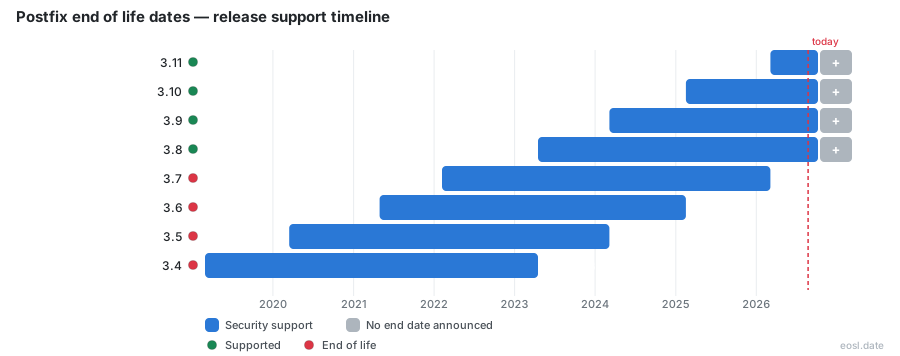
Currently Supported Postfix Releases - Active EOS/EOSL Support (4)
Postfix End of Life (EOL) Releases - No Longer Supported (14)
| Release | Released | Security Support | Latest |
|---|---|---|---|
| 3.7 | (4 years and 9 months ago) | (8 months ago) | 3.7.23 (2 months ago) |
| 3.6 | (5 years and 6 months ago) | (1 year and 9 months ago) | 3.6.21 (2 months ago) |
| 3.5 | (6 years and 8 months ago) | (2 years and 8 months ago) | 3.5.28 (2 months ago) |
| 3.4 | (7 years and 8 months ago) | (3 years and 7 months ago) | 3.4.29 (3 years and 7 months ago) |
| 3.3 | (8 years and 9 months ago) | (4 years and 9 months ago) | 3.3.22 (4 years and 9 months ago) |
| 3.2 | (9 years and 8 months ago) | (5 years and 6 months ago) | 3.2.22 (5 years and 7 months ago) |
| 3.1 | (10 years and 8 months ago) | (6 years and 8 months ago) | 3.1.15 (6 years and 9 months ago) |
| 3.0 | (11 years and 9 months ago) | (7 years and 8 months ago) | 3.0.15 (7 years and 8 months ago) |
| 2.11 | (12 years and 10 months ago) | (8 years and 9 months ago) | 2.11.11 (8 years and 9 months ago) |
| 2.10 | (13 years and 9 months ago) | (9 years and 8 months ago) | 2.10.10 (10 years and 6 months ago) |
| 2.9 | (14 years and 9 months ago) | (10 years and 8 months ago) | 2.9.15 (11 years and 1 month ago) |
| 2.8 | (15 years and 10 months ago) | (11 years and 9 months ago) | 2.8.20 (11 years and 9 months ago) |
| 2.6 | (17 years and 6 months ago) | (13 years and 9 months ago) | 2.6.19 (13 years and 9 months ago) |
| 2.5 | (18 years and 9 months ago) | (14 years and 9 months ago) | 2.5.17 (14 years and 9 months ago) |
Running a mail server on software nobody updates is a risk, so knowing the Postfix end of life schedule matters before your next upgrade. Postfix is an open-source mail transfer agent that Wietse Venema started at IBM as an alternative to Sendmail, and it delivers email for countless Linux servers. This page shows which releases still get fixes, how the project retires old ones, and how to check your own install. It is free open source software, and the answer takes a few minutes.
Postfix End of Life Dates by Stable Release
Each stable release has a release date, a fix stream and a retirement date. A supported release still receives fixes, while one that has reached end of life does not. Postfix calls older lines legacy releases, and every legacy release keeps getting fixes for a while after the newest line ships. Compare your version with the table below, which follows the endoflife.date tracker.
| Release | Released | Retired | Latest patch |
|---|---|---|---|
| 3.11 | 06 Mar 2026 | Still supported | 3.11.7 (08 Sep 2026) |
| 3.10 | 16 Feb 2025 | Still supported | 3.10.14 (08 Sep 2026) |
| 3.9 | 06 Mar 2024 | Still supported | 3.9.15 (08 Sep 2026) |
| 3.8 | 17 Apr 2023 | Still supported | 3.8.21 (08 Sep 2026) |
| 3.7 | 06 Feb 2022 | 06 Mar 2026 | 3.7.23 (08 Sep 2026) |
| 3.6 | 29 Apr 2021 | 16 Feb 2025 | 3.6.21 (08 Sep 2026) |
| 3.5 | 15 Mar 2020 | 06 Mar 2024 | 3.5.28 (08 Sep 2026) |
| 3.4 | 27 Feb 2019 | 17 Apr 2023 | 3.4.29 (19 Apr 2023) |
Versio.io counts only 3.11, 3.10 and 3.9 as supported on 26 October 2026, so trackers can differ by one line. Plan around the stricter list.
Postfix Release Strategy and Maintenance Period
The release strategy is simple: typically the last four releases are supported and receive patches. Each Postfix release therefore enjoys a maintenance period of roughly three to four years. When a new stable line arrives, the oldest supported one drops out; 3.7 was retired when 3.11 shipped in March 2026. Routine upkeep can continue briefly, as the September 2026 announcement of 3.7.23, 3.6.21 and 3.5.28 shows, but those lines will no longer receive fixes beyond that. Go by the date in the table, not by the last patch you happened to see, because every SMTP daemon on your mail server is only as safe as its newest fix.
Postfix Long-Term Support: Is There an LTS After End of Support?
No. Postfix does not designate long-term support releases, so there is no LTS line to move to once a release is retired. Every release follows the same window. Versio.io also tracks 98 unstable versions among 555 in total, and those stay off production hosts.
Check Your Postfix Version Against the Latest Version
Run postconf mail_version on the server that handles your mail. The command prints the installed release, which you match against the table. Distribution builds may carry backported fixes, so read the distribution's documentation too. Your main.cf and master.cf files hold the configuration and survive an upgrade, but back them up first. The endoflife.date API returns the same dates as JSON, so a monitoring check can query it automatically.
Why a Release Reaches EOL: Security Support and Patches
Once a line reaches EOL it gets no more security support and no further fixes, so each new vulnerability stays open. The 2023 SMTP smuggling disclosure drove special smuggling fixes even for old lines, and Versio.io lists 394 versions affected by a CVE. Dependencies retire as well: Postfix 3.6 required OpenSSL 1.1.1, which was itself ending in 2023.
Leaving a retired release means upgrading, and upgrades can carry incompatible changes. Version 3.6 introduced the compatibility level, set with compatibility_level, and deprecated old postscreen parameter names. It needs postfix stop before the update, so schedule a downtime slot.
How Operating Systems Handle Postfix Releases and Lifecycle
Postfix is the default MTA on macOS, NetBSD, Red Hat and Ubuntu, so most administrators get it from a distribution rather than from source. Distributions often freeze a version and backport fixes, which means the lifecycle you live with is theirs, not the project's. Under the hood, Postfix daemons manage the queue and mail delivery on the server, while Dovecot and spam filters sit beside them on the same mail host, so a retired build exposes the whole chain. Moving to a supported build is free, since the software is licensed under the IBM Public License or the Eclipse Public License.
Tracking Postfix Versions and Announcements
The project's announcements page lists every release, and the mailing lists carry urgent notices. When you upgrade off a retired line, download the newest source code from the main site or any mirror. Subscribe to the endoflife.date RSS feed or its iCalendar feed to get a reminder before an upgrade becomes urgent.
Planning Your Move Before a Legacy Release Retires
Treat Postfix end of life as a calendar item, not a surprise. Administrators can work through this list:
- Record which release you run and its retirement date.
- Test the next stable release on a staging server.
- Back up
main.cfand the mail queue, then upgrade at least one quarter before the retirement date. - Recheck the table after each new announcement.