HAProxy Ingress End of Life (EOL) Dates and End of Support (EOS) Dates
HAProxy Ingress end of life (EOL) and end of support (EOS) dates: 0.12 has reached EOL — EOL date: Oct 15, 2025. This version no longer receives security updates, patches, or support. HAProxy Ingress 0.16.3 is the current supported release — 4 versions in active support. Also see Chef Supermarket EOSL information for related end-of-life information.
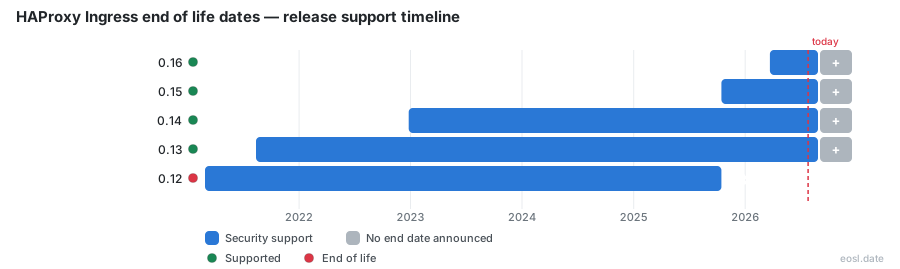
Currently Supported HAProxy Ingress Releases - Active EOS/EOSL Support (4)
| Release | Embedded Haproxy | Supported Kubernetes Version | Released | Support | Latest |
|---|---|---|---|---|---|
| 0.16 | 2.8 | 1.21+ | (7 months ago) | Active | 0.16.3 (3 weeks and 5 days ago) |
| 0.15 | 2.6 | 1.21+ | (1 year and 1 month ago) | Active | 0.15.6 (3 weeks and 5 days ago) |
| 0.14 | 2.4 | 1.19+ | (3 years and 10 months ago) | Active | 0.14.14 (3 weeks and 5 days ago) |
| 0.13 | 2.4 | 1.19+ | (5 years and 3 months ago) | Active | 0.13.21 (3 weeks and 5 days ago) |
HAProxy Ingress End of Life (EOL) Releases - No Longer Supported (1)
| Release | Embedded Haproxy | Supported Kubernetes Version | Released | Support | Latest |
|---|---|---|---|---|---|
| 0.12 | 2.2 | 1.18` - `1.21 | (5 years and 8 months ago) | (1 year and 1 month ago) | 0.12.22 (1 year and 3 months ago) |
Your HAProxy Ingress End of Life check starts with one question: does the HAProxy Kubernetes Ingress Controller release running in your Kubernetes cluster still receive support? This guide lists the end of life date for each release, explains what stops when the date passes, and shows how to schedule the move before your controller falls out of the supported window.
HAProxy Ingress End of Life Dates for Every Release
HAProxy Technologies publishes a release date, an end-of-life date and the supported K8s versions for each ingress controller release. The table below combines the community and enterprise lines so you can compare product versions side by side.
| Version | Edition | Release date | End of life | HAProxy version | Supported K8s versions |
|---|---|---|---|---|---|
| 3.2 | Enterprise LTS | 2025-12 | 2027-12 | 3.2 | 1.32 to 1.37 |
| 3.2 | Community | 2025-12 | 2027-01 | 3.2 | 1.32 to 1.37 |
| 3.0 | Enterprise LTS | 2025-01 | 2027-01 | 3.0 | 1.30 to 1.37 |
| 3.1 | Community | 2025-01 | 2026-02 | 3.1 | 1.30 to 1.34 |
| 1.11 | Enterprise LTS | 2024-02 | 2026-02 | 2.8 | 1.28 to 1.30 |
| 3.0 | Community | 2024-06 | 2025-06 | 3.0 | 1.28 to 1.30 |
| 1.11 | Community | 2024-02 | 2025-02 | 2.8 | 1.26 to 1.28 |
HAProxy Kubernetes Ingress Controller Community Releases
The community edition of the HAProxy Kubernetes Ingress Controller is open-source and has the shortest windows. Release 3.2 is the latest release, and it is supported until 2027-01, while release 3.1 reached its end of life in 2026-02. Older lines such as 1.10, 1.9 and 1.8 ended between 2023 and 2024, so a cluster still on them has no supported release to fall back on. HAProxy only guarantees Kubernetes compatibility for older controller releases against the Kubernetes version range listed for them, and it recommends the newest release for ongoing maintenance.
Enterprise Kubernetes Ingress Controller LTS Releases
The enterprise Kubernetes ingress controller adds LTS releases with longer windows, which suits teams that want commercial support and fewer upgrades. Enterprise 3.2 LTS runs to 2027-12, and 3.0 LTS runs to 2027-01. Enterprise 1.11 LTS ended in 2026-02, so it is already past its date, and 1.9 LTS ended in 2025-10. Compared with the community version, an enterprise line typically gives you about two years per release, and the release notes for each version describe what changed. Teams that value enterprise backing usually pick these builds.
Release Policy for the HAProxy Ingress Project
A separate community project, haproxy-ingress by jcmoraisjr, also carries the HAProxy Ingress name and uses a different release policy. It runs the embedded HAProxy inside the controller, or an external load balancer instance, and it advertises more than 200 configuration options. According to endoflife.date, releases 0.13 to 0.16 are supported, with 0.16 carrying HAProxy 2.8 and needing Kubernetes 1.21 or newer, while 0.12 ended on 15 October 2025. Follow the project's release schedule, and plan a move to a newer line whenever the line you run leaves that supported list.
What End-of-Life Means for Your Kubernetes Controller
An end-of-life date, sometimes called EOL, is the day a project stops its best-effort maintenance: no new bug fixes and no security fixes. A retirement does not stop your cluster from serving requests. It removes the safety net.
Security Patches and Vulnerability Exposure
The ingress controller terminates TLS and receives all external traffic, so it sits in the most exposed part of your security design. After the date, no security patches arrive, and any new CVE stays unpatched. Each new CVE then leaves open vulnerabilities that attackers can scan for.
Compliance and Audit Findings
Once your HAProxy release passes the dates in the table, regulated teams feel the pressure sooner than attackers do. Auditors flag unsupported software in the request path under SOC 2, PCI DSS, HIPAA and ISO 27001, so compliance reviews can block a release. Treat the date as an audit deadline and a standing risk entry.
Operational Drift After the Date Passes
Even without a CVE, a feature-frozen controller decays. An ended release stays pinned to its listed supported K8s versions, such as 1.28 to 1.30, so a newer Kubernetes minor version may break it, and your cluster version bump then turns into an emergency.
Planning an Upgrade Before the EOL Date
Treat the support schedule as a calendar, not a surprise. A sensible rule is to start the migration a full quarter before the end of support, then test it in staging. Teams choosing among migration paths usually weigh three routes.
Moving Within the Same Release Line
The cheapest route is a version bump to the newest supported release. Your Ingress resources and annotations stay as they are, so TLS termination, routing and traffic rules keep working. Check the supported K8s versions for your target release first, since the supported K8s versions column in the table above is what tells you whether a new Kubernetes minor release is safe to adopt.
Ingress NGINX Migration to a Drop-In Replacement
The Kubernetes community retired Ingress NGINX in March 2026, and many teams now ask whether HAProxy can take its place. HAProxy is one of several options, alongside Traefik, Envoy and the F5 controller. None of them is a true drop-in replacement, because NGINX annotations and configuration snippets rarely translate one to one.
Ingress NGINX is the retired community controller, not the F5 NGINX controller, which remains maintained. Inventory every Ingress NGINX annotation your objects use, then map each one to a matching HAProxy setting. NGINX rewrite rules, NGINX snippets and NGINX timeouts are the usual trouble spots, so test every NGINX-specific rule in staging before cutover; an NGINX-to-HAProxy move works best one route at a time.
Gateway API as the Long-Term Successor
The Ingress API is not removed, yet it is frozen, and new capabilities land in the Gateway API. The Gateway API replaces annotations with GatewayClass, Gateway and HTTPRoute resources, so routing rules become portable between controllers. A Gateway API setup costs more to learn than a version bump, yet it avoids repeating this migration every time a controller retires. Several controllers already implement the Gateway API, and a Gateway API rollout can run next to existing Ingress objects, so you can move one route at a time. Whichever Kubernetes ingress controller you run, whether HAProxy or another Kubernetes option, check its compatibility with that API before you commit.
Ingress Controller Alternatives and Retirement Timelines
If your date is close and the move looks costly, compare alternatives on three points: who maintains them, how long each release is supported, and how much work your existing annotations need. The HAProxy ingress controller publishes its dates openly, which makes planning easier than for an ingress project that gives no schedule, such as the retired NGINX one. Also review managed cloud options and any Kubernetes ingress option your cloud provider bundles, such as one built on NGINX or Traefik, since a managed service can shift the patching duty to your provider, but the same ingress controller end-of-life questions still apply to them.