Perl End of Life (EOL) Dates and End of Support (EOS) Dates
Perl end of life (EOL) and end of support (EOS) dates: 16 Perl versions have reached EOL, including Perl 5.38 (EOL date: Jul 02, 2026) — no longer receiving security updates or patches. Perl 5.44.0 is the current supported release, with support through Jul 15, 2029 — 3 versions in active support. Also see Alibaba Dragonwell lifecycle dates for related end-of-life information.
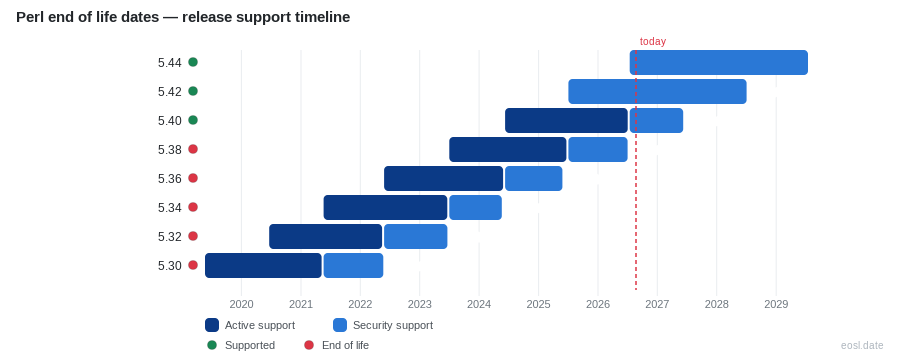
Currently Supported Perl Releases - Active EOS/EOSL Support (3)
| Release | Released | Critical security patches | Active Support | Latest |
|---|---|---|---|---|
| 5.44 | (4 months ago) | (in 2 years and 7 months) | Active | 5.44.0 (4 months ago) |
| 5.42 | (1 year and 4 months ago) | (in 1 year and 7 months) | Active | 5.42.3 (3 months ago) |
| 5.40 | (2 years and 5 months ago) | (in 6 months) | (4 months ago) | 5.40.5 (3 months ago) |
Perl End of Life (EOL) Releases - No Longer Supported (16)
| Release | Released | Critical security patches | Active Support | Latest |
|---|---|---|---|---|
| 5.38 | (3 years and 4 months ago) | (4 months ago) | (1 year and 4 months ago) | 5.38.5 (1 year and 3 months ago) |
| 5.36 | (4 years and 5 months ago) | (1 year and 5 months ago) | (2 years and 5 months ago) | 5.36.3 (2 years and 11 months ago) |
| 5.34 | (5 years and 5 months ago) | (2 years and 5 months ago) | (3 years and 4 months ago) | 5.34.3 (2 years and 11 months ago) |
| 5.32 | (6 years and 4 months ago) | (3 years and 4 months ago) | (4 years and 5 months ago) | 5.32.1 (5 years and 9 months ago) |
| 5.30 | (7 years and 5 months ago) | (4 years and 5 months ago) | (5 years and 5 months ago) | 5.30.3 (6 years and 5 months ago) |
| 5.28 | (8 years and 4 months ago) | (5 years and 4 months ago) | (6 years and 4 months ago) | 5.28.3 (6 years and 5 months ago) |
| 5.26 | (9 years and 5 months ago) | (6 years and 5 months ago) | (7 years and 5 months ago) | 5.26.3 (7 years and 11 months ago) |
| 5.24 | (10 years and 6 months ago) | (7 years and 6 months ago) | (8 years and 4 months ago) | 5.24.4 (8 years and 7 months ago) |
| 5.22 | (11 years and 5 months ago) | (8 years and 5 months ago) | (9 years and 5 months ago) | 5.22.4 (9 years and 4 months ago) |
| 5.20 | (12 years and 5 months ago) | (9 years and 5 months ago) | (10 years and 6 months ago) | 5.20.3 (11 years and 2 months ago) |
| 5.18 | (13 years and 5 months ago) | (10 years and 5 months ago) | (11 years and 5 months ago) | 5.18.4 (12 years and 1 month ago) |
| 5.16 | (14 years and 5 months ago) | (11 years and 5 months ago) | (12 years and 5 months ago) | 5.16.3 (13 years and 8 months ago) |
| 5.14 | (15 years and 6 months ago) | (12 years and 6 months ago) | (13 years and 5 months ago) | 5.14.4 (13 years and 8 months ago) |
| 5.12 | (16 years and 7 months ago) | (13 years and 7 months ago) | (14 years and 5 months ago) | 5.12.5 (14 years ago) |
| 5.10 | (18 years and 10 months ago) | (15 years and 6 months ago) | (15 years and 6 months ago) | 5.10.1 (7 years and 6 months ago) |
| 5.8 | (24 years and 3 months ago) | (17 years and 11 months ago) | (17 years and 11 months ago) | 5.8.9 (17 years and 11 months ago) |
Planning an upgrade? Perl end of life is the point where a release of this open-source programming language stops getting fixes, and the dates are easy to misjudge. Perl began as a Unix scripting tool and is now maintained by a volunteer community, so its software support rules differ from a commercial product. Here is what you need to check before your next release hits a security gap.
Perl End of Life Dates by Release
The table below lists the Perl 5 series by release date, with the day active support ended and the day security support stops. Dates follow the endoflife.date schedule, which summarises the rules in perlpolicy and the CPAN source index.
| Series | Released | Active support | Security support ends | Status |
|---|---|---|---|---|
| Perl 5.44 | 15 Jul 2026 | Yes | 15 Jul 2029 | Supported |
| Perl 5.42 | 3 Jul 2025 | Yes | 3 Jul 2028 | Supported |
| Perl 5.40 | 9 Jun 2024 | Ended 15 Jul 2026 | 9 Jun 2027 | Security only |
| Perl 5.38 | 2 Jul 2023 | Ended 3 Jul 2025 | 2 Jul 2026 | End of life |
| Perl 5.36 | 27 May 2022 | Ended 9 Jun 2024 | 27 May 2025 | End of life |
| Perl 5.34 | 20 May 2021 | Ended 2 Jul 2023 | 20 May 2024 | End of life |
| Perl 5.32 | 20 Jun 2020 | Ended 27 May 2022 | 20 Jun 2023 | End of life |
| Perl 5.30 | 22 May 2019 | Ended 20 May 2021 | 22 May 2022 | End of life |
If your server reports anything older than the rows marked supported, it has already passed its end of life.
Perl Lifecycle: Support Policy and Phases
The Perl support policy is written in perlpolicy and has two parts. The project promises to fix critical issues in the two most recent stable series, and to ship patches for any series whose first release came within the last three years. No vendor sells you a contract here, so the support timeframe is a best-effort promise. A series moves toward phasing out once two newer ones exist.
Active Support and Security Support
While a series is one of the two newest, it receives active support: bug fixes and module updates. After that, only security support remains, so you should plan your move before that window closes.
Critical Security Patches
Critical security patches ship as new point releases of a supported series. Once a series passes its end date it gets nothing, even for a severe flaw, because it is no longer supported. Development builds carry no promise of security fixes either, so the Perl Foundation vendor listing and perlpolicy agree on that point.
Perl Releases: Maintenance Releases and Development Releases
Since 5.6, Perl numbers releases as 5.series.patch, which resembles semantic versioning. Even-numbered series (5.38, 5.40, 5.42) are maintenance releases and count as a stable release line meant for production use, while odd numbers such as 5.45 are development releases for testing. Release candidates leading up to a maintenance branch are called testing releases, and you can check what you run with perl -v.
Release Series and Source Archives
Each release series has a source archive on CPAN, for example perl-5.44.0.tar.gz. To install from source, unpack the tar.gz, run Configure, then make and make install. Perl ships under the Artistic License or the GPL.
Version History and Release Notes
The version history shows steady change. Release notes for 5.44 cover Unicode 17.0 support, stricter Unicode rules for identifiers, bug fixes and named parameters in signatures, while 5.42 added Unicode 16.0 and a :writer attribute. Older shifts mattered more for upgrades: CGI.pm and several modules left the core distribution in 5.22, and the toolchain policy lets older releases keep working informally. Deprecated features, like the switch feature in 5.38, give you warning of backward compatibility breaks and keep compatibility problems visible early.
Which Perl Versions Are Still Supported
Today, 5.44 and 5.42 are fully supported, and 5.40 receives security fixes until June 2027. Perl has no formal long-term support (LTS) track, but the three-year window does the same job. A supported release still receives fixes, so plan an upgrade as the EOL date nears, ideally one series ahead.
Latest Version and Release Date: Perl 5.44
The latest version of the stable line is 5.44.0, with a release date of 15 July 2026. A 5.45 development branch is already available for testing.
After EOL: Upgrade and Migration Options
A series that has reached EOL is unsupported and, in practice, obsolete: new CVE reports go unpatched, and every series marked end of life in the table, plus everything older, gets no fixes. Your safest move is a migration to 5.42 or 5.44, tested on a staging copy first. Distribution packages may still backport patches, so ask your operating system provider before you decide.