Oracle GraalVM End of Life (EOL) Dates and End of Support (EOS) Dates
Oracle GraalVM end of life (EOL) and end of support (EOS) dates: 5 Oracle GraalVM versions have reached EOL, including Oracle GraalVM 24 (EOL date: Sep 30, 2025) — no longer receiving security updates or patches. Oracle GraalVM 25.3.4.1 is the current supported release, with support through Sep 30, 2030 — 2 versions in active support. Also see GraalVM Community Edition lifecycle dates for related end-of-life information.
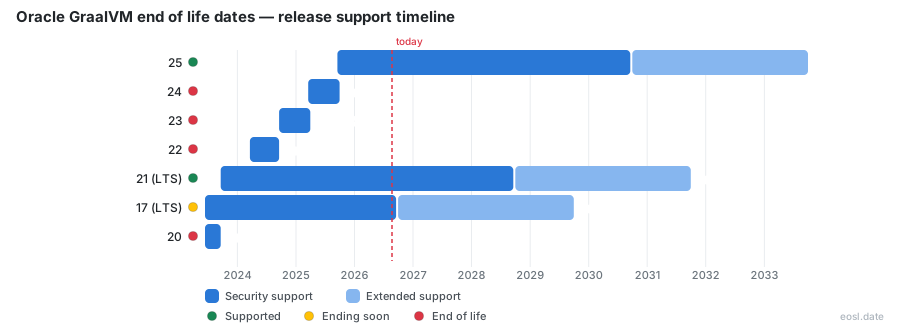
Currently Supported Oracle GraalVM Releases - Active EOS/EOSL Support (2)
Oracle GraalVM End of Life (EOL) Releases - No Longer Supported (5)
| Release | Released | Premier Support | Extended Support | Latest | LTS |
|---|---|---|---|---|---|
| 24 | (1 year and 8 months ago) | (1 year and 1 month ago) | Active | 24.0.2 (1 year and 4 months ago) | - |
| 23 | (2 years and 2 months ago) | (1 year and 7 months ago) | Active | 23.0.2 (1 year and 10 months ago) | - |
| 22 | (2 years and 8 months ago) | (2 years and 2 months ago) | Active | 22.0.2 (2 years and 4 months ago) | - |
| 17 (LTS) | (3 years and 5 months ago) | (1 month and 3 weeks ago) | (in 2 years and 10 months) | 17.0.21.1 (5 days ago) | LTS |
| 20 | (3 years and 5 months ago) | (3 years and 2 months ago) | Active | 20.0.2 (3 years and 3 months ago) | - |
Planning around Oracle GraalVM end of life starts with one fact: Oracle no longer ships GraalVM as part of its Java SE products, and support for older Java builds now flows through My Oracle Support. The Oracle build is a closed-source Java VM, so Oracle customers running legacy releases need a plan. This guide lays out the dates, what stays the same for your Java workloads, and a practical path to a new Java runtime.
Oracle GraalVM End of Life: What Oracle Announced
In its September 2025 announcement on the Java blog, Oracle explained that the GraalVM team is moving its attention to non-Java languages. For customers who bought GraalVM as a bundled extra, the relationship ends, while the open-source Java code carries on. Every customer who still needs patches for older Java builds should download them through the support portal instead of the public Java pages, and the end of support applies to the Java SE subscription bundle only.
GraalVM for JDK 24 and the Final Java SE Release
GraalVM for JDK 24 was the final release licensed and supported alongside Oracle Java SE products. The same cut-off applies to the Graal JIT: Oracle JDK 24 was the last Oracle JDK to include that experimental compiler, so Java teams should switch to the default C2 JIT in the HotSpot JVM. Early adopter technology, including bundled native image support, is discontinued for Java SE Product customers, and the older Enterprise Edition name is long retired.
What Happens to Native Image and Project Leyden
Many Java developers read this notice as the death of native image. Maintainers of the Micronaut framework replied that this is wrong, and other Java frameworks agree: customers still get instant startup and a small memory footprint from native image builds. What disappears is the bundled commercial support. Oracle points to Project Leyden in OpenJDK, which pursues faster startup time and ahead-of-time compilation as a standard part of Java.
End of Support Dates for GraalVM Releases
GraalVM for JDK 24 was the last Java SE-bundled build, so these windows apply to customers still running older GraalVM builds. Oracle JDK long-term support releases drive the schedule, and the Oracle distribution follows the Oracle JDK cadence of a new feature release every six months. Release numbering follows the Java version since 2023, which keeps every Java line easy to match against the support roadmap.
| Release | Released | Premier Support ends | Extended Support ends |
|---|---|---|---|
| 25 (LTS) | Sep 2025 | Sep 2030 | Sep 2033 |
| 24 | Mar 2025 | Sep 2025 | Unavailable |
| 21 (LTS) | Sep 2023 | Sep 2028 | Sep 2031 |
| 17 (LTS) | Jun 2023 | Sep 2026 | Sep 2029 |
Release 17 is the one to watch: its Premier Support window already closed on 30 September 2026, so its remaining updates come only under Extended Support.
Premier Support, Extended Support and Sustaining Support
- Premier Support covers minor improvements, bug fixes and security fixes. Long-term support releases get at least five years of it, and other releases only six months.
- Extended Support adds three more years of patches for LTS releases, for an additional fee.
- Sustaining Support offers help from Oracle indefinitely but ships no patches.
GraalVM Community Edition and Release Cadence
The GraalVM Community Edition is a separate, GPL-licensed build that supports only the latest JDK version, so its release cadence tracks OpenJDK so older releases are not maintained once a newer one ships. Critical Patch Updates for the Oracle builds arrive on the third Tuesday of January, April, July and October, in line with the Oracle release calendar.
Support Roadmap for Migration After Detaching GraalVM
Use this order of work for your Java estate:
- Inventory every service that runs on the Oracle build and note its Java version, plus any legacy releases still in production.
- Move JIT-dependent workloads to the C2 JIT, then measure performance before and after.
- Pick a destination: Oracle OpenJDK, the Community Edition, or Oracle JDK 25 with its ahead-of-time features.
- Ask your account team whether your contract still covers the old build, since Oracle customers keep access to existing patches.
Truffle languages such as GraalPy and GraalJS sit outside the Java SE bundle, so customers that rely on them keep a clear path, and that is where the GraalVM team is now investing.
Licensing, Open Source Options and the GFTC
Since June 2023, Oracle has offered builds under the GraalVM Free Terms and Conditions (GFTC), which allow commercial and production use. Oracle JDK 25 and later run under the No-Fee Terms and Conditions license, while Java 17 and 21 stay on the OTN license under the Oracle Lifetime Support Policy. For a download without a subscription, an open-source OpenJDK build from Oracle avoids licensing questions entirely.