OpenTofu End of Life (EOL) Dates and End of Support (EOS) Dates
OpenTofu end of life (EOL) and end of support (EOS) dates: 6 OpenTofu versions have reached EOL, including OpenTofu 1.11 (EOL date: Aug 19, 2026) — no longer receiving security updates or patches. OpenTofu 1.12 reaches its End of Support date on Feb 01, 2027 — plan your upgrade path now. OpenTofu 1.13.9 is the current supported release, with support through Aug 01, 2027. Also see cert-manager end of support life for related end-of-life information.
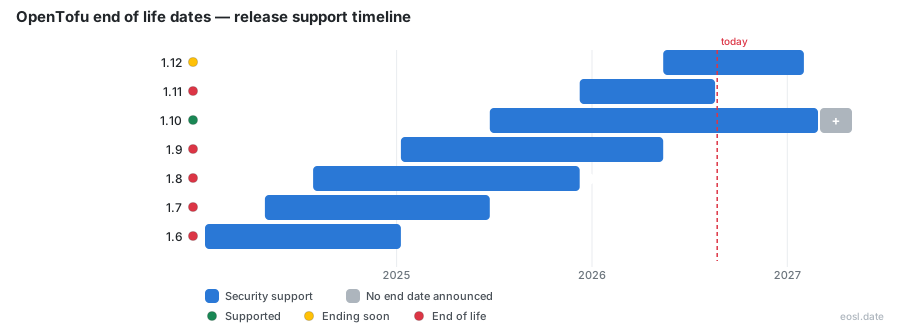
Currently Supported OpenTofu Releases - Active EOS/EOSL Support (1)
| Release | Released | Security Support | Latest |
|---|---|---|---|
| 1.13 | (1 month and 3 weeks ago) | (in 8 months) | 1.13.9 (2 weeks and 2 days ago) |
OpenTofu Releases Nearing End of Life - Support Ending Soon (1)
| Release | Released | Security Support | Latest |
|---|---|---|---|
| 1.12 | (6 months ago) | (in 2 months) | 1.12.12 (2 weeks and 2 days ago) |
OpenTofu End of Life (EOL) Releases - No Longer Supported (6)
| Release | Released | Security Support | Latest |
|---|---|---|---|
| 1.11 | (11 months ago) | (3 months ago) | 1.11.14 (3 months ago) |
| 1.10 | (1 year and 4 months ago) | (1 month and 3 weeks ago) | 1.10.10 (6 months ago) |
| 1.9 | (1 year and 10 months ago) | (6 months ago) | 1.9.4 (1 year and 2 months ago) |
| 1.8 | (2 years and 3 months ago) | (11 months ago) | 1.8.11 (1 year and 3 months ago) |
| 1.7 | (2 years and 6 months ago) | (1 year and 4 months ago) | 1.7.10 (1 year and 3 months ago) |
| 1.6 | (2 years and 10 months ago) | (1 year and 10 months ago) | 1.6.3 (2 years and 4 months ago) |
Planning around OpenTofu end of life starts with one fact: OpenTofu is an open-source, community-driven fork of Terraform managed by the Linux Foundation, and every release gets a fixed window of fixes. Below you will find the cutoff date for each version, the features and compatibility changes that come with it, and a plan for keeping your cloud infrastructure on a supported release.
OpenTofu End of Life Schedule
The table below lists each release series, when it shipped, and when its security support ends. You should be running one of the supported versions in the last column, and the newest patch of that series.
| Release | Released | Security support | Latest patch |
|---|---|---|---|
| 1.13 | 30 Sep 2026 | Ends 1 Aug 2027 | 1.13.2 |
| 1.12 | 14 May 2026 | Ends 1 Feb 2027 | 1.12.9 |
| 1.11 | 9 Dec 2025 | Ended 19 Aug 2026 | 1.11.14 |
| 1.10 | 24 Jun 2025 | Ended 30 Sep 2026 | 1.10.10 |
| 1.9 | 9 Jan 2025 | Ended 14 May 2026 | 1.9.4 |
Versions Past Their Support Window
Anything older than 1.12 is now unmaintained: it is no longer maintained with patches, so each new vulnerability stays unpatched for every resource you manage. Plan your upgrade or migration before the cutoff, because support for a series is removed on its end date, not gradually.
How the Release Cycle Sets Each Support Window
A new minor release arrives every few months, and each one begins its own support period. A major release is rarer and carries the largest changes. Since 1.11, the cutoff for a series follows the Go programming language: each series is tied to one Go version for its whole life, and the expected end date sits at the top of its changelog.
Go Programming Language Alignment
Because the dates track Go, a supported version of OpenTofu inherits upstream patches only while Go itself supports that line. Check the changelog for the exact date before you commit to a series.
Security Support for Patch Releases
Inside its window, a series receives fixes for security problems and serious bugs. The project closes a CVE in the current supported series first, then backports the patch. An attacker-controlled registry or provider endpoint is the typical threat model, so staying current protects your credentials and tofu init runs. Once a series reaches end of support, these fixes stop arriving for it, including fixes for each provider and module path.
Recent Security Advisories
- Excessive CPU use when connecting to an attacker-controlled HTTP2 server during installation, fixed in 1.12.8 and 1.13.2.
- Compromised intermediate certificates filtered out in 1.12.9 and 1.13.2.
- A remote-exec or file provisioner could deadlock against an attacker-controlled SSH server, fixed in 1.12.7.
- OCI registries could resend credentials to a redirect target, fixed in an earlier patch.
The same patches carry bug fixes, so a patch upgrade inside your series is low risk and worth taking.
Checking Your Version Before End-of-Life
Run tofu --version in every pipeline and workspace, then compare the minor number with the table. Review each configuration, because several teams run different versions side by side. The commands tofu plan, tofu show and tofu test behave the same across patches, so verify a patch upgrade with a plain plan: an unchanged state means the upgrade was safe.
Reading the Dependency Lock File After Upgrading
After an upgrade, tofu init rewrites the dependency lock file with extra checksums and hashes for every platform. The change is expected, so commit the updated lock file rather than reverting it. Version 1.12 can also write JSON to a separate file, so a JSON parser and a human reader both keep a usable view.
Compatibility Notes for OpenTofu Releases
The upgrade notes for 1.13 matter most if you plan to stay supported, because they record what is removed. Read them before you leave 1.12, since compatibility breaks cluster at series boundaries. Key deprecation items:
- The Windows connection type for provisioners is gone; use OpenSSH.
- The
base64gzipfunction output now differs byte for byte, so resources using it may show a diff. - macOS 13 Ventura or later is required.
- Windows on ARM64 is a newly supported platform; other platforms are unchanged, and some provider plugins may lag behind on new platforms.
WinRM Provisioners Are Deprecated
WinRM was deprecated in 1.12 and removed in 1.13 because its upstream libraries are no longer maintained. Teams relying on it should migrate to SSH before moving past 1.12.
Official 32-bit Builds Phase Out
Series 1.13 is the last to ship official 32-bit builds, so support for them ends with it. Move to 64-bit hardware (amd64 or arm64) before it ends; third parties may keep publishing their own builds.
New Features That Justify Leaving an Unsupported Release Series
Each series adds features that can justify the move. Series 1.11 introduced ephemeral resources and the enabled argument; 1.12 made prevent_destroy dynamic and improved provider checksums; 1.13 added new functions that reduce unknowns during planning. Every resource, module and plan benefits, and these improvements are one reason staying on an unsupported series costs more than it seems.
Linting and Symbol Libraries Experiments
The 1.13 series adds experimental linting and symbol libraries. Every experiment is subject to change, so keep it out of production modules and upgrade for stability first. OpenTelemetry tracing support has also improved.
Encryption and State Handling
State encryption remains a headline feature, with key providers for AWS KMS and OpenBao. Ephemeral values keep secrets out of state and plan files, but these features reach you only on a series that still has security support.
Where to Find Each OpenTofu Release
Every OpenTofu release is on GitHub, where you can follow a GitHub issue or discussion for a given change, and in the Docker images and through your package manager. The GitHub releases page lists each patch with its assets. The endoflife.date page also offers an API, an RSS feed and a calendar feed, so you can subscribe to the schedule and get a warning before a series expires. The official documentation lists installation guides.
Planning an Upgrade Inside the Lifecycle Window
Treat the date in the table as your deadline, then work backwards: read the notes, test in a sandbox, and upgrade one environment at a time. The community recommends moving to the newest series whenever the migration is routine, so you never end up with several versions past their lifecycle at once. If you must stay on an older series, pin to its final patch.
Release Notes and Changelog Checks for Every Support Period
Before each upgrade, read the release notes and the changelog for anything deprecated. Check the upgrade notes first, because those are the ones that break a plan.
Terraform Fork Lifecycle and Community Governance
Because the community runs OpenTofu in the open under the Linux Foundation, its lifecycle and end-of-support dates are published for every release series rather than negotiated per customer. A Terraform configuration usually moves across, but its support schedule is governed by OpenTofu alone.