Jaeger End of Life (EOL) Dates and End of Support (EOS) Dates
Jaeger end of life (EOL) and end of support (EOS) dates: 1 has reached EOL — EOL date: Dec 31, 2025. This version no longer receives security updates, patches, or support. Jaeger 2.23.0 is the current supported release. Also see cert-manager EOSL information for related end-of-life information.
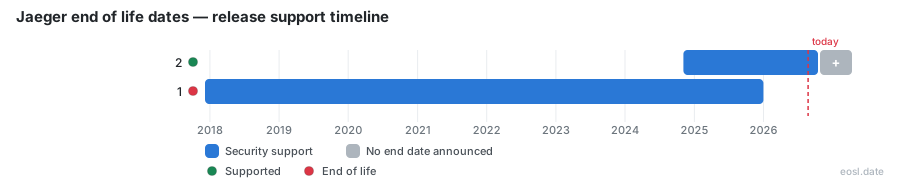
Currently Supported Jaeger Releases - Active EOS/EOSL Support (1)
| Release | Released | Security Support | Latest |
|---|---|---|---|
| 2 | (2 years ago) | Active | 2.23.0 (1 week and 1 day ago) |
Jaeger End of Life (EOL) Releases - No Longer Supported (1)
| Release | Released | Security Support | Latest |
|---|---|---|---|
| 1 | (8 years and 11 months ago) | (10 months ago) | 1.76.0 (11 months ago) |
Wondering what Jaeger end of life means for your stack? The Jaeger v1 end-of-life date passed, so only v2 gets fixes now. Built at Uber and now a graduated CNCF project, this open source tracing platform helps teams debug microservices with open-source distributed tracing. Here are the dates, the releases still supported, and your next steps.
Jaeger End of Life: What Ended on December 31, 2025
The maintainers set the v1 timeline right after v2 shipped: Jaeger 1.x would stop on Dec 31 2025. Throughout 2025 they still accepted fixes, but support ended with the new year, and v1 releases no longer receive updates. Every v1 component is now deprecated, and v2 is actively maintained.
Jaeger v1 Security Support and Updates
Under the project's security policy, only the latest major release gets new features, bug fixes and security updates. The team may offer extended support for older lines, but nothing is promised, so treat security support for v1 as over.
Does Jaeger Have a Fixed End-of-Life Schedule?
No. Beyond this one cutoff, the project follows a latest version model: only the newest major release is current, and earlier lines remain usable but superseded.
Jaeger Release Dates and Version History
Jaeger has three release lines, and only one is alive. The end-of-life dates below come from public data, with end-of-life (EOL) status shown for the old line. Each jaeger releases line is dated by its first version.
| Release line | First released | Newest build | Status |
|---|---|---|---|
| 2 | 2024-11-10 | 2.22.0 (2026-10-06) | Current |
| 1 | 2017-12-06 | 1.76.0 (2025-12-03) | Ended 2025-12-31 |
| 0 | 2017-07-01 | 0.9.0 (2017-10-26) | Retired |
Release trackers list 127 versions across these lines, 31 of them touched by a CVE, under the Apache License 2.0. None has long-term support (LTS), and the same data is available as a JSON API or an RSS feed.
Latest Version and Support Status
The newest build is 2.22.0, published on 6 October 2026. Anything older than the 2.x line, including 1.76, is out of support, so Jaeger v2 is the only line to run in production.
What Changed in Jaeger v2 After the v1 EOL
Jaeger v2 is rebuilt on the OpenTelemetry Collector framework, so one binary receives, processes and queries distributed tracing data. Configuration moves from CLI flags to Collector-style YAML. Built-in OTLP receivers listen on ports 4317 (gRPC) and 4318 (HTTP), Zipkin traffic arrives on 9411, and the UI uses its default port.
Instrumentation: OpenTelemetry SDKs and OTLP
Applications now export spans with OpenTelemetry SDKs, because Jaeger's own client libraries are archived. Point the OpenTelemetry exporter at port 4318 using OTLP, and spans and traces flow straight into Jaeger v2.
What Happened to the Jaeger Agent
The jaeger-agent daemon is gone from the v2 architecture; its last build was 1.62. SDKs send telemetry directly, or through a Collector for batching and sampling.
Migration Guide: Moving Off a Deprecated Jaeger v1 Setup
Following a migration guide is quick because v2 is a single, all-in-one binary. Swap the image, translate flags to YAML and cut over outside peak load, because incidents are where distributed tracing earns its keep: troubleshooting a slow checkout means following traces across services. Tracing is one pillar of observability, next to logs and metrics, so keep monitoring dashboards running during the switch. Maintainers deprecate old flags gradually, so upgrade early. Kubernetes users switch to the v2 Kubernetes Operator, replacing the jaeger-operator line.
Step 1: Deploy Jaeger v2 With Docker
Start the Jaeger v2 container, then open the UI on its default port.
docker run --rm --name jaeger \
  -p 16686:16686 -p 4317:4317 -p 4318:4318 \
  cr.jaegertracing.io/jaegertracing/jaeger:2.22.0
Step 2: Run HotROD and View Traces in the UI
Launch the HotROD demo, point its OTLP exporter at the container, and click a few ride requests. The HotROD timeline shows each span, so latency and performance hot spots stand out for monitoring.
Jaeger Releases: Binaries and Container Images
Binaries for macOS, Linux and Windows live on the GitHub releases page, while container images are published to Docker Hub and Quay.io. Every artifact follows one lifecycle.
Storage Backend Options
Jaeger keeps traces in storage you operate, and the storage backend you pick drives cost: Cassandra, Elasticsearch or OpenSearch, with Kafka for buffered ingestion. A remote storage service can share one node's storage across processes, and an index cleaner purges old data.
Debug and Snapshot Images
Debug images add the Delve debugger, snapshots track the main branch, and checksums plus signatures verify downloads.
Superseded Jaeger Components and What Replaces Them
- jaeger-collector, jaeger-query and jaeger-ingester: replaced by the one v2 binary.
- Jaeger agent: replaced by OTLP export.
Jaeger covers traces and spans only, while monitoring metrics and logs live in other systems. If you want all three signals together, a unified observability platform may beat a tracing-only backend, and OTLP export makes switching easy.