OpenBao End of Life (EOL) Dates and End of Support (EOS) Dates
OpenBao end of life (EOL) and end of support (EOS) dates: 7 OpenBao versions have reached EOL, including OpenBao 2.6 (EOL date: Oct 01, 2026) — no longer receiving security updates or patches. OpenBao 2.7.3 is the current supported release. Also see containerd end of support life for related end-of-life information.
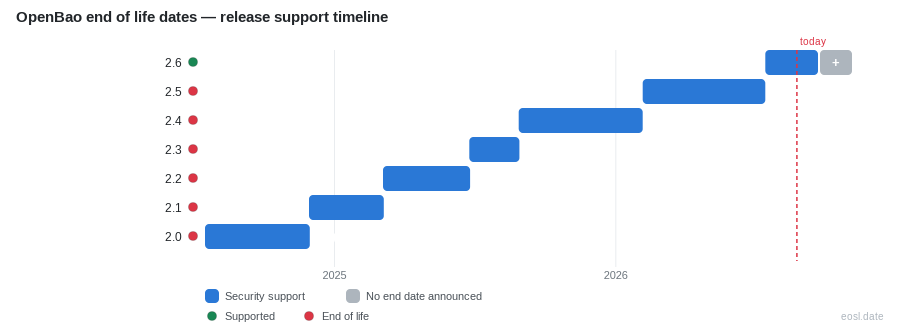
Currently Supported OpenBao Releases - Active EOS/EOSL Support (1)
| Release | Released | Standard Maintenance | Latest |
|---|---|---|---|
| 2.7 | (1 month and 4 weeks ago) | Active | 2.7.3 (3 days ago) |
OpenBao End of Life (EOL) Releases - No Longer Supported (7)
| Release | Released | Standard Maintenance | Latest |
|---|---|---|---|
| 2.6 | (4 months ago) | (1 month and 3 weeks ago) | 2.6.6 (3 days ago) |
| 2.5 | (9 months ago) | (4 months ago) | 2.5.5 (5 months ago) |
| 2.4 | (1 year and 2 months ago) | (9 months ago) | 2.4.4 (11 months ago) |
| 2.3 | (1 year and 4 months ago) | (1 year and 2 months ago) | 2.3.2 (1 year and 3 months ago) |
| 2.2 | (1 year and 8 months ago) | (1 year and 4 months ago) | 2.2.2 (1 year and 5 months ago) |
| 2.1 | (1 year and 11 months ago) | (1 year and 8 months ago) | 2.1.1 (1 year and 10 months ago) |
| 2.0 | (2 years and 4 months ago) | (1 year and 11 months ago) | 2.0.3 (2 years ago) |
Running a secrets platform you can't patch is a risk, so learn the OpenBao end of life rules before a release goes stale. This guide shows which versions are covered, when each one ended, and how lifecycle management works for this open source project.
OpenBao End of Life and the Release Support Policy
OpenBao follows a short release support policy: the maintainers fix problems in the newest build and ask everyone else to test it. The technical steering committee approved the rule on October 10, 2024, and it promises best-effort maintenance rather than long-term backports.
Why Only the Latest Release Is Supported
There is no LTS branch. Only the latest series receives patches, and a newer series replaces it. If a problem isn't easy to reproduce on an older build, expect a request to retest on the latest release.
A Community-Driven Fork of HashiCorp Vault
OpenBao began as a fork of HashiCorp Vault and now lives under the Linux Foundation as an open source project with open governance. Its inherited code carries the MPL 2.0 license, and because the community runs it under an OSI-approved license rather than a vendor roadmap, the community decides how long each version stays supported.
OpenBao EOL Dates for Every Release
Each row shows when a series shipped and when its standard support ended, based on the published schedule.
| Series | Released | Standard support ended | Last patch |
|---|---|---|---|
| 2.7 | Sep 23, 2026 | Still supported | 2.7.1 (Oct 1, 2026) |
| 2.6 | Jul 14, 2026 | Oct 1, 2026 | 2.6.4 |
| 2.5 | Feb 5, 2026 | Jul 14, 2026 | 2.5.5 |
| 2.4 | Aug 28, 2025 | Feb 5, 2026 | 2.4.4 |
| 2.3 | Jun 25, 2025 | Aug 29, 2025 | 2.3.2 |
| 2.2 | Mar 5, 2025 | Jun 26, 2025 | 2.2.2 |
| 2.1 | Nov 29, 2024 | Mar 6, 2025 | 2.1.1 |
| 2.0 | Jul 17, 2024 | Nov 30, 2024 | 2.0.3 |
The latest version is 2.7.1. Compare each series' release date with its end date and a pattern appears: standard support ended one day after its successor shipped, and only 2.6 ran about a week longer. Everything older than 2.7 has reached EOS.
Check Which Supported Release You Run
Run bao version on each node and compare the output with the table. The operator who owns the cluster should do this before every upgrade window. Builds ship through Docker images, OCI images on ghcr.io and quay.io, and Homebrew (brew), so confirm the tag you actually deployed.
Track Support Dates with endoflife.date
The endoflife.date page exposes the schedule through an API, an RSS feed and an iCalendar calendar, so a DevSecOps team can wire expiry alerts into existing automation. Subscribe to a series' feed and you get an alert when its support ends. Maintainers confirmed on GitHub that older series are not covered.
Release Cadence, Versioning and Maintenance
A major release is signalled by a change in the first or second digit of X.Y.Z, so 2.7 and 2.6 are different series while 2.7.1 is a patch. New series appear every few months with no strict release cadence, and patch builds arrive roughly monthly. That versioning scheme explains why a series drops out of support so quickly.
Release Notes and Unreleased Tags
The release notes list every change per series, and they show skipped tags: v2.4.2 is marked unreleased because the release pipelines ran out of space.
Patch Releases Between Major Versions
A patch is where you get a fix, not a feature. Version 2.4.3 (October 22, 2025) repaired namespaces edge cases, such as mount creation failing when a mount shared its namespace's name, and 2.4.4 followed a month later.
Lifecycle Management: What a Supported Release Receives
Support for a series means two kinds of patches, both protecting the secrets it holds, covered below.
Security Fixes and CVE Disclosures
Only supported series receive these patches, so a retired series stops getting security fixes. Recent examples: v2.4.4 corrected policy-name casing on identity groups (CVE-2025-64761) to stop root policy assignment, and v2.4.3 redacted response bodies in audit logs. Authentication fixes follow the same rule, including OCSP handling for certificates in auth/cert and token renewal in auth/jwt authentication.
Bug Fixes and Improvements
Bug fixes stop once a series is retired. Until then they cover stability: a fix for a Raft memory leak, plus renewal of older JWT and OIDC tokens. Improvements are smaller, like the 15% expiry threshold for short-lived certificates in diagnostics.
Plan for OpenBao EOL Before You Upgrade
When your series drops out of support, move to the newest series instead of waiting for backports, because none are promised, and a store holding secrets is the last place to run unpatched software.
Deprecations and Migration Steps
Scan the deprecations list first, since removals do happen: 2.4.0 dropped several sdk helper packages and tightened audit file modes. For the migration, test on a staging cluster and confirm that your secrets, each secret engine, dynamic secrets for platforms such as Kubernetes, encryption keys, every lease and revocation behave as before, then roll production.