Linux Kernel End of Life (EOL) Dates and End of Support (EOS) Dates
Linux Kernel end of life (EOL) and end of support (EOS) dates: 31 Linux Kernel versions have reached EOL, including Linux Kernel 7.2 (EOL date: Nov 01, 2026) — no longer receiving security updates or patches. Linux Kernel 5.10 (LTS) reaches its End of Support date on Dec 31, 2026 — plan your upgrade path now. Linux Kernel 7.3.5 is the current supported release — 5 versions in active support. Also see containerd end of support life for related end-of-life information.
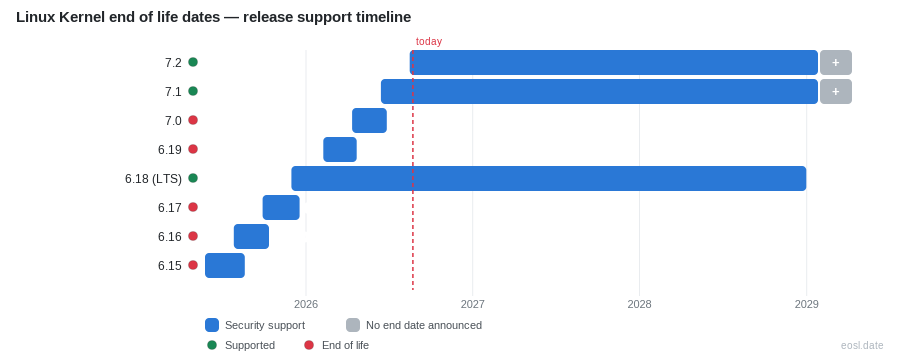
Currently Supported Linux Kernel Releases - Active EOS/EOSL Support (5)
| Release | Released | Security Support | Latest | LTS |
|---|---|---|---|---|
| 7.3 | (1 month and 3 days ago) | Active | 7.3.5 (4 days ago) | - |
| 6.18 (LTS) | (11 months ago) | (in 2 years and 1 month) | 6.18.64 (4 days ago) | LTS |
| 6.12 (LTS) | (2 years ago) | (in 2 years and 1 month) | 6.12.118 (4 days ago) | LTS |
| 6.6 (LTS) | (3 years ago) | (in 1 year and 1 month) | 6.6.162 (2 weeks and 1 day ago) | LTS |
| 6.1 (LTS) | (3 years and 11 months ago) | (in 1 year and 1 month) | 6.1.192 (2 weeks and 1 day ago) | LTS |
Linux Kernel Releases Nearing End of Life - Support Ending Soon (2)
Linux Kernel End of Life (EOL) Releases - No Longer Supported (31)
| Release | Released | Security Support | Latest | LTS |
|---|---|---|---|---|
| 7.2 | (3 months ago) | (2 weeks and 6 days ago) | 7.2.15 (2 weeks and 6 days ago) | - |
| 7.1 | (5 months ago) | (2 months ago) | 7.1.13 (2 months ago) | - |
| 7.0 | (7 months ago) | (4 months ago) | 7.0.14 (4 months ago) | - |
| 6.19 | (9 months ago) | (6 months ago) | 6.19.14 (6 months ago) | - |
| 6.17 | (1 year and 1 month ago) | (11 months ago) | 6.17.13 (11 months ago) | - |
| 6.16 | (1 year and 3 months ago) | (1 year and 1 month ago) | 6.16.12 (1 year and 1 month ago) | - |
| 6.15 | (1 year and 5 months ago) | (1 year and 3 months ago) | 6.15.11 (1 year and 3 months ago) | - |
| 6.14 | (1 year and 7 months ago) | (1 year and 5 months ago) | 6.14.11 (1 year and 5 months ago) | - |
| 6.13 | (1 year and 10 months ago) | (1 year and 7 months ago) | 6.13.12 (1 year and 7 months ago) | - |
| 6.11 | (2 years and 2 months ago) | (1 year and 11 months ago) | 6.11.11 (1 year and 11 months ago) | - |
| 6.10 | (2 years and 4 months ago) | (2 years and 1 month ago) | 6.10.14 (2 years and 1 month ago) | - |
| 6.9 | (2 years and 6 months ago) | (2 years and 3 months ago) | 6.9.12 (2 years and 3 months ago) | - |
| 6.8 | (2 years and 8 months ago) | (2 years and 5 months ago) | 6.8.12 (2 years and 5 months ago) | - |
| 6.7 | (2 years and 10 months ago) | (2 years and 7 months ago) | 6.7.12 (2 years and 7 months ago) | - |
| 6.5 | (3 years and 2 months ago) | (2 years and 11 months ago) | 6.5.13 (2 years and 11 months ago) | - |
| 6.4 | (3 years and 4 months ago) | (3 years and 2 months ago) | 6.4.16 (3 years and 2 months ago) | - |
| 6.3 | (3 years and 6 months ago) | (3 years and 4 months ago) | 6.3.13 (3 years and 4 months ago) | - |
| 6.2 | (3 years and 9 months ago) | (3 years and 6 months ago) | 6.2.16 (3 years and 6 months ago) | - |
| 6.0 | (4 years and 1 month ago) | (3 years and 10 months ago) | 6.0.19 (3 years and 10 months ago) | - |
| 5.19 | (4 years and 3 months ago) | (4 years ago) | 5.19.17 (4 years ago) | - |
| 5.18 | (4 years and 5 months ago) | (4 years and 3 months ago) | 5.18.19 (4 years and 3 months ago) | - |
| 5.17 | (4 years and 8 months ago) | (4 years and 5 months ago) | 5.17.15 (4 years and 5 months ago) | - |
| 5.16 | (4 years and 10 months ago) | (4 years and 7 months ago) | 5.16.20 (4 years and 7 months ago) | - |
| 5.14 | (5 years and 2 months ago) | (5 years ago) | 5.14.21 (5 years ago) | - |
| 5.13 | (5 years and 4 months ago) | (5 years and 2 months ago) | 5.13.19 (5 years and 2 months ago) | - |
| 5.12 | (5 years and 6 months ago) | (5 years and 4 months ago) | 5.12.19 (5 years and 4 months ago) | - |
| 5.11 | (5 years and 9 months ago) | (5 years and 6 months ago) | 5.11.22 (5 years and 6 months ago) | - |
| 5.4 (LTS) | (6 years and 11 months ago) | (11 months ago) | 5.4.302 (11 months ago) | LTS |
| 4.19 (LTS) | (8 years ago) | (1 year and 11 months ago) | 4.19.325 (1 year and 11 months ago) | LTS |
| 4.14 (LTS) | (9 years ago) | (2 years and 10 months ago) | 4.14.336 (2 years and 10 months ago) | LTS |
| 4.9 (LTS) | (9 years and 11 months ago) | (3 years and 10 months ago) | 4.9.337 (3 years and 10 months ago) | LTS |
Knowing the Linux kernel end of life date for the version you run tells you when it will no longer receive security fixes. The kernel is a free and open-source, monolithic, Unix-like operating system core that runs servers, embedded devices, Android phones and supercomputers, so every version that stops getting patches is a risk to your devices. Check the table below, then update to a higher version before your support lifecycle ends and critical updates stop.
Linux Kernel End of Life Dates by Version
Each release gets a limited window of security support, and the latest release always sits at the top. Once a branch passes its end-of-life date it is marked EOL, and you should treat it as unsafe. A kernel's released date and its security support end date are the two figures to compare, and the table lists both for recent versions.
| Kernel version | Released | Security support ends | Type |
|---|---|---|---|
| 7.3 | 18 Oct 2026 | Still supported | Mainline |
| 7.2 | 16 Aug 2026 | Still supported | Short-term |
| 7.1 | 14 Jun 2026 | 2 Sep 2026 | Short-term |
| 7.0 | 12 Apr 2026 | 27 Jun 2026 | Short-term |
| 6.18 | 30 Nov 2025 | 31 Dec 2028 | LTS |
| 6.12 | 17 Nov 2024 | 31 Dec 2028 | LTS |
| 6.6 | 30 Oct 2023 | 31 Dec 2027 | LTS |
| 6.1 | 11 Dec 2022 | 31 Dec 2027 | LTS |
| 5.15 | 31 Oct 2021 | 31 Dec 2026 | LTS |
If your version is not an LTS branch and is missing from the supported rows, upgrade now. The nearest deadline is 5.15, released in October 2021, which stops receiving security fixes at the end of 2026. Most Linux end of life problems start when nobody tracks these support dates and an old branch quietly falls out of the list of supported versions. Each kernel from upstream also carries a CVE history, so an unpatched branch keeps every known flaw.
Linux EOL Support Phases and Life Cycle
Vendors that package the kernel describe the same life cycle as a series of phases. Red Hat moves each major release through three steps, and each support phase in Red Hat's model narrows what ships. Red Hat documents every support phase on its customer portal, and a Linux distribution such as Debian or Canonical's Ubuntu follows its own calendar on top of the kernel's. The software you run decides which clock matters.
Full Support and Bug Fixes
During full support you get qualified security errata, urgent bug fix releases and, at the vendor's discretion, new hardware enablement. A vendor's full support phase can end well before or after the upstream kernel branch it ships, so the vendor phase often matters more than the kernel version.
Maintenance Support and Security Updates
Maintenance support keeps delivering security updates and selected fixes, but new features and hardware enablement become rare. Backported kernel patches still flow, which keeps servers safe even after the upstream branch has gone EOL.
Extended Life Phase
The extended life phase mostly provides documentation access and limited help. Without a paid add-on you should no longer receive patches, and this is when the vendor stops patching the kernel it ships, which is the practical end of service life for that distribution.
Long Term Support and EOL Windows
An LTS kernel is a branch chosen for long maintenance, which is why 6.18, 6.12, 6.6, 6.1 and 5.15 outlast their neighbours. Ordinary stable kernels such as 7.1 and 7.0 end within a few months, so production systems usually pick an LTS release and follow its latest release point updates. The latest point release of each branch carries the newest fixes.
Ubuntu Interim Release Versus LTS
Ubuntu ships an LTS version every two years in April, and each one is released with 10 years of coverage. An interim release arrives every six months and lasts nine months, so interim releases reach end of service life quickly. Each Ubuntu release ships a specific kernel, so the release's end date sets that kernel's practical support limit.
Red Hat Ten-Year Life Cycle
Red Hat Enterprise Linux 8, 9 and 10 each get a ten-year life cycle across full and maintenance support before the extended life phase begins. Red Hat's backported kernel stays supported for the full ten years, even though the upstream branch it started from ended much earlier. Linux Mint follows Ubuntu's base, so Linux Mint users inherit its kernel dates, and its older 18, 19 and 20 series have already been retired.
Extended Support Options After Kernel EOL
If you cannot upgrade in time, vendors sell extended support by subscription. Red Hat's Extended Life Cycle Premium stretches coverage on eligible minor releases, and long-life add-on terms renew annually. Ubuntu offers Extended Security Maintenance to subscribers, and it works alongside Canonical's Livepatch for running systems.
Extended Security Maintenance and ELS
Red Hat's extended update support and the Red Hat ELS offering deliver selected critical fixes for the last minor release. Both Red Hat and Ubuntu programs patch the kernel after upstream support ends, and Park Place Technologies lists an EOSL date for each Linux Mint series. These programs cost money and cover fewer packages, so treat ELS as a bridge while you plan the move.
Planning Upgrades Before End of Service Life
Run an audit to list each kernel version across your devices, and build a report from it. Compare the report with the table above, then rank systems by exposure: internet-facing servers first. Your IT teams should test the newer version on staging, then schedule the change before the deadline, which avoids service gaps and emergency downtime. The report should list each kernel version with its end-of-support date. Doing it early also protects your budget from rushed extended support purchases.
- Run
uname -rto read the running kernel version. - Choose the newest LTS kernel your distribution supports, and confirm your software still runs on it.
- Subscribe to vendor security notices for each supported release, and note the EOSL for each distribution.