containerd End of Life (EOL) Dates and End of Support (EOS) Dates
containerd end of life (EOL) and end of support (EOS) dates: 10 containerd versions have reached EOL, including containerd 2.2 (EOL date: Nov 06, 2026) — no longer receiving security updates or patches. containerd 2.0 (LTS) reaches its End of Support date on Mar 01, 2027 — plan your upgrade path now. containerd 2.4.2 is the current supported release, with support through May 16, 2027 — 2 versions in active support. Also see Kubernetes EOSL information for related end-of-life information.
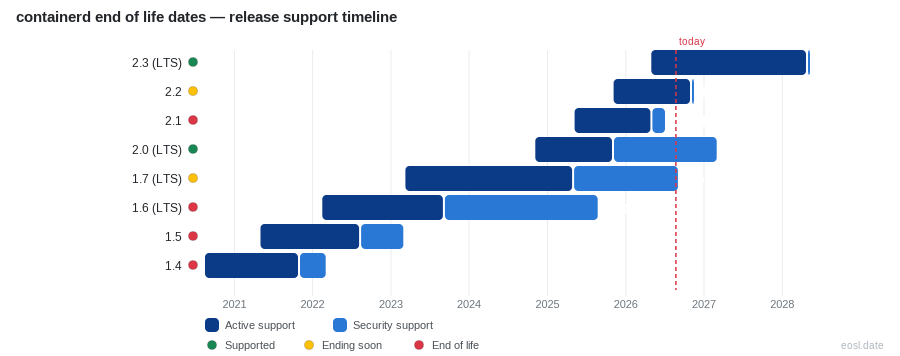
Currently Supported containerd Releases - Active EOS/EOSL Support (2)
containerd Releases Nearing End of Life - Support Ending Soon (1)
| Release | Released | Extended Support | Active Support | Latest | LTS |
|---|---|---|---|---|---|
| 2.0 (LTS) | (2 years ago) | (in 3 months) | (1 year ago) | 2.0.14 (1 month and 1 week ago) | LTS |
containerd End of Life (EOL) Releases - No Longer Supported (10)
| Release | Released | Extended Support | Active Support | Latest | LTS |
|---|---|---|---|---|---|
| 2.2 | (1 year ago) | (2 weeks and 2 days ago) | (2 weeks and 2 days ago) | 2.2.10 (1 month and 1 week ago) | - |
| 2.1 | (1 year and 6 months ago) | (4 months ago) | (6 months ago) | 2.1.9 (5 months ago) | - |
| 1.7 (LTS) | (3 years and 8 months ago) | (1 month and 3 weeks ago) | (1 year and 6 months ago) | 1.7.36 (1 month and 4 weeks ago) | LTS |
| 1.6 (LTS) | (4 years and 9 months ago) | (1 year and 2 months ago) | (3 years and 2 months ago) | 1.6.39 (1 year and 4 months ago) | LTS |
| 1.5 | (5 years and 6 months ago) | (3 years and 8 months ago) | (4 years and 3 months ago) | 1.5.18 (3 years and 9 months ago) | - |
| 1.4 | (6 years and 3 months ago) | (4 years and 8 months ago) | (5 years ago) | 1.4.13 (4 years and 8 months ago) | - |
| 1.3 | (7 years and 1 month ago) | (5 years and 8 months ago) | (5 years and 8 months ago) | 1.3.10 (5 years and 8 months ago) | - |
| 1.2 | (8 years ago) | (6 years and 1 month ago) | (6 years and 7 months ago) | 1.2.14 (6 years and 1 month ago) | - |
| 1.1 | (8 years and 6 months ago) | (7 years ago) | (7 years ago) | 1.1.8 (7 years and 1 month ago) | - |
| 1.0 | (8 years and 11 months ago) | (7 years and 11 months ago) | (7 years and 11 months ago) | 1.0.3 (8 years and 7 months ago) | - |
Running a container runtime past its support window is a quiet risk, so this guide lays out containerd end of life dates for every release. containerd is the daemon for Linux and Windows that handles image transfer, storage and running containers, and its stability depends on picking a release that still gets backporting and security patches. Use the end-of-life dates below to see what you can run safely and what you need to move off.
containerd End of Life Dates and Version History
The table below follows the published schedule for each line, with data as of 26 October 2026. Every release has a start date, a status and an end date; the latest version is 2.4.2, and the latest patch for the 2.3 line is 2.3.7. Roughly 300 versions have shipped across 15 releases, and many of the unstable versions carry a CVE, which is why staying on a maintained version matters.
| Release | Status | Start | Ends |
|---|---|---|---|
| 1.6 | Ended | 15 Feb 2022 | 23 Aug 2025 |
| 1.7 (LTS) | Ended | 10 Mar 2023 | 30 Sep 2026 |
| 2.0 (LTS) | Winding down | 5 Nov 2024 | Mar 2027 |
| 2.1 | Ended | 7 May 2025 | 3 Jul 2026 |
| 2.2 | Supported | 5 Nov 2025 | 6 Nov 2026 |
| 2.3 (LTS) | Supported | 30 Apr 2026 | 30 Apr 2028 |
| 2.4 | Supported | 16 Sep 2026 | 16 May 2027 |
| 2.5 | Planned | 6 Jan 2027 | 6 Sep 2027 |
Everything older than 1.6 has reached end of life, and the license is Apache License 2.0. Tracking sites also publish a JSON API or an RSS feed that lists every release date.
containerd Release Lifecycle and Support Stages
Each containerd release follows semantic version numbering (SemVer) in a major.minor.patch form, and every new line is cut from the main branch with GPG signed tags. Each patch release then comes from a dedicated release branch such as release/2.3, which the release branch owners maintain. Before a final release the project ships an alpha, a beta and a release candidate, and the main branch enters a feature freeze while nightly builds keep testing it.
A branch moves through the states Future, Beta, RC, Active, Extended and End of Life. The maintainers and committers track each stage on a public roadmap.
Release Cadence and Minor Release Timing
Since 2.3, a minor release arrives on a four-month time basis, scheduled for April, August and December so it lines up with Kubernetes. Regular non-LTS lines are supported for about eight months, and the lifecycle of each one runs on that clock, which fixes its end of life date.
Support Horizon and Release Owners
The support horizon is defined per release branch, and the named release owners decide when a line moves from active to its final stage. That choice, and the end of life date it sets, is announced before the support window ends.
containerd LTS Releases and Extended Support
One release each year is designated long term support. An LTS release is supported for at least two years, and today the LTS lines are 2.0, 2.3 and the retired 1.7. Active support means bug fixes and patches, while extended support accepts security fixes only. The maintainers of an LTS branch can commit to a longer period, and the branch can also receive dependency updates and some Go modules changes so it stays maintainable. A six-month overlap separates one LTS from the next. Plan for the support period of your chosen line, not just its launch date, and note its end of life date, since maintenance and patches stop on the end date.
Which containerd Versions and Latest Version Are Still Supported
As of today, three lines still receive patches:
- 2.4 is supported until 16 May 2027.
- 2.3, the current LTS, is supported until 30 Apr 2028.
- 2.2 reaches EOL on 6 November 2026, only days away.
Any of the containerd versions in the 2.2 line should move now. Docker installs that bundle an older runtime should be checked on every container host, too, since compatibility depends on the bundled version.
Kubernetes Support for containerd Releases
Kubernetes only works with a release that speaks a supported CRI version. Every current line uses CRI v1 over gRPC, and the shim starts runc through an OCI runtime spec. The CRI gRPC API is the contract between the kubelet and the daemon, and the CRI API has been stable since 1.6. The matrix below shows the minimum versions that pair with each cluster version.
| Kubernetes | containerd | CRI |
|---|---|---|
| 1.34 | 2.1.3+, 2.0.6+, 1.7.28+ | v1 |
| 1.35 | 2.2.0+, 2.1.5+, 1.7.28+ | v1 |
| 1.36 | 2.3.0+, 2.2.0+ | v1 |
| 1.37 | 2.4.0+, 2.3.0+ | v1 |
Kubernetes Support Matrix and CRI Versions
A Kubernetes version keeps a supported partner at all times, because the project promises that every supported cluster release has a matching containerd plugin and API. Older CRI alpha interfaces were removed in 2.0, and the CRI gRPC contract is now v1 only. A line past its end of life also drops out of this matrix.
Platform Support Tiers
Platform support is split into three tiers: tier 1 covers linux/amd64, linux/arm64 and windows/amd64 with full CI testing; tier 2 ships artifacts without functional tests; tier 3 only checks that the build compiles. Tier 1 platforms get backports through the support window; lower tiers carry no such promise once a line ends.
Deprecated Features and API Stability Before containerd EOL
The gRPC API, the metrics API, the plugins API and the Go client API are stable, so a deprecation notice appears a release or two ahead of the removal, and the target line tells you which end date forces the change. Each item lists its target version for removal, such as the built-in aufs snapshotter, the Runtime V1 shim and legacy NRI plugin support. Plan for cgroup v1, which is on its way out in 2.2, by moving hosts to cgroup v2.
Deprecated Config Properties
Daemon configuration carries a configuration version, and version 3 needs at least 2.0.0. Properties such as systemd_cgroup and the old gRPC address tweaks were removed in favor of runc options. Fix them before your line ends, because an unsupported release gets no fix for a broken config.
Planning Around containerd End-of-Life
Treat the end of life date as a deadline for your move, not the day you start testing, since an ended line is past its end of life and gets no fixes. Check your infrastructure for hosts that still run an ended line, then schedule a migration to a supported release before the next cut-off:
- Inventory every node's runtime with
containerd --version. - Map each node to its line and end date from the table above.
- Confirm the Kubernetes pairing before you move.
- Upgrade staging first, then production.
Backporting, Security Fixes and the Upgrade Path
Backports land only on supported branches, so fixes never reach an ended line. Move one step at a time, from 2.2 to 2.3, run the version command again to confirm the result, and read the notes from the CNCF graduated project for each cloud native release.