Ansible End of Life (EOL) Dates and End of Support (EOS) Dates
Ansible end of life (EOL) and end of support (EOS) dates: 13 Ansible versions have reached EOL, including Ansible 13 (EOL date: Jun 18, 2026) — no longer receiving security updates or patches. Ansible 15.0.0 is the current supported release — 2 versions in active support. Also see Django end of support dates for related end-of-life information.
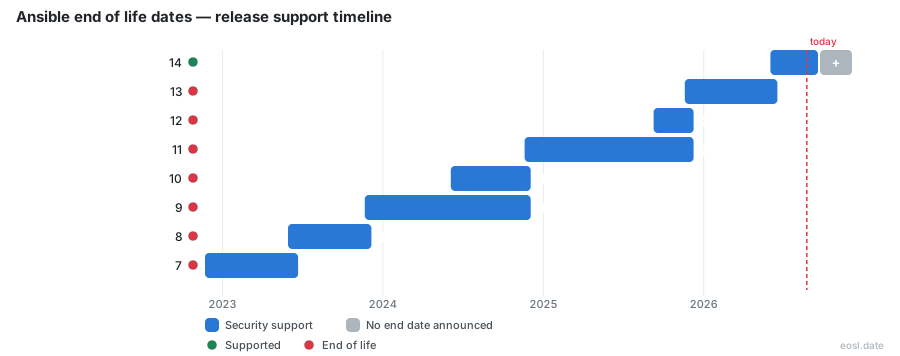
Currently Supported Ansible Releases - Active EOS/EOSL Support (2)
| Release | Ansible Core Version | Powershell Versions Managed Node | Python Versions Control Node | Python Versions Managed Node | Released | Supported | Latest |
|---|---|---|---|---|---|---|---|
| 15 | 2.22 | 5.1 - 7 | 3.13 - 3.15 | 3.9 - 3.15 | (4 days ago) | Active | 15.0.0 (4 days ago) |
| 14 | 2.21 | 5.1 - 7 | 3.12 - 3.14 | 3.9 - 3.14 | (5 months ago) | Active | 14.6.0 (2 weeks and 3 days ago) |
Ansible End of Life (EOL) Releases - No Longer Supported (13)
| Release | Ansible Core Version | Powershell Versions Managed Node | Python Versions Control Node | Python Versions Managed Node | Released | Supported | Latest |
|---|---|---|---|---|---|---|---|
| 13 | 2.20 | 5.1 | 3.12 - 3.14 | 3.9 - 3.14 | (1 year ago) | (5 months ago) | 13.8.0 (5 months ago) |
| 12 | 2.19 | 5.1 | 3.11 - 3.13 | 3.8 - 3.13 | (1 year and 2 months ago) | (11 months ago) | 12.3.0 (11 months ago) |
| 11 | 2.18 | 5.1 | 3.11 - 3.13 | 3.8 - 3.13 | (2 years ago) | (11 months ago) | 11.13.0 (11 months ago) |
| 10 | 2.17 | 3 - 5.1 | 3.10 - 3.12 | 3.7 - 3.12 | (2 years and 5 months ago) | (1 year and 11 months ago) | 10.7.0 (1 year and 11 months ago) |
| 9 | 2.16 | 3 - 5.1 | 3.10 - 3.12 | 2.7 / 3.6 - 3.12 | (3 years ago) | (1 year and 11 months ago) | 9.13.0 (1 year and 11 months ago) |
| 8 | 2.15 | 3 - 5.1 | 3.9 - 3.11 | 2.7 / 3.5 - 3.11 | (3 years and 5 months ago) | (2 years and 11 months ago) | 8.7.0 (2 years and 11 months ago) |
| 7 | 2.14 | 3 - 5.1 | 3.9 - 3.11 | 2.7 / 3.5 - 3.11 | (3 years and 11 months ago) | (3 years and 4 months ago) | 7.7.0 (3 years and 4 months ago) |
| 6 | 2.13 | 3 - 5.1 | 3.8 - 3.10 | 2.7 / 3.5 - 3.10 | (4 years and 5 months ago) | (3 years and 11 months ago) | 6.7.0 (3 years and 11 months ago) |
| 5 | 2.12 | 3 - 5.1 | 3.8 - 3.10 | 2.6 - 2.7 / 3.5 - 3.10 | (4 years and 11 months ago) | (4 years and 5 months ago) | 5.10.0 (4 years and 4 months ago) |
| 4 | 2.11 | 3 - 5.1 | 2.7 / 3.5 - 3.9 | 2.6 - 2.7 / 3.5 - 3.9 | (5 years and 6 months ago) | (4 years and 11 months ago) | 4.10.0 (4 years and 11 months ago) |
| 3 | 2.10 | 3 - 5.1 | 2.7 / 3.5 - 3.9 | 2.6 - 2.7 / 3.5 - 3.9 | (5 years and 9 months ago) | (5 years and 6 months ago) | 3.4.0 (5 years and 6 months ago) |
| 2.10 | 2.10 | 3 - 5.1 | 2.7 / 3.5 - 3.9 | 2.6 - 2.7 / 3.5 - 3.9 | (6 years and 1 month ago) | (5 years and 9 months ago) | 2.10.7 (5 years and 9 months ago) |
| 2.9 | 2.9 | 3 - 5.1 | 2.7 / 3.5 - 3.8 | 2.6 - 2.7 / 3.5 - 3.8 | (7 years ago) | (4 years and 5 months ago) | 2.9.27 (5 years and 1 month ago) |
If you run automation software in production, Ansible end of life dates decide when your package stops getting fixes. This guide covers the end of life Ansible schedule for the community package and ansible-core, the platform lifecycle from Red Hat, and how to plan an upgrade before a release becomes unmaintained.
Ansible is an open-source software framework for configuration management, deployment and infrastructure as code, and it manages Unix-like systems and Windows alike. The community package bundles ansible-core with extra modules, while the Ansible Automation Platform from Red Hat adds enterprise automation on top, so each automation product follows its own schedule.
Ansible End of Life Dates for Every Supported Release
The community package ships two major release lines a year, and maintenance fixes are guaranteed only for the latest major release. Every older version is effectively ended the moment a new one lands, so check the supported release column before you deploy. The latest release today is Ansible 14.
| Ansible package version | Released | Support status | Support ended |
|---|---|---|---|
| 14 | 2 Jun 2026 | Supported | Current |
| 13 | 19 Nov 2025 | Ended | 18 Jun 2026 |
| 12 | 9 Sep 2025 | Ended | 9 Dec 2025 |
| 11 | 19 Nov 2024 | Ended | 9 Dec 2025 |
| 10 | 4 Jun 2024 | Ended | 3 Dec 2024 |
ansible-core Maintenance Windows
The ansible-core package follows a graduated maintenance structure that covers three major releases at a time. The roadmap lists upcoming versions, and each ansible-core release stays supported for roughly 18 months.
| ansible-core version | Support status | Support ends |
|---|---|---|
| 2.21 | Supported | 30 Nov 2027 |
| 2.20 | Supported | 31 May 2027 |
| 2.19 | Supported | 30 Nov 2026 |
| 2.18 | Ended | 31 May 2026 |
| 2.17 | Ended | 30 Nov 2025 |
Ansible Lifecycle Phases: Full Support to EOL
Red Hat publishes a life cycle for its subscription product, and the life cycle phases move a version from full support through two maintenance stages before EOL. The life cycle dates for each version are on the vendor page, and the scope of support depends on your subscription. Features and bug fixes target only the latest versions of the product.
Maintenance Support and Security Fixes
During maintenance support phase one, critical and important security fixes continue, but bug fixes are critical only and there are no enhancements. In phase two, only critical errata ship and nothing else changes.
- Full support: security fixes, bug fixes and select enhancements
- Maintenance support 1: critical and important fixes only
- Maintenance support 2: critical fixes only
Extended Life-Cycle Support
An extended life-cycle support add-on can cover qualified critical security fixes for platform versions after their normal EOL date, so it delays the end without removing it. It is a paid subscription extra, not a reason to skip an upgrade.
Ansible Automation Platform Lifecycle and Support Requirements
The Red Hat Ansible Automation Platform, an enterprise automation platform, is versioned separately from the community package: platform versions such as 2.5, 2.6 and 2.7 each bundle a default ansible-core. Ansible support for the platform is provided to customers for the whole lifecycle of a version, and your operating system and database must meet the published requirements.
| Platform version | Default ansible-core | RHEL-provided PostgreSQL | Install operating system |
|---|---|---|---|
| 2.7 | 2.16 | 15-17 | RHEL 9, RHEL 10 |
| 2.6 | 2.16 | 15-17 | RHEL 9, RHEL 10 |
| 2.5 | 2.16 | 15 | RHEL 8, RHEL 9 |
Execution Environment Images
Each execution environment ships container images that pin a specific ansible-core version, so supported images follow the same lifecycle. Ansible Automation Platform releases publish versioned and version-less images, and an image pinned to an ended ansible-core version is itself unmaintained. Use versioned images in production and update them when the Ansible Automation Platform version changes. The official documentation lists which automation platform image matches each ansible-core build, and the platform dependencies it needs, such as a database and operating systems, are in the install table above. Each platform version reaches its own end of life, so match your version to the Red Hat lifecycle page.
Ansible Lifecycle Python Compatibility for Control Node and Managed Node
Compatibility matters as much as dates: each version needs a minimum Python on the control node and a wider range on the managed node, and Windows targets rely on PowerShell. A Python upgrade can force an Ansible upgrade and vice versa, so check this table first. A release that ends support also stops getting Python compatibility fixes. Dependencies such as operating systems packages and modules can also pin a Python level, so read the documentation for any collection you use.
| ansible-core | Control node Python | Managed node Python | Managed node PowerShell |
|---|---|---|---|
| 2.21 | 3.12 - 3.14 | 3.9 - 3.14 | 5.1 - 7 |
| 2.20 | 3.12 - 3.14 | 3.9 - 3.14 | 5.1 |
| 2.19 | 3.11 - 3.13 | 3.8 - 3.13 | 5.1 |
Ansible Collections After EOL
Collections are versioned and supported on their own schedule. Ansible collections bundled in the package are not updated once a major release ends, and the PyPI package for an ended line is frozen at its final version. Red Hat also lists configuration as code collection requirements for the platform.
Running EOL Ansible in CI
Many collections still run CI against ended ansible-core versions. The community End of Life Ansible for CI repository on GitHub keeps branches such as stable-2.9 and stable-2.10 working, up to stable-2.14, with older container images copied to its own registry.
Use these branches only for testing, never to keep production on an unmaintained release.
Upgrade Plan Once Maintenance Ends
Move at least one release before the date in the table. Upgrade your control node first, test playbooks against the new version, then roll managed node changes. Review the security impact: an unmaintained version gets no critical patch. Track dates automatically: endoflife.date offers an RSS feed, an iCalendar calendar feed and a JSON API, so your automation can alert you before a release ends. The API returns each release as JSON, so one API call per product keeps a dashboard current. Dates drift, so check the live lifecycle pages for each version before you commit.